Showing posts with label Functional Hallux Limitus. Show all posts

Friday, December 9, 2011

The popliteus muscle and functional hallux limitus

This is just a quick post for myself before I go for a new and welcome appointment tomorrow. I think I have clarified a lot of my thinking lately and I want to see how right I am. The really really good news is that in the last post I wrote about a doctor who I was told I should go see. I got an appointment, but he is so busy that my appointment wasn't going to be until the end of April. Well he found my blog post and emailed me to offer me an appointment this Saturday as he was going to be in the office doing paper work. Well, isn't that the greatest? I also had a running friend email me as he has been a patient and he also says that he is the best and definitely who I should see! I can only say that I am very fortunate to find a doctor who is very eager to fix problems and to make time to see a new patient. That is quite exciting. The rest of this is more boring stuff, and mostly for my reference, but you never know who may read this and offer some insight or get some ideas to help figure out their own biomechanical problems!
So my hip has been fixed and an MRI ruled out a back or nerve problem so what is up? And what is the etiology, or cause, of my messed up mechanics and problems running. I am going to write what I now think and I then want to compare it to what the doctor says tomorrow, but most important for me is what to do about it all and I think I have found the right doctor to do that!

Last week (after a month of feeling my left lower leg was pointing out more to the side and creating instability on my whole left side) I did some massage on the back of the knee and upper calf. It started feeling better and lining up better. I asked my PT about this and she said it is the popliteus muscle and that muscle can rotate the lower leg out. She then did Graston and deep tissue massage on this and the surrounding muscles. My leg felt better than it had in over a month. I also noticed, however, that when I stand or walk, my big toe really doesn't touch the ground and when I walk or run that left foot awkwardly shifts from from the outside to the inside rotating my foot and lower leg out to the side to try to get that toe on the ground. I also noticed that I have no foot tripod on my left foot (I was aware of this before) as when I  pronate forward the 1st MTP joint gives way and collapses without supporting my foot. The joint and toe is there, but it is almost like it is cut-off and doesn't do what is supposed to do and just gives way.There is a name for this phenonena and it is called functional hallux limitis and I do have orthotics for this, but they seem not to work correctly anymore. So I took out the orthotics ( a cutout under the 1st MTP joint is supposed to preload the joint so this doesn't happen) and instead put a wedge under the big toe which is supposed to do the same thing for the toe joint but in a slightly different way. It is called a cluffy wedge and I bought a set before I got the orthotics made, but I never really used them as I had orthotics. I used them and had a great 8 mile run on Saturday (my only run of the week) and my foot felt much better (of course I got sore muscles from going so far with a change in what I had inserted in my shoe and using a regular insole instead of an orthotic).

So I think that my big toe is the source of my problem.s With functional hallux limitis the big toe joint doesn't work and the foot can't propel itself over the toe, so it finds an new way to do this through pronation. Over time the pronation then forced my foot to point out and that created havoc with my knee (the poplietius muscle). This created the inward rotation at my hip which caused the hip not to work correctly which led to the back pain on the left side for the past 25+ year and the labral tear in the hip. In other words I think the problems start in my toe. Now the question is can we finally fix it and retrain my muscles to work properly. I will be most interested to see what the doctor says tomorrow.

I was also supposed to see the podiatrist who is renowned for his work with functional hallux limitis and made my orthotics this week. I somehow got lost and missed the appointment, which is too bad, because I was looking forward to his thoughts and to get the manipulations on my feet. I have an appointment next week if I need it.

This is my podiatrist showing one of his manipulations for the popliteus:


soft tissue treatment of the popliteus


more on the popliteus and its role as a knee rotator- also ways to strengthen the popliteus


how the cluffy wedge works


My current orthotic works like this with a first ray cutout:


Here is my PT showing a big toe mobilization that I have started doing:


Here is a TRX guy showing some toe joint manipulations:


Here is his explanations for the big toe joint and if I am right explains a lot of the compensations my body has created over the years:
Often overlooked, the big toe is not a big joint (metatarsophalangeal joint) but vital for performance and non dysfunctional movements. Mobility is key in locomotion and reciprocal patterns with the feet like the lunges in all planes of motion. Compensations will happen when motion can't occur in this part, which can give other dysfunctions higher up in the chain, muscle or joints or both. Proper gait pattern requires ability to flex the knee to 40 degrees, the dorsiflex the ankle at minimum of 20 degrees, and to be able to extend the first MTP joint to a minimum of 65 degrees (Oatis, 2004). The inability to extend the first MTP joint due to joint degeneration, structural change, or general restriction is commonly known as hallux limitus and is often seen in running athletes who wear traditional running shoes (not all but many of them). This range of motion is very important in the grand scheme of the "Windlass Mechanism" , which is a passive loading mechanism that occurs as the calcaneus clears the ground in late stance and the weight transfers over the heads of the metatarsals. Combined, these motions load the plantar fascia and intrinsics of the foot that help to transform the foot into a stable lever off of which to push (Fuller, 2000). As demonstrated by Carlson, there seems to be an incremental, linear relationship between hallux dorsiflexion and increased tensile strength of the plantar fascia (Carlson, 2000). As you know, the plantar fascia and Medial Longitudinal Arch are capable of producing a great deal of elastic return in running, so imagine the detrimental effects when this mechanism cannot function well. Those with reduced hallux extension and pronated feet often have diminished effects of this mechanism and ultimately less efficient (Dananberg, 1986). When the big toe does not extend well during late stance, plantar flexion torque decreases and occurs in a delayed fashion (Hall, 2004), knee flexion increases (potentially as a result of tension from the distal end as the calcaneus raises early), and hip extension decreases. To compenstate, there must be an increased drive of the hip flexors to advance the leg. When the foot is fixed upon the ground, this contraction creates potential for lumbar rotation and lateral flexion can occur stressing the intervetebral disks and potentially leading to low back pain and dysfunction (Kapandji, 1974). Add to that the possibility of the body compensating with an anterior tilt to facilitate hip flexion and you have a gamut of issues that sounds a lot like the makings of Janda's lower crossed syndrome with excessively toned hip flexors, inadequate gluteal strength, and possibly an increased full body anterior tilt placing the plantar flexors under excessive load. It is very common in the running world. Additionally, the early knee joint flexion and limited extension of the hips can beget a loss of transverse plane stability possibly as a result of ineffective use of the "screw home mechanism" at the tibiofemoral joint and ineffective activation of the hip extensors. Put all of the above together and you have a recipe for increased forces at the PFJ, shearing across the iliotibial band, potentially increased contact pressures at the anterior hip capsule, excessive activation of the deep hip rotators forcing the hip into a hyperextended position causing decreased sacral rotation during gait, low back pain, and SIJ instability. Clearly, limited hallux extension/flexion/abduction is not something to be ignored.

Sunday, October 31, 2010

A Conversation with Fitness Expert Jonathan Ross

This week I had the privilege of having a phone conversation with  fitness trainer Jonathan Ross. Jonathon is a multiple award winning fitness trainer who most recently won the 2010 IDEA Personal Trainer of the Year. He has a blog for Discovery Health called The Everyday Fitness Blog and is the author of the just released book Abs Revealed.

If you are curious how I got to talk to Jonathan, it came about in a very serendipitous way. I happened to be on Facebook a couple of Sundays ago, when a post came up from the people at TRX Suspension Training Systems. It mentioned that the first three people who correctly answered three questions would win some TRX swag. It was a trivia contest celebrating the book release of Jonathan Ross's "Abs Revealed". It also mentioned that one of the first three respondents would win a phone conversation with Jonathan Ross. I ended up being the second person to answer the questions (you had to be quick) and later was notified that I won the phone conversation too.

I immediately ordered the book so I would have it before the phone call and checked out some of Jonathan's videos online. I have and love my TRX suspension trainer, but I am very much a beginner at using it despite having 4 of the TRX DVDs. The TRX Pendulum was the first I found and it is a really good one.


This is one of the videos from the "Abs Revealed" book, which is the first book to include exercises for the TRX Suspension Trainer. Jonathan got in email contact with me and we set up a time for the call. He also wanted to know if I had a couple of questions in mind to send his way. Being a long time distance runner with all sorts of functional and biomechanical issues, I quickly gave him an overview and sent him a link to my blog. I looked forward to the phone call, but wasn't sure how it would go. Would he be a trainer who was anti-running (particularly for someone like me with so many issues) or would he just go through the motions during the call to fulfill his obligations? I would have been pleased just to have him answer a couple of questions from his book.

I was pleasantly surprised when he got on the phone and was very complimentary on my willingness to pursue my own fitness goals despite my issues and on how much I had done on my own. He had actually read my blog to find out about my issues and how to best answer my questions and give me the best advice possible. Without seeing me in person, he thought it would be hard to see all that was going on in my body, but he did put together a few exercises beforehand that he thought would help me out to get back to running which is the activity I love to do. Jonathan began describing and explaining three exercises in particular. I found his explanations clear and I was able to visualize exactly what he was saying, even though two of the exercises were unlike anything I have encountered before, and I have done a lot of research and reading on all sorts of exercises. I was writing notes like crazy as he talked as I realized that I was hearing some real creative and applicable advice. The exercises were designed to address some of my asymmetries and imbalance issues and I immediately saw the rationale and thinking behind each exercise. The time went by quickly, but it seemed like I was on the phone for hours, because Jonathan gave me so much detailed information. My brain was popping by the end and I was very tired from just all the great things I was hearing and trying to capture. Let me just say, Jonathan Ross it a true professional. He gave me more that 100% of his time and his advice was creative (not some rehash of the same old movements) and sensible. He was also extremely motivational and complimentary and made me believe again that I was on the right track and doing the right things in trying to get my body to behave again. If you go to Jonathan Ross's AionFitness website, you will see that Aion comes from the Greek word meaning age and eternity. He explains:

I believe that fitness is a life long pursuit of living to your maximum physical potential. I will teach you to enjoy movement and physical activity, and to use your body like it was meant to be used.

Fitness is about being able to do the activities you enjoy without feeling your body complaining to you or limiting you in any way.

Aion Fitness = Fitness for a Lifetime!

That is exactly what I want out of my fitness and running and I thank Jonathan for a super phone conversation full of great advice that fulfills my goals and helps me on my way to moving and running correctly again. Thanks also to the TRX folks for putting on the contest and giving me this opportuning to learn a little bit more of how to enjoy adn maximize my own fitness.

So what did Jonathan teach me? The first move was something simple called "toe raises". This is pertinent because I have hip problems and hip problems are often tied together with feet problems and I have those too. I am also adjusting to new orthotics due to a toe problem called Functional Hallux Limitis. My current hip problems that have put a stop to my running are probably due a lot to jumping into to using new insoles to correct the problem this summer. Within a couple weeks of using them, I had bumped my mileage up to an 85 mile week (including 52 miles in 3 straight days). I was correcting one problem, but starting a new one! The toe raises also help with balance and help to keep my arch from collapsing. The point is to sit or stand flat-footed (and barefoot)and lift up either the big toe or the four other toes. It sounds easy, but I found I couldn't even figure out how to lift up the big toes on their own. Try it, is it easy for you? I am slowly getting some control over the big toe, but it is hard to lift up and even get some toe awareness going. This is a great little exercise I can do anywhere.

The second is an exercise I am familiar with, but I am familiar with so many exercises it is hard to know which are the good ones to do for my own conditions and which are not that important. Because I run and move with the left side shifted ahead of my right side, Jonathan thought this would be good for me. Basically, you sit tall with a ball between your knees, hold your arms across your chest and rotate left to right for a set before rotating to the opposite side. This exercise works the obliques and I think is another easy and essential exercise to do, particularly when I even find it hard to turn around to look behind me when I run.

The third exercise is really great. Why didn't I think of this one? I think it will help my sore adductors as well as my wayward left leg with its instability. It is a standing internal and external rotation for each leg. You do it by standing facing forward on one leg and rotate the other leg across the body in front and moving around it  like the hand of a clockback toe-tapping the ground for balance as you go. If you stand on an "+" marked on the ground you can see your improvement as you go.

These are all great exercises that Jonathan picked out for my specific needs. I think they are really great and I am thrilled that he took the time to tailor the phone call to my needs. He also gave me some tips for using my orthotics, for using my TRX (do one legged exercises for the lower body) and a progression of very slow lunges where I am to work on the weight shifting from one leg to the other and back. This is all good stuff and I can see why Jonathan Ross is such an award winning trainer. He treats you with respect, is positive and affirming in his comments, and is creative in his approach to problem solving. I was not given cookie-cutter exercises, but the exercises were individualized to meet my needs.

His new book is called Abs Revealed and we didn't even talk about that. I am still reading through the book but it has solid advice on food and nutrition as well as a progression of exercises utilizing a variety of exercise tools like the TRX as well as Bosu and stability balls. Each exercise has positioning and technique explanations as well as performance tips. It is very readable and has color photographs on its big glossy pages. My advice is to get yourself a TRX Suspension Trainer. It is such a great tool for runners that is full of possibilities and if you want a good book on using the TRX to strengthen your core, this is definitely it. I have to get my running under control and then I can really work on getting some killer six-pack abs!!

In this video Jonathan Ross answers some questions about abs training and his book.

Monday, August 2, 2010

Meet the Quadratus Lumborum

UPDATE: This is an old rambling post, but it is also a very popular one as people try to figure out their quadratus lumborum. Here is a recent ebook by Sean Schniederjan I purchased called Quadratus Lumborum Fixed: For Ultimate Low Back Balance, Strength and Comfort (Simple Strength Book 14). I have used many of Sean's ideas in some of his other ebooks and here he has the first book, that I know of that explains the purpose of the QL as well as gives ideas for controlling it:

Some experts say that as much as 65% of low back pain is quadratus lumborum related. Do you have quadratus lumborum problems? Do you feel tightness on one side of your low back that simply won't go away? This book delivers fast, easy to digest knowledge and fixes to quadratus lumborum imbalances using your natural movement for a healthier and balanced lower back. BONUS - also get enhanced super stretches to increase low back flexibility.

The Quadratus Lumborum is not a math formula or punk rock group! But first, I am happy to have had a great week of running last week totaling 85 miles.
Mon. 5 miles (5k trail race)
Tues. 8 miles
Wed. 12 miles
Thurs. 8 miles
Fri. 22 miles (planned on 16 but felt real good-had plently left in the tank)
Sat. 14 miles (planned 8 but felt pretty good-would have gone longer, but I carried  no $ to get liquids)
Sat. 16 miles (planned 11 to get to 80 for the week but felt pretty good)

Two weeks ago I hit 73 miles and figured that might be the most for a week this summer, but the weather turned cooler on Friday and if the running feels good and fun, I say, "Keep running!"

After finishing the 73 mile week I took a day off, and the next day I felt "off" a bit in the mid back area and right side, like something was twisted wrong. I ran the Mine Falls 5K Trail race and that didn't help. I then ran the Gate City Striders Ultimate Runner track night 4 races (400m, 800m, 1 mile, 5K) and my right side was still bothering me. It wasn't a memorable event, but I made it through. The only fight I had was in the 5k when Karen P. caught up with about 3/4 of a mile to go. I tried to keep in front of her and that helped me pick up the pace and hopefully had her running faster too.


photos Jim Rhoades

Thursday I did a new workout DVD that I had that combines the TRX with Kettlebells. It was a killer workout, but it didn't help my back and neither did the 8 miles I did after the workout.


Then I went to the Cape for a few days and my back and hips were just horrible. It was very uncomfortable to just move and I only pushed through one 5 miler. I did get some sun and surf in with the family. It was a completely horrible week of running, and I was looking forward to my offfice visit with Dr. Baroody on Monday.

During the trip I decided to make sure I was using my abs correctly. I used a tip from Dr. Jolie Bookspan (article here from the book The Ab Revolution Third Edition- No More Crunches No More Back Pain)  and also started doing these exercises from Dr. Stuart McGill.


On Monday, Dr. Baroody worked on the tweak in my back and that started clearing things up, but I had a follow-up visit on Friday and I told Dr. Baroody about my left hip-glutes. This seems to be the major problem now. The left glute gets rather tight and I feel really tight at the top of the left back pelvis. I told him when I run I can't rotate the left hip back and the femur sort of presses into the hip creating the pain and not giving me a  hip rotation. He's a good listener and tried to make sense out of what I was explaining. He did a lot of ART work and finished on the back of the hip. He said it was the quadratus lumborum muscle.

The QR was already a muscle I was quite aware of, but it is a tricky one and one I never found a good stretch that would help it. About 10 years ago when I completed the Falmouth road race, I went direcly to the massage tent where I usually meet a local chiropractor. From years of doing this, he knows a bit about my hip problem. A couple of times, after having an uncomfortable race, he did work on my QL and I would feel great afterwards. In fact, I would feel better running a 5 mile cool-down to my parent's house then I did running the race! However, I never could find a way to stretch, release, or strengthen this muscle.


What is the Quadratus Lumborum?
The quadratus lumborum is a well known muscle that is a primary cause of lower back pain. Its action of bringing the hip up is important for balancing postural distortion. Not only does it refer into the Sacro-Iliac joint, but can cause stress in that joint by pulling the hips out of alignment.
According to this article
The quadratus lumborum muscles, together with the illiopsoas, are a common cause of lower back pain....Because most people sit for 90% of the day, their quadratus lumborum muscles are short, tight, and overused. The quadratus lumborum muscles assist in side bending and in back extension...If you have back pain that is only on one side of your lower back, there’s a good chance it’s the quadratus lumborum on that side...If indeed one of your quadratus lumborum muscles is causing you pain, the quadratus lumborum pain is due to habitual overuse.


With the constant tightness back there (and this is exactly where I used to press 25 year ago to "crack" my own back), I decided to target this area. Dr. Baroody showed me a couple of stretches. One looks like this (you have to go 52 seconds into the video to get the stretch).

Another is a stretch on a swiss ball. This video has a good summary on the quadratus lumborum.


Here is another QL stretch I found that I am doing.


He also said that doing kettlebell windmills will strengthen this area.


The problem with the stretches is that I don't feel them exactly where I feel tight, however something good must be going on as my hips are feeling a little bit better every run and I did run the equivalent of 2 marathons over the past three days.

I am sure the QL stretches are helping some. I'll give it a couple of weeks. In addition, I have started doing resistance stretching of my hamstrings in particular again. My quads and hammies are stating to loosen up some. I wrote tons on resistance stretching a couple of years ago (good place to start) and it still is a unique stetching program that works. I also had a massage a week ago and two weeks ago. That started the loosening process.

UPDATE
I just found this book and am reading it slowly. It has a great section on the quadratus lumburom with stretches and trigger point areas for releasing the QL. I have had other books on trigger points, but this one seems very comprehensive with loads of information. I will report on this book later, after I have read and tried some of the ideas in it more thoroughly.


To see a hamstring resistance stretch find the 4:00 mark. This comes from the Resistance Stretching With Dara Torres DVD.


Bob Cooley, author of The Genius of Flexibility: The Smart Way to Stretch and Strengthen Your Body,shows a partner resistance stretch here.


Finally, I noticed that one of my posts on functional hallux limitis got mentioned on a forum for Aikido (OK he did say my post might be like "watching paint drying" to some readers!). Josh mentions my posts on the stiff big toe and learning body wisdom. I know nothing about Aikido but read through the thread and wanted to find out more about what they were talking about. I do like the phrase "wisdom of the body"  as that is what I am trying to figure out. The links sent me here, where I wanted to learn what Kua was. I found this video and found the movements interesting. My femurs often seem stuck and this actually helped me feel them rotate better.


Anyhow, it has been a successful and busy week!

Sunday, July 18, 2010

Higher Mileage

Good mileage this week for a total of 73 miles:
Sun 8
Mon-8
Tues 8 + 5k race
Wed 8
Thurs 13
Fri 9
Sat 16

I am slowly adjusting to the new insoles, but here is the peculiar thing; when I went to Dr. Dananberg to get the insoles for Functional Hallux Limitis, he said in passing that I had a shorter left leg. I told him that I have always had a shorter right leg (measured by many doctors from junior high and on) and then just let the comment pass as he is the noted podiatrist. Two days ago though, I noticed that he had glued a post on the bottom of the left insoles of about 1/4 inch. I didn't know he did that, but the funny thing is, I feel more stable and balanced with the insoles and the lift. He never measured my legs, he just used his observations, but who I am to argue if it works. Maybe it has to do with a more "functional" difference under walking and running conditions. I am still running slower than I would like, but it is nice to start getting the mileage up and the more I ran this week the better I felt.

Here is an intersting improvement on the hip flexor (psoas) stretch by Mike Boyle author of Advances in Functional Training: Training Techniques for Coaches, Personal Trainers and Athletes. You will find this stretch in the book, along with the advice to treat the soft tissue (I am getting ART), to stretch (like with this stretch), and to strengthen (he suggests doing seated psoas contractions with hands behind the back to maintain the lumbar curve and seating high enough that your feet don't touch the floor. Then begin with three ten-second holds and work up to ten X ten second holds).

Wednesday, July 7, 2010

Working the Insoles

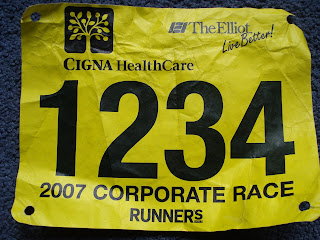
Those CIGNA 5K race people are mocking me! I am sure. I was checking out their race app/brochure and noticed the picture they used to showcase their new timing system. They used the number 1234. If you want to read the strange and unusual things that happened to me when they gave me the unlucky number 1234 a couple of years ago, check out this true story.


After one week of running with the insoles for functional hallux limitis, I have had mixed results. They feel great standing and walking and are absolutely awesome when riding my bike and kickbike. I do struggle to run with them. They feel good, but they slow me down. I feel like I am running in sand with all the support that I am not used to having. My legs and feet definitely need more time to adjust.

Last week's running
Mon. Mine Falls 5K Trail Race 20:18 (used cut-out insoles-hips were O.K. but lost balance a few times)
Tues. Lowell Classic T-Shirt night 19:55 (used brand new insoles that I got in the morning)
Gotta work on my race wardrobe! But at least I am ahead of Fil Faria, for a bit, who keeps beating me (usually by one place-twice a week!) I forgot to wear an old t-shirt. I was going to wear a 1981 Lowell Oktoberfest Marathon shirt (if it still fit).

photo Ted Tyler

Wed. Track night 6 miles including 2 X 2miles (hip was tight something like 12:15 and 12: 48) last one I almost quit after 1 lap as my hip hurt and I had a hard time moving-but I made a comeback.
Thurs. 8 miles slow with insoles
Fri. 8 miles slower with insoles but felt great otherwise.

Took out my Kickbike for the first time all year and did 8 miles (stride felt great-foot plant was excellent with the insoles),

then took out my Centurian Cinelli Equipe racing bike from the mid-80's- a great friend with all the miles and racing we did together) for another 8 miles (again felt great- I have never been able to get my left foot comfortable on a bike- and with the same setup of cleats and saddle I keep trying every year or two but it always feels off and hurts my foot and I can't balance on the saddle correctly-this time it felt excellent with the midsoles-my left leg was aligned, had power, and I could sit properly on the saddle-wow- that has never happened before even before when I started biking),

then I took out my mountain bike and did 8 miles including the trails off Gilson Rd.,

I was going to ride my black K2 but some spokes were broken (I have less than 50 miles on this bike-got it cheap-everytime I ride it something is wrong),

I didn't ride my Cannondale Triathlon bike but I need to get it cleaned up to sell.

I was still feeling fantastic so I took out my Kettlebell and worked the rest of my body. It was a great day playing with all my toys. I love days like that, but they are rare to find any more.
Sat. 8 miles- really slow-I knew I'd be sore-but my stride is real short and I ran 1 1/2 minutes per miles slower than a good day.
Sun. no running 14 miles of biking
Monday- heat! MineFalls 5K trail race 21:19 ouch. Started off great, had a hard time staying out of the lead, then my left glute spasmed up at about the 3/4 mile mark, making it hard to run for 1/4 mile or so and then it was a sort of limp home to the finish.

photo Steve Wolfe

Tues. Real hot 90+degrees! Reverse the Course 5k in Lowell 20:28. I was giving my feet a rest today from the insoles and decided to try the Cluffy Wedges in my shoe. I ordered these before I got the insoles for FHL and when they arrived I had put them aside because they came the same day I got the insoles. They work in a similar way by putting a wedge under the big toe to allow the 1st MTP joint to work. Unfortunately, after I entered the race I started to warm up and my left glute was still tight and sore from the previous day. I was limping and couldn't run. I did some quick  Postural Restoration stretches to readjust the left hip and stretched the quads a bit. This seemed to help. I got a good start in this race. Felt OK with the Cluffy wedges-more normal but my feet were beat up a bit and my right toe joint began to really hurt again after doing much better with the insoles.


photo Mike Stanwyck

I had another ART appointment today with Dr. Baroody. I explained how tight the muscles all around my hip and pelvis were: from the insertion of the hamstring to the muscles all around the hips. He gave my 5 dynamic flexibility exercises to do and will give me more stretching exercises next visit. There is so much readjustment being done that the muscles seems to be getting tighter and tighter almost like they are trying to protect my  hips from moving, so we'll see how that goes.


Friday, July 2, 2010

"The Gait Guys" Offer an In Depth Report

As soon as Dr Baroody mentioned that I had a condition called Hallux Functional Limitis and an inverted heel, I went online to find out everything that I could. One place that I went to was "The Gait Guys" website.
THE source for progressive and innovative gait analysis, performance and rehabilitation information.


I embedded one of their videos on  my post on inverted heels, but I had a question, so I asked it in their forums.  Dr. Ivo Waerlop, one of the Gait Guys, was kind enough to repsond and gave a pretty thorough and technical observation of what he saw going on with my feet and legs based on my videos. It is nice to give names to what I sensed was going on, even though I didn't know what it was called that made my feet and legs "not the norm". I guess it all started going awry as I was developing before I was born. Thanks Mom! He then goes on with more descriptions after observing pictures of my feet. I guess my feet and stride are even curious enough that they may make a teaching case from my videos and photos.

I do know one saying that I really dislike and I have heard it constantly in one form or another from my earliest days of running. It goes something like this, "Running is 10% physical and 90% mental." I always think that this quote is very wrong in implying that good running is basically a case of who is the strongest mentally. I would disagree, you  need to be born with a good set of wheels if you want to be good! Everyone does not start out on equal footing (or with equal feet). It is what you do with your wheels that forms the mental part.

I appreciate Dr. Ivo's responses and look forward to seeing what I can still do to improve my mechanics and functioning. That along with  the quality care I am now getting from Dr. Baroody and the insoles from Dr. Dananberg might mean I may be able to get a few more years out of these legs, and hopefully do so with an improved economy and efficiency.

How are the new insoles going? I got them Tuesday and wore them all day. I ran the Lowell 5K about 20 seconds slower than the previous week, but once I started running my left sacrum started seizing up. Wednesday I wore them again all day and at the track my left glutes were really stressed and sore. The workout was a struggle as I think my left glutes were starting to do work for a change. This is the side that the PT said my glute medius was very week on, as well as my hip flexor being tight and weak, and so I was using my TFL to compensate. Well these muscles were getting really sore, particularly the glutes. This morning it was again tight and sore. I ran 8 miles slowly. I almost turned home after 100 yards as it was difficult to move. Halfway through the run, things loosened up a bit. My feet seem to be very stable on the ground and my toes appear to point straight ahead. I don't have as much twisting and turning. I noticed that my feet roll across the ground and after awhile I realized that I was extending my leg behind me more and actually getting a push-off. I had another ART treatment today that worked on the muscles that had tightened up in the hips, back, and noticeably the hamstrings, so I hope things start settling down and working together for an improved stride.

I do like this video, "What Can The Single Leg Deadlift do for you?" that Frank Snideman posted here. The forum discussion where I found it is here. I think it can be very important for my strengthening at this time and I find it much easier to do these types of moves with the balance that is restored to my feet with the new insoles.

Wednesday, June 30, 2010

Functional Hallux Limitis

Functional Hallux Limitis. That is the name. Hopefully I have the fix. I have been trying to get my hip, back and stride fixed for too many years. I now have a name for what has been causing my imbalance, form, functioning, and pain problems. I have to give kudus to Dr. Baroody for identifying the problem. Well, actually I believe it was identified 20 years ago, but I did not understand the issue and could not afford the treatment. Twenty year after seeing Dr. Dananberg the first time, I went back again yesterday. He also identified the Functional Hallix Limitis and fit me in a pair of the Vasyli-Dananberg insoles specifically engineered for FHL. The product is named after Dr. Dananberg as he is known worldwide for his work with FHL.

Named among the most influential Podiatrists in America by Podiatry Management Magazine, and is a founding member of the new Vasyli Think Tank™.


Howard is renowned for his work in the development of the concepts associated with Functional Hallux Limitus. His published articles on Sagittal Plane Biomechanics, his patented Kinetic wedge and work on gait-related back pain is recognized world wide.
Here is a great article which explains FHL, the compenstations the body "invents" in order to "work", and how the insole restores proper function. Dr. Dananberg did not really discuss FHL with me in detail, but fortunately I had done my homework so I knew what he was talking about and referring to as he checked out my feet.


The good news is that he feels that this is treatable with his insoles and I can decide later if I need a more specialized pair of orthotics built up for me. He wasn't worried about the pain over my right big toe. I have had this for about four months now after every run and I was worried that my toe may be going to a more rigid diagnosis that usually leads to surgery. I was very much  thinking he might end up telling me my running days were over. He was not concerend with this at all which puts me at ease. He also said the inverted heel is probably a result of the FHL and things should improve. I am thrilled and hope the insoles really work. They do feel good (they were heat-molded to my feet) and the cutouts and shape very much give my feet balance when standing and certainly let my feet "roll" forward as I run. They are not miracle workers as I used them in the Lowell 5K race last night and was about 20 seconds slower than the week before, but if they allow me to run without the imbalances (over time) then I can get my mileage back up and my race times down. Most important I want to get my running stride back so that I can enjoy just running again instead of trying to constantly figure out what is wrong and how to fix it.

With FHL, the first metatarsal joint does not function correctly. The 1st MTP joint is the joint leading to the big toe. When you stride forward all of your body weight is supposed to hinge forward over this joint and it is suppposed to support your foot and body and raise your heel through the gait cycle (or this is how I understand it). Unfortunately if you have FHL the 1st MTP joint cannot do its job and the body attempts all sorts of compensations to try to correct itself. I have noticed this problem through the years and explained what I thought was happening in my foot to many experts, but I guess no one was informed enough on this condition until Dr. Baroody identified it. I have tried many remedies on my own because they "seemed" to make sense such as cutting out an insole under the 5th (little toe) joint to try to balance the bottom of my foot or running with wedges under the 1st metatarsal and big toe to try to give them support so my foot wouldn't  cave in.  My intution was correct, but maybe not the remedies! With the new insoles an area is cut out underneath the 1st MTP joint which allows it to descend so that the 1st metatarsal head can plantarflex which allows the 1st MTP joint to dorsiflex.

I think what this means is that with the insole my feet can now support my stride. With FHL your 1st MTP joint cannot work properly and so your toe cannot get involved with the stride either. My main compensation on the left foot was that the 1st MPT joint would collapse on contact with the ground giving me no support. The foot would then severely pronate over the toe and evert my foot out to the side throwing off my stride and giving me the constant hip and back problems. On the right foot the pronation wasn't as pronounced, but the joint and toe still weren't doing their job as the toe would stiffen up when bearing weight and again giving me no push off. Dr. Baroody also explained that this is why I have a mutlitude of stiff muscles. That is bad, but it was somewhat good as my body was doing whatever it could to achieve a running stride and protect itself and make itself work in my own unique way. Besides the ART treatments for my muslces, I am hoping that the insoles will take the stress off many of my overworked muscles and allow them to release and function properly.

Dr. Dananberg's article describes walking with FHL as akin to walking with swim fins on your feet. Since the body can't properly go forward with the fins on, it is like stepping upwards with no propulsion forward or a mechanical stride. He suggests four compensations that the body will do to achieve a gait. One, a midfoot collapse with delayed heel lift (the PT did say that my left stride was slower than my right- this is the side with most of my symptoms). Number two is an absence of heel lift during single support phase that can lead to balance problems. Three is inversion compensation (I not sure if this is similar to the inverted heel that Dr. Bardooy suggested). The fourth symptom is abducted compensation. As Dr. Dananberg descibes, when the forward motion over the toe joint is blocked then the foot will find the least path of resistance in order to move forward, So the foot pronates and twists and the effects of that go up the alignment of the skeleton. I certainly hope that the insoles do what they are supposed to do and my body starts fixing itself. My feet feel "strong" under the metatarals for a change once I put them in my shoes and my left hip also felt stronger and in a better position. Let's hope that those are good signs.

Dr. Dananberg also did some manipulations of my feet and ankles to restore lost motion and free restrictions. In these videos he is seen doing similar manipulations and other manipulations. These are to be done by an expert, I am only showing them because they are interesting.


Wednesday, June 23, 2010

An Opportunity Missed?

Twenty years ago, soon after I moved up to Nashua, someone recommended to me that I visit a podiatrist named Howard Dananberg. He was noted to be a top notch podiatrist and I was having terrible back problems from my 5 years in triathlons. I went for an initial visit, but it was going to cost over $1000 dollars further and I could not afford the price. I went to a local podiatrist instead who refurbished the old pair of orthotics I had used off and on with no success for about 5 years. They still didn't do much for me after that.

I recall Dr. Dananberg telling me something was wrong with my forefoot, but I can't recall what it was. He taped up my feet in a special way and I ran great for a couple of runs until the tape fell off. Still, I could not imagine how the front of my feet and the way they lined up could possibly affect my left lower back (and no way to research online either). I have since seen Dr. Dananberg's name repeatedly over the years in all sorts of studies and references. He is a very well-known podiatrist. I have often wondered what would have happened if I could have afforded those orthotics and recieved his care those 20 years ago.

I tried orthotics again a little over 10 years ago. That did not go well either. While they were comfortable, they seemed to make my "supposed" leg-length difference worse. Even a local chiropracter was speechless when he tried to x-ray me with and without the orthotics. When I put a heel lift in my right shoe under the orthotic, the x-rays showed the right leg getting shorter. He could not figure it out. Two months into wearing the orthotics, I ran the Cape Cod Marathon. My legs felt balanced only when I added a heel lift to the right shoe, and by then I had over 1/2 inch of extra lift under the right orthotic, and my back couldn't handle the stress. I was holding my right lower back rigid and tight the first 16 miles of the race. Then I grabbed a drink of water and relaxed, immediately my back went into severe spasms and I was out of the race and running for many days. That was the end of wearing those orthotics!

I have tried the minimalism thing for the past few years, but there is still something wrong with my feet, hips, and back. When I first went to Dr. Baroody (the ART doctor)last week, he said that both my feet have "functional hallux limitis" and my left foot has an inverted heel. I have been trying to research both of these issues. I can't find much on the inverted heel, but there is a lot on functional hallux limitis. The other day I googled Dr. Dananberg's name to see if he still practiced in the area and found out that...

"Howard Dananberg, is renowned worldwide for development of
the concepts of Functional Hallux Limitus and the relationship of
gait style to Chronic Lower Back Pain
."

I found a very recent video where Dr. Dananberg describes this condition in an easy to understand way.


I also noticed that there is an insole which is named after him that is supposed to manage the condition (see video). I decided to call his office to see if they sell the insole "off the rack". I explained that I had been in 20 years earlier and the price I was quoted (that I could not afford). I was told that at that time Dr. Dannanberg probably wanted a specific and costly gait analysis done and that he doesn't need to do that anymore. When I asked about current pricing, it was like $120 for an initial visit (comparable to 20 years ago)and that the insoles would be about $150 unless I needed some posting done. Different orthotics would be about $480. That is not much more than the orthotics I had 10+ years ago from a no longer remembered podiatrist. Well, I missed the opportunity 20 years ago and I am not going to do that again when I have one of the most well-regarded and innovatice doctors in the field just miles down the road. I have an appointment set for next Tuesday.

I am still getting ART treatment. Dr. Baroody viewed my videos and saw "lots" of things. Well that wasn't hard to do. He has worked on my tight hip flexors and has now started working on my tight glutes and hamstrings. The funny thing is, I keep reading how ART treatment is supposed to hurt. Just like with the last ART doctor I went to, I barely feel anything but the pressure of fingers. There is no pain and I was watching Dr. Baroody as he kept looking at me in surprise. He was sure I would feel something on some of those muscles, but there was no pain at all. Oh well, that is fine with me!

I did cut out a section of under the first metatarsal on a pair of Dr. Scholls generic plastic insolesas Dr. Baroody suggested. I ran in them Friday for 8 miles as soon as I cut them out (probably not good- I know) and they changed my stride some and fatigued the hip in a different place, but I did not like the high arch on the insoles. I ran 8 miles the next two days, and they made me run slow and I felt real awkward. I stopped wearing them as my whole left side was now messed up and it felt like something was pinching. I ran the Mine Falls race Monday night without them and my left hip was stuck. I ran 20:24. After an ART visit Tuesday morning things felt better. I ran with the insoles in my light Puma K Street shoes in the Lowell race. That felt a bit better and I ran 19:33 for an easier course. My hip wasn't stuck, but muscles were not balanced properly.

Here are some of Dr. Dananberg's artices that relate to Functional Hallix Limitis from the Vasyli Think Tank™ and the insole company.

Here is a Carson Boddicker article on "Mobilizing the Big Toe" and a video.


Here is a Gary Moller video on mobilizing the big toe. He is the older brother of Lorraine Moller, one of the great female marathoners (Olympic medal, BAA Marathon win, ect.)

Friday, June 18, 2010

Two Halves do not make a Whole!

After a bit of a hiatus from training, I am back on the roads this week. I was getting good running success with the Postural Restoration therapy that ended in February, but as I continued to run (and faithfully do the exercises) things started to slowly fall apart again. I was back to a point in my training where the left side of my body and the right side of my body were doing two different things. I noticed my mileage going down from 50 a week to 40. Then it was down to 30 and then 20. Each run was taking longer to recover from as I got more and more imbalanced and as my hip hurt more and more after most runs and there was not much fun in it at all. The racing was even worse! Finally last week, I only ran twice: two 5k races. At the end of both races I was limping on my left hip. The last race was the Hollis Fast 5K. As I limped back to the awards ceremony, I had the feeling that something "more" was wrong with my hip. It hurt. I seemed to be "protecting" it more as I ran and I had such a terrible stride as I tried to run faster that it was no fun to even race. I thought to myself that "something" must be more wrong with that hip then I could figure out and I felt that the next step must be to go to a doctor and get it looked at. Maybe it was a labral tear that wouldn't let the femur fit properly in the pelvis. I did not feel like running any more as each training run was leading to a day or two of problems and I was uncomfortable running at any speed.

Before calling up a doctor, I also was thinking that no matter how hard I worked on my exercises and strength work I was just strengthening a dysfunction and not correcting it. I had already gone back to the postural restoration therapist last Monday (on my own dime), hoping to see if she could see what I was doing wrong with my exercises. I was shown the ones that should work best for me, but there were no new revelations. The only thing that was confirmed is that when I run my left stride is slower that my right. I was wondering about this and that is probably why that my legs get worse as I try to run fast. I still believe that the Postural Restoration work is very valuable for me, but until I can figure out and straighten out the root cause of my imbalances that nothing will get fixed. It does give me good strength work and can help with working on positioning and muscle balance, but it seems to help me more for basic walking and standing and I haven't got it to work yet for running (fast running in particular). That left me again frustrated at the end of the Hollis race and asking myself, "What is wrong with my body causing it to work so incorrectly."

I started thinking that before I call a doctor to check for an injured hip and socket, I might want to try one more time at seeing if there are restrictions in my hip that may be causing the failure after all the exercises I have been doing. Maybe it was time to call an ART (Active Release Technique)doctor. I was very high on ART back about 10 years ago when I first went to Boston to have treatment done. The doctor started fixed my psoas muscle that had been giving me back pains for years (due to triathlons). He got rid of the scar tissue and the results were pretty dramatic (the first thing that worked on me in over 15 years). However when I went back to see this doctor a few more times to see if he could help with my hips, he did little and seemed real disinterested in the whole process and in even helping me (I believe he no longer practices). I had wanted to try ART with someone else, but I could not find anyone local who took insurance. Maybe it was worth another shot, so I called Dr. Steve Barooby of Artful Chiropractic in Manchester. I had talked to him on the phone a few years ago, but never went in to see him (I did Rolfing instead). Dr. Barooby has lots of certifications in ART and I had heard good things about him. I gave him a call and was even more happy to find he takes insurance now. I have gone in three times this week. I told Dr. Baroody that my body was a puzzle and there had to be a way to figure it out. He has discovered some missing puzzle pieces that I have been trying to get answers on from so many other people I have seen and there is even names for these things that are wrong with my feet.

He did a lot of listening and asking questions and then he got tolooking at my feet. I have been trying to figure out why my left foot does so many strange things during my stride and I have tried all sorts of remedies on my own to figure it out and fix it. In fact, that is how I got the referral from my doctor last fall. I simply wanted to ask a PT about my foot and ankle. He asked if I have ever damaged my left foot with a severe sprain. He said my left heel was "inverted". I have asked many other therapists about this heel that seemed "out of position" before and could not get an answer. I think that what he means by inverted is that it is rotated inwards. Maybe this is why my forefoot also everts out. I don't know. He said this inverted heel causes my heel to suppinate. He also said that I have something wrong with my front toes. It is called "functional hallux limitus". Basically on the left side, the toe and its metatarsal does not work. That is why that foot rolls over onto the inside trying to connect to the ground. In other words, it pronates heavily. So, my left foot suppinates at the heel and pronates from the forefoot. It is trying to do two opposite things at once! Is that it? I have been thinking my imbalances stem from the left side of my body being different from the right and not equaling a whole. However it might simply be the back part of my left foot not playing nicely together with the front part and creating havoc on the left side of my body and messing up my running and alignment throughout my body.

Dr. Baroody has been softening up my feet by mobilizing my stuck joints as well as using ART on my heel area to work on the "fixing" of my heel. All of a sudden my running is easier again (not perfect) but I ran 8 miles on Tuesday, did the track workout on Wednesday (800, 1200, 1600, 1200, 800 first laps in 90 sec. each lap after that in 91 sec. Mike Ward started pushing the pace on the last 1200 and we did that in under 6:00 mile pace, and then I ran the last 800 in 2:52- certainly a decent workout). My hip didn't hurt at all during or after the track work, and I ran 8 miles each of the next two days. Still no hip soreness (I have been getting ART treatment on the Psoas muscle along with the foot work). So far that is good progress.

The interesting thing that I now recall is that during the two months of Postural Restoration work, the PT twice mobilized the bones in my left foot. The PR exercises helped, but it was after the mobilizations that my mileage started going up in the winter. I could get the left toe metatarsal on the ground after those mobilizations and I could run so much more easily. I think it lasted for awhile, but the joints got stuck again and that is why my running got worse and worse each week. I felt the same "working" of that first metatarsal after the mobilization work this week. When I ran yesterday, I tried to "listen" to my feet (after learning more about this "functional hallux limitus"). On both of my feet, the first metatarsals are now touching the ground as I run. However on the left foot, the big toe does not even touch the ground at all during my stride. As I run it goes "heel-first metatarsal" and that is how I push-off the ground. There is no involvement of my toes. On the right foot it is the same thing, except the big toe does touch the ground, but it doesn't exert much force. This also gives me a scary reason for my having a "pins and needle" toe joint pain on my right big toe knuckle for the past 3-4 months after my runs. That toe joint is very stiff and I notice that there is a further condition that many runners develop where that toe joint becomes rigid. Oh, No! I don't want to go there!

Anyhow that is more than anyone needs to know about my feet. I am again getting closer to figuring out my stride problems and I think this doctor has some interesting solutions. Today, I ran with Dr. Scholls insoles that Dr. Baroody advised me to try. He showed my how to cut out the area under the first metatarsal so that it "dropped" the toe joint down and "hopefully" cause it to function correctly. I didn't like the bouncy feel of the arch on the insole, and I am not used to it yet at all (basically I used it as soon as I cut up the insole), but it really shook things up in the way my stride and muscles worked today. I don't know if this will help in the end, but it is certainly worth a shot! The next few weeks should be very interesting!