Wednesday, August 24, 2011

Creaking...

It has been just four weeks and two days since my hip surgery (arthroscopic for a torn labrum) and I am testing out running again. Today' workout: 1/2 mile around the block. This was my second run. I ran around the block a couple days ago and nothing bad happened so I tried it again today. After "jogging" around the block, I went to the YMCA and did 10 miles on the recumbent bicycle, then 3 miles on the elliptical, and finally I ventured forth to attempt one mile on the track. It took 10 minutes, but it is a starting place. The new Nashua YMCA has been great for me. I have been using the elliptical for a couple weeks now. Thw longest distance I have completed on the elliptical is 7 miles on the day after the Falmouth Road Race and I did so in its honor. That was also just 3 weeks post surgery. I am happy with my recovery, but the joints are a bit creaky.

Speaking of Creaking, my son Andrew did an internship at Regenerate Music Company in Tennessee this summer. At the end of the summer, he was allowed to record and produce his own song. Andrew wrote "Creaking Door", recorded and performed the singing and guitars (everything but the bass and drums), and produced the music track. It has become my favorite song of the summer.You can listen to it here. I think he did an excellent job for being self-taught in singing, writing, and playing. You can even download it for free if you like it. It is a little tough to hear your son, who is exactly half my age, wishing for a moment that he was younger. I would gladly take his 21 years!


Web music player


Two other Regenerate musicians I enjoyed listening to this summer (and Andrew got to work with) are Hawkboy and the smooth voiced Asiah Mehok. Here are both of their versions of Hawkboy's Two-Bit.


Monday, August 22, 2011

Chasing Ghosts by Philip Reilly


I was looking for another interesting and inspiring book to read as I recover from surgery and came upon a fictional story called Chasing Ghosts written by Philip Reilly that was released earlier this year. Recommendations for the book compared it to the classic Once a Runner so I decided to order it for reading on my Kindle. The book was an excellent and entertaining read. The story rang true as it was written by runner and tells the story of Joey McNeal, a runner from Philadelphia, who decides to take out his running shoes one more time to see how far he can really go with his talent after having retired from running post-collegiality. Still having regrets about his racing career, he decides to vanquish any ghosts of his past, so he doesn't have to ask, "What if?"  As he says to his girlfriend midway through the book as she question his devotion to running:
You want to know why I am running so hard? Because I still can. It's what I do, heck it's what I am. If I am not training hard for something, then I feel like something's missing. Ever since I was twelve years old, I've run....I just need to know. I need to know how good I can be before it's too late... Every time I wake up in the morning with aches in muscles I didn't know I even had, I realize I am not 20 years old anymore. But I sure ain't dead either...I want to run to the best of my abilities and try to be great.
That quote tells it like it is for many a runner. It is a story that runners from aging weekend warriors to highly competitive athletes can thoroughly enjoy, because it is the story that we all live every time we go out on a training run in anticipation of getting the best out of our bodies. Joey McNeal had given up competitive running and was working as a teacher and coach when he decided to give running one more shot. He gets three former teammates and friends to join him in his running quest. An acerbic old Irish coach guides them as Joey strives to make the 1988 US Olympic team in the 800 meters race. One thing I enjoyed about the books was the likeable characters and their realistic lives as they go about "living the dream." I also enjoyed hearing about the training and racing along the way as Joey attempts to qualify for the trials. As a distance runner, I was interested in the training and the racing accounts for an 800 meter runner. It is a distance I have never raced, but the more I follow racing it is a distance that gathers my respect and admiration. It is not really a distance event and not nearly a sprint. It takes both speed and endurance as well as a workable strategy. Go out too fast and the gorilla jumps on your back as you near the finish, go out too slow and no matter how fast you sprint at the end you may be outrun or boxed into a position that keeps you from winning the race. It is a wonderful distance to watch if you enjoy the drama of how a race unfolds and in the book the pain of the distance is abundantly clear.

Chasing Ghosts is also realistic in its portrayal of racing choosing the Millrose Games and the Olympic Trials as key races, as well as the Broad Street 10 mile race in Philadelphia. The Millrose Miles turns out to be a realistic race with world class runners Bernard Lagat and Craig Mottram competing with our fictional hero. Alan Webb, Galen Rupp, Letsrun.com, and other names and places give the story a real and familiar feel. However, the most important race in in the story, no matter how wonderfully and agonizingly portrayed, cannot compare to the actual race that really took place at the 2008 Trials. I am talking about the 800 meter final in the 1988 Olympic Trials as seen in this video. How do you compete with that? I get goosebumps every time I watch it!


Well the racing scenarios and the story of Joey McNeal and his friends, make for an entertaining read. The 800 meter Trials race and the ending is satisfying and leaves an opening for the story to continue.The one thing that I didn't like may be just something related to reading the story on the Kindle. There were some mistakes, but most glaring for me was the formatting of the story. There was a mix of indented paragraphs and paragraphs that were not indented at all, which was the usual case. My brain hesitate at each of these mistakes as it didn't just "appear right" as I was reading. Maybe these will be fixed in the future if it is a Kindle formatting problem, but other that that if you are looking for an inspiring read, Chasing Ghosts might just be the book for you.


Tuesday, August 9, 2011

The Ghost Runner: The Tragedy of the Man They Couldn't Stop


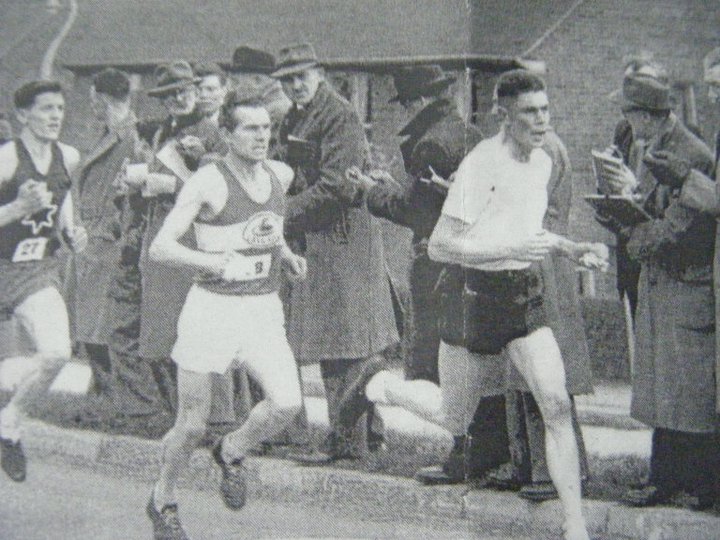
John Tarrant was the ultimate running bandit: a man who obsessively loved to run, yet was denied the opportunity to officially participate in the sport he loved so much.  So he ran unofficially without a race number and the media soon dubbed him "The Ghost Runner." He was good too, Good enough to win major races and to be a man with dreams of participating in the Olympic Games. I didn't know anything about this book The Ghost Runner by Bill Jones and had never heard of John Tarrant before buying the Kindle Version of the recently released book. I am not sure many people, particularly here in America, have ever heard about this amazing runner, and there is a reason for that.


While a young man in 1950's England he had tried his hand at boxing and took a measly £17 in payment. For this minor infraction (and the fact that he naively reported it), he was not allowed to run as he was no longer an "amateur" athlete. No matter how hard he tried, he could not get the "powers" to be to let him officially run, so he became the "ghost runner" sneaking into races and running without a number or official recognition. Whether he won a race or not, he was ignored and never entered into the results. John had Olympic ambitions, and when the British officials finally relented and allowed him to race in England, they would not let him represent England in any race outside the country and put the pressure on other countries so that he could not participate as an official runner when he came to run races in America and South Africa. So, he remained a "ghost runner' again as he raced in those countries.


John did set two world records, one for 40 miles and another for 100 miles, as he became a marathoner and eventually an ultramarathoner. The story tells of his upbringing in England and is as much a story of a man railing against "the man" as it is a story about running. John was born in 1932 and eventually due to the war and his mother's illness he was sent to a children's home home with his beloved younger brother. It was an unhappy experience and one that formed his attitudes towards life.  It is also a story about the impoverished working class life of post war England. Points were also made about the divisions between the working class athlete versus the educated upper class "amateur" athlete that was prevalent at the time.


John's fury over his circumstances and his single minded hard-core devotion to running does not always make him a pleasant character. He virtually leaves his wife and son to live a life of poverty and loneliness as he seems to have no other goals and ambitions outside of running. But his goals and ambitions are laudable as I can't think of many, if any, athletes who would put up with his lot in life without giving up. He becomes one of the best ultra runners in the world and won the London to Brighton Ultramarathon twice and traveled to South Africa to race and try and win the the Comrades Ultramarathon. In South Africa he formed a kinship with Indian and Black runners, who also where not allowed to compete in Comrades due to apartheid. He even went on to run in a "mixed race" ultramarathon as the only white runner the first year, playing a small part in the breaking down of racial barriers in South Africa. The book tells of his devoted and long-suffering wife and his relationship with his brother, who seems to be a conspirator to get him into races.

John with his wife Edie
John and his brother Vic
 Here is a video of John Tarrant winning the second of his two London-Brighton races in 1968.

LONDON - BRIGHTON RACE


There are many tragedies to John Tarrant's story. Certainly, he pursued his dreams with uncommon optimism and dedication, despite the ridiculous ban on his competing in races. He lived simply and cared for little: work, possessions, or a normal family life. He received much sympathy and support from other runners and the newspapers of his day, but ultimately never received the honors and recognition that he deserved and so desperately wanted.


The book makes an interesting read, telling about the transition of running and sport from the formal "amateur" "Chariots of Fire" athletics of the prewar world to the coming running boom of the 1970's and the professionalism of the 1980's. Sadly, John Tarrant never saw those days as he died from cancer at 42 years of age in 1975. An astute observer of the sport would pick up a few names mentioned in the book. Harold Abrahams, the 1924 Olympic Champion in the 100 meter sprint as depicted in "Chariots of Fire" is one of the British officials who at first sympathetically started the process of allowing John to officially race in England, but who later helps stand in the way of allowing him to run in other countries. Runners from the 1970's will notice the mention of American ultramarathon runners Tom Osler and Ted Corbitt as well as a young Ron Hill. Chris Brasher, a pacer for Roger Bannister's sub 4 minute mile, also turns up as the person who helps John Tarrant get his autobiography, also called "The Ghost Runner" published. Brasher was also one of the co-founders of the London Marathon.


 All in all it was a fascinating read. I also think the story would make for an interesting movie- if a director could delve a bit more into the human side of John Tarrant. It was not written for runners necessarily, as I think people outside the running world would be intrigued by the conflicts presented to John and his single-minded devotion to sorting out the wrongs given to him by the authorities. He was an uncommon character in an unjust world.

John Tarrant's photo was on the back cover of the 1971 Runner's World Pictorial Booklet of the Month. Frank Shorter made the cover.


The Purple Runner

Monday, August 8, 2011

Excellent Hip Recovery


My recovery from the labral tear hip surgery is going wonderfully! It was only two weeks ago that I had the surgery and I did not expect it to be this easy. I am taking it slow and cautious, but I have heard very few accounts of people doing so well after this surgery, so I am pleased. The above photos is from the surgery and shows inside my hip joint. The pictures look like little planets! The top left red shows the labral tear.  I was told that they wouldn't have placed much money on me for doing so well after hearing my running history, but I was found to have only minimal arthritis (I think that groove is part of it) and that my hip structure was like that of someone much younger. The yellow yolky stuffy is junk that was cleaned out. 

I could walk without crutches days after the surgery and I no longer use them at all. I was told I can do light spinning and also try an elliptical machine. I did 15 minutes of spinning and then 30 minutes the next day. It felt good, but I do have a minor pinching so I am taking it easy. I think my left leg is lining up much better and my muscles need to adjust. I was even told I could do some easy jogging if I felt like it (would be better on my hip than attempting power walking). I have never heard of anyone starting that up so early, so I haven't tried it yet even though I barely notice the hip at all and my leg feels strong. I even tripped over a cord yesterday and my left leg made a huge lunge forward so that all of my weight rested on it and there was no pain or anything after that. I was told no tennis, basketball, and weighted squats. I was also told that after 3 weeks, it may possibly be a bit more sore as they "cleaned" out the joint and things may build up again, but once I make it past Labor Day I should be OK. I am determined to take things slowly and not rush., but I can't help but marvel how easy recovery has been and how pain free my hip has felt.

I think it may be because my tear was not where I bear weight, but a little to the side. Also, the labrum was still attached so it did not need reattachment. I think they doctor used a tool that uses heat to refuse the labrum rather than using stitches. I was worried that my bone may need some shaving or reshaping, particularly because it always felt like that hip got stuck and something was blocking its movement. I didn't need that, but the doctor did find some synovial impingement that the doctor debrided (smoothed down) and this was what was causing that "stuck" feeling. I can recall back to a PT that worked on my left hip capsule over 10 years ago due to it getting stuck, so I am hoping all this work is freeing my hip up from years of working improperly. I won't be able to tell until I actually start running again. I was told that my funky running stride and mechanics may have come from my body inately "protecting" itself from what was going on in my hip. When I walk around the block or ups the stairs I can feel the hip bearing my weight properly. I have run for years without fully being able to push off that hip joint properly, it always was very unstable. So I am thrilled with the surgery, taking things slowly, and hoping that I will have a great recovery into being a runner again some day soon.


Update:
This new book from the author of The Entrepreneurial Patient blog is a must read book for anyone with hip problems and is thinking about about arthroscopic hip surgery or has had arthroscopic hip surgery for a labral tear or FAI.


Thursday, July 28, 2011

Running for the Hansons: by Sage Canaday


What else do you do after having hip surgery, but fire up the Kindle with a few motivating books and read away. The first book I read post surgery is the newly released Running For The Hansons: An Insider's Account of The Brooks-Sponsored Marathon Training Group Made Famous by Olympian Brian Sell (Volume 1) by Sage Canaday. If you ever wanted to know what it is like to be a struggling professional runner hoping to make it big in the running world than this is the book for you. Sage Canaday joined the Hanson's Brooks Distance Projects soon after graduating from Cornell and wrote about his and his teammates experiences with the team.

I enjoyed the book and found it an interesting read. The organization of chapters kept it humming along. It wasn't strictly a linear journal as it bounced along to other topics to keep a flow going. Athletes like Brian Sell and Desiree Davila are highlighted. You get a good feel for what it would be like to train full-time while trying to work and progress as a runner. It doesn't sound easy!

If you are a fan of running, you might find inspiration in the book. It seems written for the Letsrun.com crowd, with even a singular reference to Kip Litton. Another Letsrun mentions involves Sage reporting from the January 2010 Boston Indoor Games, where he talks about trying to be the first to get results up on Bernard Lagat's World Indoor record 5000m run. Here is his video:


Here is my video:


I had a better view of the finish right at the line. Lagat handed his victory flowers to the girl next to my daughter. I am not sure who got the video up first!

Sage on pursuing his dream, " Within 5-10 years my body is going to be done in terms of being able to run a national class marathon time. I already hobble down the stairs like and old man, feet blistered, tendons swollen, and muscles banged up. The body can only take so much before it breaks down. We seek to capture our youth, cherish it, and utilize it to our advantage!" Sage most recently ran 2:16 for 8th place overall at the 2011 San Diego Rock ‘n’ Roll Marathon.You have to give credit to the runners who are pursuing their dreams and if you never had the talent, it can be fun to just read about what it takes to follow those dreams.

Wednesday, July 27, 2011

Successful Hip Operation!

Monday, I had my operation for a labral tear in my left hip with Dr. Joseph McCarthy at the Newton-Wellesley Hospital. The surgery is a hip arthroscopy that is a rather newer type of surgery. You can read more about the surgery here and even see a video of what they do on that link if you dare!

Having read all the message board posts of various athletes and people that have had this surgery, I wasn't sure what I was in for. One warning: on message boards you tend to hear from all the people that had things go wrong! I was extremely pleased with the results so far! I am doing better than the "best of" scenarios that I imagined. After waking up from surgery, I felt fine. Where was the pain? Of course, I had limited mobility, but I was happy to not have any pains!

When I got home I could sleep on my back and right side and move around slowly without hurting. I was walking gingerly with crutches, but moving OK. Yesterday, I started some light PT movement exercises at home. Today, two days later, I got out the door to go blueberry picking and got some ice-cream with my family. I used the crutches, but I can walk in a straight line without using them. I have to be careful of twisting and rotating the leg, but I never would have guessed that I would feel this good.

Now, I know there is a long recovery and I intend to take it very slowly, no heroics here as I want no setbacks, but it was good to hear Dr. McCarthy tell me before the surgery that I would be running again. The interesting thing will be: at what level? Will my hip go back to where it was a year or two ago? 10 years ago? 25 years ago when I started having problems? or what? I will be happy to just be able to run again, it has been a long year without running.

Tim Thomas, the Bruins Goalie, had the same surgery last year. Things worked out pretty well for him!


Tyson Gay, America's top sprinter, had the same procedure done earlier this July.

Tuesday, July 19, 2011

Running and Racing in Kenya and Tanzania

Last week I got back from spending two of the greatest and most rewarding weeks ever in Kenya. I was on a mission trip to work in the Mathare Valley slum of Nairobi helping out in the schools and with teachers. Despite the incredible poverty, I found the children to be happy and friendly and it was a privilege to be part of this trip. You can read more about the trip here: although there is plenty more to report and on that blog.

Who would have thought that I would ever be in Kenya and then who would have thought that when I was in Kenya that I could not run? Well, that was the case as I have not run a step since around March due to a torn labrum in my left hip.

Fortunately, I asked the doctor before leaving if there was anything I could take to relieve the pain I was feeling on my left side. I was told it is nerve pain from something being pinched due to the hip. I took a drug that left me basically pain-free for the first time in many years. My hip was not a worry at all and I was able to focus all my energies on the work that I was doing.

Anyhow, I could not resist the urge to run just a little bit. So while on safari, we got out of our vans at a marker seperatating Tanzania from Kenya and I did a short two country run. Then I invited some teammates to join me again for a race between the two countries. It was a blast. Never mind the 40+ pounds I have put on since not being able to run, it was good to move again.


To top off that day, I did some dancing and jumping with some Massai Warriors. I am suprised I got off the ground.


I got to talk Kenyan runners with many of the students I worked with and Ethiopean runners with a host at an Ethiopean restaurant, but I saw very very few Kenyans running. School children were all walking. I guess the runners are up in the mountain of Kenya.

Now the good news. My surgery for the torn labrum has been moved ahead to this coming Monday. If all goes well and after a long recovery, I may be back on the road to running by the end of the year!