I enjoyed the book and found it an interesting read. The organization of chapters kept it humming along. It wasn't strictly a linear journal as it bounced along to other topics to keep a flow going. Athletes like Brian Sell and Desiree Davila are highlighted. You get a good feel for what it would be like to train full-time while trying to work and progress as a runner. It doesn't sound easy!
If you are a fan of running, you might find inspiration in the book. It seems written for the Letsrun.com crowd, with even a singular reference to Kip Litton. Another Letsrun mentions involves Sage reporting from the January 2010 Boston Indoor Games, where he talks about trying to be the first to get results up on Bernard Lagat's World Indoor record 5000m run. Here is his video:
Here is my video:
I had a better view of the finish right at the line. Lagat handed his victory flowers to the girl next to my daughter. I am not sure who got the video up first!
Sage on pursuing his dream, " Within 5-10 years my body is going to be done in terms of being able to run a national class marathon time. I already hobble down the stairs like and old man, feet blistered, tendons swollen, and muscles banged up. The body can only take so much before it breaks down. We seek to capture our youth, cherish it, and utilize it to our advantage!" Sage most recently ran 2:16 for 8th place overall at the 2011 San Diego Rock ‘n’ Roll Marathon.You have to give credit to the runners who are pursuing their dreams and if you never had the talent, it can be fun to just read about what it takes to follow those dreams.
Monday, I had my operation for a labral tear in my left hip with Dr. Joseph McCarthy at the Newton-Wellesley Hospital. The surgery is a hip arthroscopy that is a rather newer type of surgery. You can read more about the surgery here and even see a video of what they do on that link if you dare!
Having read all the message board posts of various athletes and people that have had this surgery, I wasn't sure what I was in for. One warning: on message boards you tend to hear from all the people that had things go wrong! I was extremely pleased with the results so far! I am doing better than the "best of" scenarios that I imagined. After waking up from surgery, I felt fine. Where was the pain? Of course, I had limited mobility, but I was happy to not have any pains!
When I got home I could sleep on my back and right side and move around slowly without hurting. I was walking gingerly with crutches, but moving OK. Yesterday, I started some light PT movement exercises at home. Today, two days later, I got out the door to go blueberry picking and got some ice-cream with my family. I used the crutches, but I can walk in a straight line without using them. I have to be careful of twisting and rotating the leg, but I never would have guessed that I would feel this good.
Now, I know there is a long recovery and I intend to take it very slowly, no heroics here as I want no setbacks, but it was good to hear Dr. McCarthy tell me before the surgery that I would be running again. The interesting thing will be: at what level? Will my hip go back to where it was a year or two ago? 10 years ago? 25 years ago when I started having problems? or what? I will be happy to just be able to run again, it has been a long year without running.
Last week I got back from spending two of the greatest and most rewarding weeks ever in Kenya. I was on a mission trip to work in the Mathare Valley slum of Nairobi helping out in the schools and with teachers. Despite the incredible poverty, I found the children to be happy and friendly and it was a privilege to be part of this trip. You can read more about the trip here: although there is plenty more to report and on that blog.
Who would have thought that I would ever be in Kenya and then who would have thought that when I was in Kenya that I could not run? Well, that was the case as I have not run a step since around March due to a torn labrum in my left hip.
Fortunately, I asked the doctor before leaving if there was anything I could take to relieve the pain I was feeling on my left side. I was told it is nerve pain from something being pinched due to the hip. I took a drug that left me basically pain-free for the first time in many years. My hip was not a worry at all and I was able to focus all my energies on the work that I was doing.
Anyhow, I could not resist the urge to run just a little bit. So while on safari, we got out of our vans at a marker seperatating Tanzania from Kenya and I did a short two country run. Then I invited some teammates to join me again for a race between the two countries. It was a blast. Never mind the 40+ pounds I have put on since not being able to run, it was good to move again.
To top off that day, I did some dancing and jumping with some Massai Warriors. I am suprised I got off the ground.
I got to talk Kenyan runners with many of the students I worked with and Ethiopean runners with a host at an Ethiopean restaurant, but I saw very very few Kenyans running. School children were all walking. I guess the runners are up in the mountain of Kenya.
Now the good news. My surgery for the torn labrum has been moved ahead to this coming Monday. If all goes well and after a long recovery, I may be back on the road to running by the end of the year!
I have always liked training in lightweight racing shoes and was certainly a minimalistic runner long before the recent fad of runners running in Vibram five-fingers or simply going barefoot. I recently spent a couple of years doing a large portion of my running and racing using Puma H-Street "slippers" and have not yet found a trainer that I like running in. I most like doing all my running in racing shoes like the Asics Hyperspeed. Last summer I attempted using trainers again, bulky ones at that, and I don't know if that helped make my hip worse or not. I haven't been able to run since last August due to a torn labrum in my hip. I will have surgery to repair it next month. I think I always liked minimalistic shoes to help my hip and feet deal with the peculiar imbalances that I have had for years. Hopefully the surgery will clear up my stride and mechanics and let me run pain-free again.
I do think the minimalistic fad has gone a bit overboard, there are some great choices in shoes with a low heel drop and light weight out there now, something that was hard to find up to recently, but I doubt that minimalism and barefoot running is for most runners. It works for some, but many more end up injured.
Which brings us to a newer trend in running shoes: maximalism. A couple of companies are making shoes that oppose the minimalistic attitude with big cushiony shoes that are also supposed to help runners with their stride. The most interesting shoe is made by a company called Hoka One One.The ultramarathon trail-running crowd seems to be gravitating towards these behemoths of a shoe. I have heard that some claim it is like going mountain biking when you run the trails in these. You can step over and on anything. Running Times says it is like using a hovercraft. Hoka One One claims it is like levitating:
Despite their outrageous clown-sized foot plant they are also very lightweight. The first model made by Hoka One One is the Maffate which is their trail shoe.
Recently they have come out with the Bondi B which is not as severe a shoe, but still loaded with cushioning and meant to be also used for the roads, Many reviewers say that they can run 20 milers and still have fresh legs that don't feel beat up at all.
These shoes, although silly looking, intrigued me. I thought that the cushioning might be a good thing to have post surgery and the rocker sole sounded interesting for my functional hallux limitis (inability to bend the big toe when pushing off the ground). When I saw a pair of Bondii B's on eBay for far cheaper than the $170 retail price, I decided to get a pair. I am hoping that they may help me recover and get me back running much easier once I have recovered from my surgery. Now that they have arrived and I have put them on my initial reactions are 1) they are very big looking 2) they are very lightweight 3) boy, they are really cushioned, like walking on marshmallows 4) they seem a bit unstable walking around and 5) I think these might be very interesting to run in - I am not at all put off by them (usually a cushioned bulky shoe drives me nuts right when I put them on 6) I am going to try walking around in them - I really wish my hip let me run!
Ultramarathoner Karl Meltzer ran an average of 51.6 miles a day on his 2,064 mile journey across the historic Pony Express trail from Sacramento California to St. Joseph Missouri using 7 pairs of the Mafates.
Another recent running shoe that seems to be anti-minimalistic is the Mizuno Wave Prophecy seen here:
Mizuno says this of their shoe:
The result of seven years of intense research and development, Wave Prophecy is our most advanced, most dynamic shoe ever. Our engineers designed Wave Prophecy to match your running gait and the natural spring rate of your muscles and tendons. Whether you land on your forefoot, midfoot or heel, Wave Prophecy’s full-length Infinity Wave plates propel you forward with a smooth ride mile after mile. No matter how far and how often you run, you’ll always have the ride of your life.
Probably the most eye-catching and controversial design feature of the Prophecy shoe is the sole. It is almost completely separate from the rest of the shoe, connected by rubber posts. This creates 4 large holes that run right through the sole. A friend of mine joked that you could store your energy gels in there. The sole itself is shaped by the famous Mizuno “Wave.” This runs through the whole shoe and not just part of the sole as with previous Wave incarnations.
There you have it, you can go minimalistic or you can go maximalistic. The choice is yours.
When the names of greatest runners from the 1980's are mentioned, there is quite a list of runners to discuss. One runner that may be overlooked is the British marathoner, Charlie Spedding; however to overlook his achievements would be a mistake. Who, you say? Unless you are a true fan of the sport, the name might not ring a bell, but just take a look at his marathon record:
1984
Houston Marathon Texas January 15th 1st place 2.11.54 (the result was so close it took 15 minutes to figure out who won and 3rd place was 1 second behind!)
London Marathon 13 May 1st place 2.09.57
Los Angeles Olympic Games 3rd place 2.09.58 (bronze medal)
1985
London Marathon 21 April 2nd place 2.08.33 (English record)
1986
Chicago Marathon 26 October 3rd place 2.10:13
1987
London Marathon 10 May 8th place 2.10.32
1988
London Marathon 17 April 10th
Seoul Olympic Games 2 October 6th place 2.12.19
Charlie Spedding has an Olympic Bronze medal and a 6th place Olympic marathon finish, wins in London and Houston and other impressive finishes and times. He still holds the English marathon record of 2:08:33 set in London in 1985-Steve Jones (from Wales) set the British record by winning the race. Got that? A runner of this caliber certainly begs a bit of study, and fortunately Charlie Spedding himself has written an autobiography chronicling his running career. He describes himself as someone without much talent, so he must have done something right to reach the heights he did. He spells out the secrets to his success in his book From Last to First. I read the recently released Kindle version.
Charlie Spedding winning the 1984 London Marathon
The 1984 Olympic Marathon
The book is a compelling read, but not just because it is interesting to read what is going through his head as he runs the Olympic marathons and other races. He had a deliberate plan to bring a positive mindset to his racing, and it worked very well. Charlie Spedding could be called one of the all-time great peakers, because the bigger the race, the better he ran. Charlie could sense that the highly touted runners like Rob DeCastella did not have a winning attitude as they started and ran the Olympic races as favorites and thus they never got the medals that others predicted they would win. On the other hand, Charlie looked for the positives and produced when it most mattered. This unfortunately led to his demise as a professional runner, as he couldn't muster the mental focus to cash in on his marathon successes after the fact. He could prepare himself for the big races, but that meant he couldn't run the smaller races with the same mental and physical peak.
"The better I became at digging deep in a major race, the less able I was to run hard in any other event. I tried to do my best, but I became less and less able to produce a performance if a race didn't matter to me"
If you enjoy a well-written book and want to learn about one of the marathon greats, then this book is for you. You might also pick up some tips on how to mentally prepare yourself to be the best runner that you can be. One of my favorite running quotes (I listed it in my high school yearbook) comes from Frank Shorter, "...to me the object is not to beat someone, but merely to live up to your potential. If you do this, then you will end up winning a lot..." Charlie had a similar mantra, that he wrote down in his notebook at the start of his quest to become a champion, "Success is measured by how much I fulfill the talent I was born with." Charlie Spedding was a successful runner by all counts!
1984 Olympic Marathon
Bronze and Silver (John Treacy)Medalists in 1984
New England runners got a closer look at Spedding before both Olympic Marathon races as he trained and raced in the Boston area leading up to both races. He also ran the Falmouth Road Race twice: finishing in 9th place in 1981 and 30th in 1988.
Charlie Spedding on reaching goals:
"I achieved my targets because I knew what I wanted. I knew why I wanted it; and I knew how much I wanted it.I also stuck to it when things went wrong, and I wasn't distracted by other things that came along."
Charlie Spedding on his greatest moment in running (a moment that all runners have dreamt about and that Charlie lived) :
"...the question usually includes a choice between winning the London Marathon and being third in the Olympics. Both of these are very high on my list, but neither is my greatest moment....My reply would often cause surprise because my greatest moment was not a result, but a spell of running which lasted about five minutes. The greatest moment in my two decades of running came 22 miles into the Olympic marathon when I took the lead and pushed the pace. After all the setbakcs, injures and failuresm I was living the fantasy that every distance runner has on a long, cold winter run, I had the initiative. I was calling the tune. I was grasping my opportunity with both hands. I was taking part in Olympic proportionsI was running as fast as I dared. I was trying my upmost to fulfill my wildest dreams. Today was indeed the day. I was doing it. I was flying and I felt absolutely fantastic."
Check out the 3:05 mark in the Olympic marathon video above for this moment.
1985 London Marathon 2nd in 2:08:33 with Steve Jones 2:08:11 1st place.
1986 Chicago Marathon with Mark Curp 12 and Thom Hunt 10
Here is an interesting interview with Charlie from back in 2003.
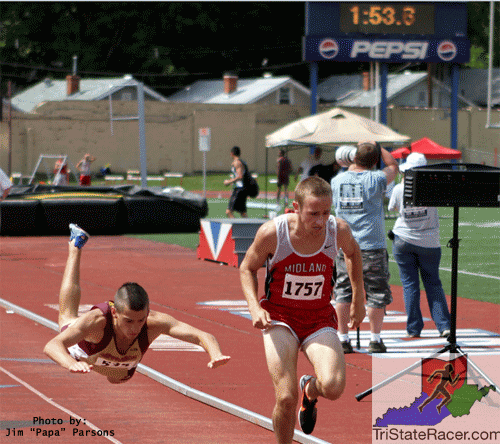
Here is a dive toward the finish line at West Virginia AAA 880 a week ago. Burcham (in red) wins, 1:54.01, to Brandon Doughty's attempt at being Superman in 1:54.03.
You can see the drive and dive towards the finish line in the race video here (at about 1:50).
Here is another diving finish at the Footlocker XC national Championship: Zachary Torres dives to tie for 15th with Dylan Sorensen earning both athletes an All-American (top 15) award.
Not just a dive, but a somersault for the relay win (quick view- start at 3:00)!
This dive earned David Neville a bronze in the 400m at the 2008 Olympics.
Here is a new addition to this post on finish line dives. If you are going to take a header at the end of the race then you should at least add some style to it to entertain the fans!
August 8 is the scheduled day for my hip surgery. I am very much looking forward to seeing if this surgery will fix things and I wish that August would get here quickly. Dr. Joseph McCarthy will be the surgeon and he is one of the most well-regarded surgeons for hip arthroscopicy in the the nation.
Here is another doctor explaining what he did during surgery for a labral tear. They don't know exactly what damage is in there until the surgery, but besides a torn labrum, I am hoping they find something they can do to fix the way my femur sits in the socket by shaving an impingement down. There has always been something wrong with that hip, even before I started running in ninth grade. I did learn at the last appointment that I have a shallow hip socket and that I have very minimal arthritis, which is good.
However, before I have surgery, I have to finish out the school year and then I will be going on a trip to Kenya. I will be working with with a group of people from my church in the Mathare Slums of Nairobi. My primary job will be working with Kenyan teachers who teach in a school in the slum. I am very excited about this trip and to see what I can learn and do. The only negative is that I am going to Kenya and I can't run! It will be a very life-changing summer indeed: a trip to Kenya and surgery to make my body work again.
Here is another interesting video by Kelly Starrett over at MobilityWod. File this under things I wish I knew and did a few years ago. He gives a simple visual tutorial of how the femur and hip fit together with the hip capsule. He shows how to create stability in the hip and to keep away from having an impinged hip. Great stuff....I highly recommend following his blog.
Update:
This new book from the author of The Entrepreneurial Patient blog is a must read book for anyone with hip problems and is thinking about about arthroscopic hip surgery or has had arthroscopic hip surgery for a labral tear or FAI.


 by Sage Canaday. If you ever wanted to know what it is like to be a struggling professional runner hoping to make it big in the running world than this is the book for you. Sage Canaday joined the Hanson's Brooks Distance Projects soon after graduating from Cornell and wrote about his and his teammates experiences with the team.


 . I read the recently released Kindle version.