For the fourth year in a row, I participated in the Tri-State Seacoast Century, but this year I changed things up. During the 2013, 2014, and 2015 versions of the event, my goal was to try to go sub 6 hours on my ElliptiGO which meant that I did not stop to eat or drink and only used what little that I carried because I was counting time as elapsed time. This resulted in some really hard core EllitpiGO rides that left me having some pretty interesting final miles. I also realized, I might never break 6 hours on this course with the winds that you get along the coast and the traffic problems that are sometimes encountered. This year, I decided to have some fun and enjoy the ride (or should I say rides) as I wanted to try doing the century ride on both Saturday and on Sunday.
Nubble Light house - the halfway point
For Saturday's ride, I was supposed to ride with Andrew Warby, but he was held up by work and I went solo, although I did see Andrew later out on the course. The early morning start was cold and I was wearing gloves until the first aid station. The wind was similar to last year's ride as it was more in our face going out. I am glad that I wasn't going for time as I was stopped twice at the drawbridge in Portsmouth for about 10 minutes each time both coming and going. I was happy to finally stop at the food and aid station both times and let me tell you that drinking lots more fluids and eating food on a century ride makes the final miles of the century much nicer,
See, I stopped to sight-see a bit this year!
Nearing the finish of the ride at about 85 miles, a rider in front of me was taking a left turn. I watched from about 30 feet behind him as he slid down to the ground like he had taken the turn too sharply and slid on some sand, There was no sand, however, and he remained down. I realized quickly, along with the other riders who were behind me, that he was stone cold knocked out. Strangely, I am pretty sure that he didn't even hit his head on the ground. His body was twitching and his eyes were staring and opaque. He was not responding and someone had called 911 and then handed me the phone since I had seen him go down. For about 3 minutes he was completely out and not responding. I was asked to count his breathing (which frustrated me at first until I realized I shouldn't be looking at his mouth, but at his chest). He was a 62 year old male named Tim and he had a medic alert bracelet on that let us know that he had no major health issues. After about 3 minutes, he started stirring a bit. When the ambulance came after about 5 minutes, he was just starting to respond. He told us when we asked him how he felt that he felt great! He could not remember what had happened to him. I left after the ambulance and fire trucks arrived and assume from what others have said that he might have had a heart attack or some other heart issue. The guy behind me said that it looked like he might have been out before he even hit the ground. I hope that he is fine and recovering. Update: I heard back from Tim and we are from the same town, He broke his collarbone and rib, but did not have a heart issue. He thinks it may have been a seizure of some type that blacked him out. Like a true athlete, he said that he was looking forward to getting on a spin bike and riding again.
Once I finished the course, after following the GPS route map and marks on the road, I realized that I must have missed some circuit somewhere as my mileage was not quite 100 miles. I did miss turning on my GPS a few times, but didn't miss that many miles. Everyone else I talked to seemed to miss hitting 100 miles too!
My biggest fear for Sunday, was that I might sleep in and miss the start, but I got there on time to meet fellow ElliptiGOer Steve Lecours, who I was planning to ride with, I did arrive on time and it was a chilly and windy morning again. Right before starting, I noticed my brakes were a bit off and then noticed my rear wheel nuts were also loose. I attempted to fix things and then Steve and I were off on the initial 17 mile loop through Massachusetts. I felt pretty good, but my ElliptiGO felt tight and I was having a hard time keeping pace with Steve. I chalked it up to the previous day's ride and the fact that I hadn't warmed up yet. At the end of the loop, I stopped to look at my chain and sure enough, I had tightened the rear wheel which had tightened the chain so that there was absolutely no slack in it at all. I loosened things up and hoped for better.
Steve and I kept a good pace, but I was definitely working very hard to just stay in contact. I wondered if it would be this way all day or even if I could finish. Approaching the Nubble Lighthouse, I finally figured out how I felt. I pretty much felt like you do during a marathon between miles 16-20. I was tired and tightening up, but I could still hold a decent pace. The question was, would I fall apart at this pace and blow up or would I be able to maintain. Fortunately, the answer was that I could maintain. The second half felt better the closer I got to the finish. I never really had any snap or pop in my riding, and tended to lag a bit on the uphills, but at the end of the day, I finished the ride at just about the same average speed as I rode the previous day. That is all thanks to chasing Steve throughout the day, Without him, I would have eased up on so many sections and might have ridden the whole thing about an hour slower.
It was interesting pushing new barriers and riding two long days in a row, Thanks to the ElliptiGO, you can put in a massive effort one day and return the next to do so again as it does no damage to your joints!
Sunday, I rode the Boston Hub on Wheels cycling event. We started at Government Center, rode up up and back on Storrow Drive then went south before returning to Boston for a fun 40 mile ride. It was a great way to see the city. I rode it with fellow ElliptiGO rider Andrew Warby. We had a lot of comments and questions about our ElliptiGOs before, during, and after the event.
Sunday, I competed the Mount Washington Hill Climb along with two other ElliptiGO riders and about 600 cyclists. This was a huge challenge and I am happy that the event is now over. I drove my van up late Saturday night and slept a few hours in it across the street from the start. That allowed me to wake up early to the moon shining down on the start of the Mt. Washington Auto Road.
I had done the practice ride up Mt. Washington in July and so many things went wrong. It was a good learning experience. The next couple of weeks I was fixing things on my ElliptiGO. First, the bolts on my rear axle were loose and my rear tire was rubbing at times throughout that ride, It drained me physically and I had to stop at 4 1/2 miles to borrow a tool from someone in a car to try to fix it. That only helped a little and I had to walk parts of the way to the top. I realized that this was now a huge undertaking, but I had to fix my ElliptiGO before the race. I first got the axle tightened, but I still was experiencing friction on my rides until I realized I needed a new bottom bracket (I have 19,000 miles on my ElliptiGO). I got that fixed and then I realized I needed new tracks and load wheels. My ElliptiGO rode so much better with these fixes.I was putting in great mileage (up to 250 miles/week), but preparing for the nonstop climb is something different. I was very nervous going into this race.
The morning of the hill climb, I met up with fellow GOers, Andrew Warby (who I have previously ridden a century with as well as the midnight bike ride from Boston to Hopkinton and back the night before the Boston Marathon this year) and Jim Cremer, who drove out from Iowa just to ride the hill.
Andrew and Jim at the starting line.
They would be starting in a wave 5 minutes before my start. As you can see it was a beautiful day to ride up the rock pile. When I first started planning this ride, I thought it would be nice to get the ElliptiGO record for climbing Mt.Washington. Only two people had done the ride on an ElliptiGO before and the record is 1:54:22 by Bryce Whiting during the Newton's Revenge race in 2010. After the practice ride, my new goal was just to get up without dying or walking. The record was still in the back of my mind, however. I did the practice ride in 2:20, with walking-which is not much slower than riding- and while trying to fix my ElliptiGO. I realized I would need to have an average speed of around 4 mph to do this.
After a short easy section of about 2/10ths of a mile, the climb is nonstop with an average grade of 12%. I tried to get into a rhythm and things were going pretty well. My heart rate was calm enough and I was staying over 4 mph for the first half of the climb. I had to stop once, when a cyclist fell right in front of me, but I was able to get going. He was very apologetic and offered to push me, but I got going on my own. He was not the only cyclist I saw tumble over.
At 4 1/2 miles, I hit the dirt road section of about one mile. During the practice ride, it was pretty much impossible to ride this section as it was raining and the dirt had the consistency of wet peanut butter. This day it was dry and I was able to power right up it. I did start noticing a grabbing at my back wheel every once in awhile at this point (usually when I shifted into a higher gear) just like during the practice ride, but it would let up if I shifted the angle of my wheels to the ground or shifted to an easier gear.
I was very pleased to not stop and dismount at any of the really steep grades. Looking up ahead at a wall of road rising in front of me was very unnerving, so I tried not to look and just kept my head down on the steepest climbs. The problem with this course is that there is no place to recover or relax. You can't let up anywhere to catch your breath. When the grade was between 8-12%, I felt my best as I could move up a gear or two and try to get my average speed up.
Miles take forever when you are going so slow, but eventually I neared the top. The steepest section is the corner right before the finish line. They say the average grade here is 22%, but during the practice ride, my Garmin shows at least one bump at 39%. I went wider around the corner this time and it still registered 37.5%. But, before I got there, I was doing great with my plan of riding all the way to the top without walking.
Andrew Warby nearing the top. Photogragh by Joe Viger
What an awesome photogragh by Joe Viger of Andrew Warby.
Jim Cremer nearing the top. Epic photogragh by Joe Viger.
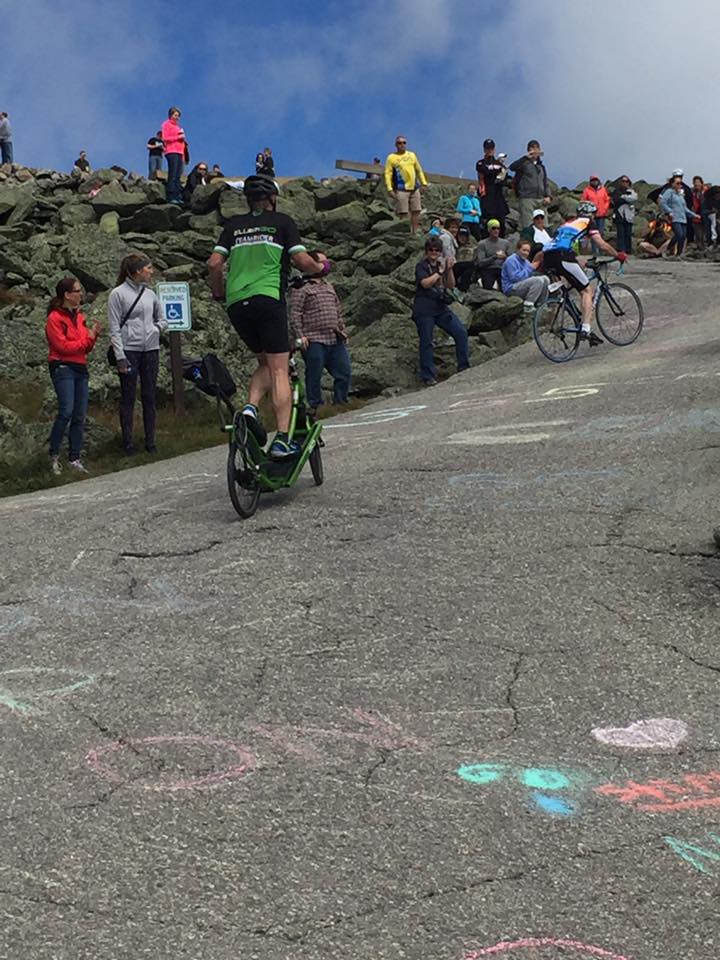
As you can see in this photo, I am almost to the corner, but shortly after this photo was taken, I had to dismount and walk before I got back on again and finished.
The other side of the above photo. This one by Joe Viger.
I finished the ride in 2:06:17 for an average speed of 3.6 mph. I am the slowest of all five people to have ever ridden up Mt. Washington on an ElliptiGO, so I will go with being the oldest and only ElliptiGO rider from New Hampshire to ride up that beast of a hill. Andrew Warby was the first finisher in 1:56:27 coming close to the record and riding at 3.9 mph. Jim Cremer finished in 2:00:49 before jumping back into his car for the long drive back to Iowa. It was a great day for riding and for the ElliptiGO riders, proving what a versatile machine it is. Here is a video I took of the start and then the final few miles. You can scroll quickly through it to get a feel for the climb. Sorry for the smudge on the camera lens! At 8:00, I lose concentration and almost veer over the side, at 28:00 I go flying by some hikers, and at 36:00 starts the drive to the finish.
Jim and I at the summit. We couldn't find Andrew for the photo.
He was already running all the way down the hill.
I am retiring from running and riding up Mt. Washington.
Next time up, I hope to go on the Cog Railway.
Lessons learned for future riders:
DON'T!
If you must, you will need to change your gearing. Talk to Keri at ElliptiGO.
I used a 130 chainring and a 20T cog, I have an eight speed. Jim and Andrew had 11 speed GOs so their gearing would be different. Jim Cremer says he used a 38 tooth chainring and the stock sprocket on his 11 speed. He used 1st and 2nd gear most of the time, with 3rd and 4th once in a while on the rare brief mini-breaks. Andrew used a 42 tooth chainring. It still allowed him to get some speed on the flats and he kept it on for several months prior to train with it as much as possible. Note, I tried riding on regular roads with my setup, but it was nearly impossible. All of my 8 speeds were too low and unless I was going downhill, I could barely get over 10 mph, no matter how fast I was spinning,
Make sure your ElliptiGO is ready for the challenge. Mine was not for the practice ride, and even with all the repairs I made, my rear wheel was still off a bit during this ride. I should have had a professional mechanic go over it.
I did not use a heart rate monitor. I was scared of my heart rate being too high due to the practice ride and also some rides up Pack Monadnock. I think I kept it in an acceptable place the whole ride, so I am happy about that.
You can never build momentum on this ride, if you don't move, you will stop!
I think it would be best to lose as much weight as you can before doing this ride. I was no where near my former running weight. My ElliptiGO weighs 42 pounds so that is a disadvantage when compared to cyclists, whose bikes weigh 1/3 to 1/2 of that.
I found that on my eight speed that in the lowest gear, I could not really get over 4 mph, but you need that gear where it is steep (and that is most of the way). The second lowest gear would keep me around 4 mph. The next higher gears did not get enough use, but when they did, I could go faster. There just wasn't enough time to keep those gears engaged.
I brought water, but did not drink it while riding. I would have to stop pedaling to drink and that would cause my ElliptiGO to stop or fall over. Drink a lot before your ride. Wear sunscreen, I did not, and got sunburnt a bit.
You cannot ride an ElliptiGO or bike down the hill. You will need to find a ride down. This is not hard. Jim and I both found rides down the day of the ride.
Here are three recommendations from Andrew Warby to anyone who wants to attempt the climb in the future:
1) Gear down to something that will give you a level of resistance you are comfortable with
2) Maintain an even effort
3) Do the practice ride the month prior. It will help you know what to fix.
First off, I was a bit disappointed that there would be no east coast ElliptiGO race this year to get me hyped up and training harder. The previous three New England races were a blast and got me in a competitive mode that I so enjoy and miss! I do understand that it takes a lot of work to put on a quality race and that things did not work out this year, so I had to find a new challenge.
Sure, I will be doing more centuries and trying to break the 6 hour barrier, but that is a different kind of intensity. I could go out to the Mt. Palomar ElliptiGO World Championships in the fall, but that is way out of my price range (although some year I hope to make it to the race). I started thinking it would be cheaper to do a race in my own back yard of New Hampshire and that would be to ride my ElliptiGO in one of the two bike races up Mt. Washington. Then I saw how incredibly expensive the race entry fees were. Further research showed that one of the two races, Newton's Revenge, would not be held this year, so that left the Mt. Washington Hill Climb held on August 20. Two ElliptiGO riders rode in the Newton's Revenge event in 2010 so if I wanted to bite the bullet and try out this race, I thought it best to ask first if I could ride my ElliptiGO before committing to the race and paying for the entry. I was told I would be OK for riding since it had been done before and that they would keep no official records- they also allow tandems and unicycles- with no records, but even better, they added an ElliptiGO category to the race- you can even see it on the entry form. With thanks, I sent in my entry fee and at least one other rider is joining me. I hope to see more this year as I am sure this will be a one-time deal for me and the more the merrier.
2010 Newton's Revenge results (unofficial ElliptiGO record held by Bryce Whiting):
I have two goals for the race:
1) finish within 20 minutes of my fastest run up the hill (who even knows if this is possible)
2) ride all the way up without stepping down off of my ElliptiGO.
I have ridden up Pack Monadnock twice now and it has a steeper section than Mt. Washington.
The first time up, I had to put my foot down as I was tired from trying to blast up it as a 10 mile "race"effort on the old Pack Monadnock Road Race course.The next year I made it to the top without putting my foot down, but it was terribly hard to keep moving and balanced on the steeper sections!
1996 Mt. Washington Road Race 76th place 1:22:23 nearing the summit.
I have been up the mountain many times before, mostly in the Mt. Washington Road Race. When I was about 10 years old, my family drove to the top and down in our 1962 Chevy 2 wagon that was falling apart. It was quite an achievement for that car.
Me Planning further adventures up the mountain 47 years ago!
Family trip to the summit in 1969.
People were astounded that our old 1962 Chevy 2 Wagon made it to the top.
But it did!
With my mom and siblings.
Cog Railway at the summit.
Summit view.
I am sure I will have to add some hills to my training and change my gears so I have a lower range for the steep climbing. Who know what it will bring, but it should be fun in its own crazy way!
My running times at the Mt. Washington Road Race:
1992 1:32:19
1996 1:22:05
1996 1:22:23
1997 1:33:08
2000 1:33:21
Then I got smart and stopped racing.
So now I have something to look forward to (or regret).
Photos from 2014 trip up Pack Monadnock: From FB post: Made it to the top of PackMonadnock on the auto road without dismounting my ElliptiGO (last fall I had to stop and walk a few seconds as I was riding as hard as I could to race 10 miles to the top and was puking up air before the real climb even started). The auto road is 1.3 miles long and gains 788 feet with an average grade of 11.9% and a max grade of 20+% (steeper than Mt. Washington, I have heard which is at 22% max and 12% average). It is a beast, but first I had to ride 30 miles to get there and then 30 back home.
For the third year in a row I made sure that I was watching the Great Edinburgh XC race in Scotland on Saturday morning. Number one, it is a great race to watch during the winter season: number two, they always have a top notch runner racing: and number three, the landscape and course is both beautiful and rugged. I fondly recall Edinburgh from my visit there in 1979. Having watched the two previous editions of this race, I knew that Garret Heath owned the course and I was interested to see how he would do against Mo Farah. I had a strong suspicion that he might just get the victory. The men's race was exciting and Garret Heath did pull off the upset for his third win in a row. The previous wins were on a shorter course.
Here is a video of the last half of the men's race. You can watch full race replays here.
Jae Gruenke at the Balanced Runner has an interesting discussion about the running form of the top athletes at this race and some slow motion video that she recorded. You can check it out here.
Here is her video of the top men:
A story from the summer involves Garrett's brother Elliot, who is also a top level runner. I noticed on the ElliptiGO Stava mileage board in August that Elliot was posting some massive and hilly rides on an ElliptiGO (must have been injured) He did a couple of weeks of over 250 miles each in August, if I recall, and may have led for most mileage on an ElliptiGO for those weeks. I was already anticipating doing a 300 mile week and I was checking to see if I could maintain my ElliptiGO mileage lead throughout the week. You never know types of massive rides an athlete might do each week and it is usually on the weekend. I got up over 300 miles and had a good lead, but Elliott wasn't posting so I didn't know if he would hook up his computer at the end of the week and beat me. I ended up with 350 miles for an easy lead. Elliot never posted much mileage that week. He never knew I was competing against him! All that I knew was that if I was GOing 350 miles, I did not want to rate second in total miles!
The good news about this year is that I started what I hope is a small running comeback at the end of 2015. My heart never strays far from my love for running, but I have developed one rule since my many painful attempts at coming back post hip surgery in 2011. That rule is to not run if it leaves me limping the next day or sore in my hip joint. Over the past two years, I keep making attempts and each attempt would end up with me limping and frustrated. In 2014, I only totaled 88 miles of running and this year the grand total was only 66 miles. I did hit two running goals this year. I ran a 7+ mile run on my old favorite route (I could do it, but ended up limping), but that was to get my mind set to run while I was in Kenya and I did do a 4 mile run through the Kenyan countryside in July. Other than that my running was going nowhere. That is until I came up with a new thought and plan. I wondered what would happen if I ran uphill on the treadmill? So a couple of weeks ago, I tried it out, setting the treadmill at 5% and then running. My stride is shorter and my cadence is slower going uphill and my joints don't take as much of a pounding. I found I could do two to four mile runs like this easily (but slowly) and for the past two weeks I did 1/3 of my mileage total for the year running two double digit weeks (11 miles and 10 miles). I get tight the day after these runs, but not in the hip joint so all is good. I hope to continue this uphill running while increasing the pace and lowering the elevation. I did do a four mile run outdoors last week that I survived according to my rules.
Who knows where this will lead? Might I do some snowshoe racing this winter, uphill mountain runs, Mt. Washington, regular 5ks? Another reason I am being more successful at this comeback attempt is I am learning which stretches, band distractions, and mobility drills work best on my hip and other misaligned parts of my body and when they work best.
The close finish with Jeff Caron at the Spring Classic
On the ElliptiGO front, I noticed last night that I needed 11 more miles to hit 6000 miles for the year. I just had a tooth extraction and implant under anesthesia earlier in the day, but I hopped on my ElliptiGO (on a trainer) and got those 11 miles in. That is 215 miles less than the previous year, but I did have two bouts with kidney stones and the past month I have been dealing with a tooth infection and those have slowed down some of my riding. I have totaled over 15,000 miles on my ElliptiGO in the 2 1/2 years I have owned it. Can I mention what a great machine it is!
I rode a total of 350 miles one week in August and did three century rides in September and won the ElliptiGO Spring Classic after having one of the most thrilling battles in all my years of racing! I have now won all three EllitpiGO races in New England over the past three years. It has been mentioned that this year's Spring Classic will have a new location and might be over the 1/2 marathon distance. This year I was also honored by ElliptiGO as one of their Riders of the Month (interview here). I love my ElliptiGO for allowing me to keep moving, training, and racing even though I can no longer run!
This year, I hope to have a great race at that new ElliptiGO Spring Classic, hit another 6000 ElliptiGO miles, get under 6 hours on my ElliptiGO for 100 miles, and to see where my running comeback takes me (my goal as of now is just to run over 10 miles/week for as long as I can without any hip problems and see what happens). I hope everyone else had a fulfilling 2015 no matter what your sport and for those fighting injuries: never give up!
One thing I noticed the other day is that Amazon now sells the EllitpiGO. I would rather GO through a dealer, but it is good place to read reviews. The Arc is not on Amazon.
According to this tweet ElliptiGO is coming out with a new version of its bike. It looks like it is still under wraps, but there are some clues in the photo that lets you know this is not the same ElliptiGO model that is sold today. I noticed right away that it doesn't seem to have the drive arms protruding above and beyond the rear wheel.
I am no expert on what ElliptiGO is going to unveil, but I have heard rumors and have had discussions and my guess is that it will have a lower price point by having not as long a wheelbase and not as long a stride (or even the same motion), so it will have slower speeds. Maybe it will be a beginner or introductory machine for those who think an ElliptiGO is too expensive (and who may move up at a later time to the current models). Maybe it will be more a training or supplementary machine for those who won't GO as many miles, but could use one when injured or to cross train without so much of a commitment . I am very excited to see this as many people balk at purchasing an ElliptiGO due to its price. A lot of the cost of an ElliptiGO does come from its quality components and that long wheelbase is something that, I am told, adds greatly to the cost of the machine. It will he interesting to see what this is when it is revealed. If you want to know more, you can sign up here with ElliptiGO to be notified. It does say you have to wait a few more days, so it could be soon!
One thing I noticed the other day is that Amazon now sells the EllitpiGO. I would rather GO through a dealer, but it is good place to read reviews. The Arc is not on Amazon.
Last month as it was getting darker earlier and earlier, I often found myself racing the darkness home on my ElliptiGO. I decided I needed to be safer in those moments and see if I could extend my riding in the dark, so I broke down and bought some bike lights for my ElliptiGO.
After much research, I still wasn't sure which lights to buy, but I ended up with the NiteRider Lumina 550 Headlight. It is a a model between the two NiteRider models recommended on the ElliptiGO site. It is charged by USB and it can blink as well as have a steady beam of light at three different intensities. I was amazed by how much it lit up the the road and felt completely safe riding in the dark with this light. On the ElliptiGO you want to place it as close to you can to the midpoint of the handlebars so the beam isn't angled out to the side. The rubber band holding it to the bar is easy to set up and holds it securely. The on/off button glows blue when it is in use and red (as I found out today) when it needs recharging, but I still rode for 30 minutes more and got home without losing light. Riding at night opens up a whole nother world!
I would have been happy trying the NiteRider Solas 40 Taillight as well, but wasn't assured that it was easy to attach to my ElliptiGO. On a friends recommendation, I bought the Light and Motion VIS 180 Degree Micro Bike Light and quite easily attached it to the rear reflector. I secured it with some Cable Ties so that it didn't fall off unnoticed by me. This light works great and can also blink. It is also easy to recharge by its USB plug. I noticed cars going wide around me as I rode in the dark and I guess that is the desired outcome! I also bought a cheap clipon Nathan Strobe Light to put on the back of my shirt or jacket as I ride. It gives extra protection and it can also blink or give a steady light. Now I am in full nerd mode, but I am much safer and can ride longer while I add another dimension of fun and experiences to my riding!
September was the month for centuries. For three straight weeks, I rode a 100 miler on my ElliptiGO. I started with the Ride for Angels century which was held on September 13 and started in North Andover, MA. It would travel through Southern New Hampshire and Northeast Massachusetts. It was hillier than I had imagined and we had some wet roads in the morning and mild rain later in the ride. I had a brake pad that was rubbing and my chain dropped off twice. Not only that but I went off the course and up one of the bigger climbs of the day before turning around and getting back on course. I hit the 100 mile mark in 6:35 elapsed time. I try not to stop except to fix problems or to navigate.
A week later I rode the Charles River Wheelmen Fall Century. This one passed through some of my training routes. It was hillier than the previous week, but I felt real good except for the last three miles. My elapsed time for 100 miles was 5 minutes slower than the previous week, but this was a tougher course with all the climbing.
Six days later, I rode the Tri-State Seacoast Century. This was my third year doing this ride (2014 and 2013) and this year the chilly wind was blowing in the opposite direction. The first half of the ride was riding into the brisk wind and the return trip was supposed to have more of a tailwind, but the course was more sheltered and this was my slowest of three tries at this century. My elapsed time was 6:46 for the 100 mile mark. I guess this is not the year I go under 6 hours. Doing it the way I ride them, without stopping for rest stations, is a tough way to GO 100 miles. The effort is similar to running a marathon and you go through the same draining of energy near the end.


 My biggest fear for Sunday, was that I might sleep in and miss the start, but I got there on time to meet fellow ElliptiGOer Steve Lecours, who I was planning to ride with, I did arrive on time and it was a chilly and windy morning again. Right before starting, I noticed my brakes were a bit off and then noticed my rear wheel nuts were also loose. I attempted to fix things and then Steve and I were off on the initial 17 mile loop through Massachusetts. I felt pretty good, but my ElliptiGO felt tight and I was having a hard time keeping pace with Steve. I chalked it up to the previous day's ride and the fact that I hadn't warmed up yet. At the end of the loop, I stopped to look at my chain and sure enough, I had tightened the rear wheel which had tightened the chain so that there was absolutely no slack in it at all. I loosened things up and hoped for better.




 . It is a a model between the two NiteRider models recommended on the ElliptiGO site. It is charged by USB and it can blink as well as have a steady beam of light at three different intensities. I was amazed by how much it lit up the the road and felt completely safe riding in the dark with this light. On the ElliptiGO you want to place it as close to you can to the midpoint of the handlebars so the beam isn't angled out to the side. The rubber band holding it to the bar is easy to set up and holds it securely. The on/off button glows blue when it is in use and red (as I found out today) when it needs recharging, but I still rode for 30 minutes more and got home without losing light. Riding at night opens up a whole nother world!
 as well, but wasn't assured that it was easy to attach to my ElliptiGO. On a friends recommendation, I bought the
  and quite easily attached it to the rear reflector. I secured it with some
  so that it didn't fall off unnoticed by me. This light works great and can also blink. It is also easy to recharge by its USB plug. I noticed cars going wide around me as I rode in the dark and I guess that is the desired outcome! I also bought a cheap clipon
  to put on the back of my shirt or jacket as I ride. It gives extra protection and it can also blink or give a steady light. Now I am in full nerd mode, but I am much safer and can ride longer while I add another dimension of fun and experiences to my riding!


