Wednesday, July 7, 2010

Working the Insoles

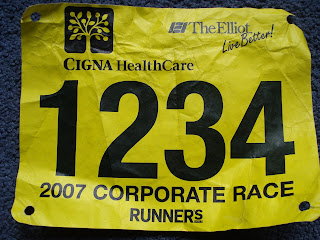
Those CIGNA 5K race people are mocking me! I am sure. I was checking out their race app/brochure and noticed the picture they used to showcase their new timing system. They used the number 1234. If you want to read the strange and unusual things that happened to me when they gave me the unlucky number 1234 a couple of years ago, check out this true story.


After one week of running with the insoles for functional hallux limitis, I have had mixed results. They feel great standing and walking and are absolutely awesome when riding my bike and kickbike. I do struggle to run with them. They feel good, but they slow me down. I feel like I am running in sand with all the support that I am not used to having. My legs and feet definitely need more time to adjust.

Last week's running
Mon. Mine Falls 5K Trail Race 20:18 (used cut-out insoles-hips were O.K. but lost balance a few times)
Tues. Lowell Classic T-Shirt night 19:55 (used brand new insoles that I got in the morning)
Gotta work on my race wardrobe! But at least I am ahead of Fil Faria, for a bit, who keeps beating me (usually by one place-twice a week!) I forgot to wear an old t-shirt. I was going to wear a 1981 Lowell Oktoberfest Marathon shirt (if it still fit).

photo Ted Tyler

Wed. Track night 6 miles including 2 X 2miles (hip was tight something like 12:15 and 12: 48) last one I almost quit after 1 lap as my hip hurt and I had a hard time moving-but I made a comeback.
Thurs. 8 miles slow with insoles
Fri. 8 miles slower with insoles but felt great otherwise.

Took out my Kickbike for the first time all year and did 8 miles (stride felt great-foot plant was excellent with the insoles),

then took out my Centurian Cinelli Equipe racing bike from the mid-80's- a great friend with all the miles and racing we did together) for another 8 miles (again felt great- I have never been able to get my left foot comfortable on a bike- and with the same setup of cleats and saddle I keep trying every year or two but it always feels off and hurts my foot and I can't balance on the saddle correctly-this time it felt excellent with the midsoles-my left leg was aligned, had power, and I could sit properly on the saddle-wow- that has never happened before even before when I started biking),

then I took out my mountain bike and did 8 miles including the trails off Gilson Rd.,

I was going to ride my black K2 but some spokes were broken (I have less than 50 miles on this bike-got it cheap-everytime I ride it something is wrong),

I didn't ride my Cannondale Triathlon bike but I need to get it cleaned up to sell.

I was still feeling fantastic so I took out my Kettlebell and worked the rest of my body. It was a great day playing with all my toys. I love days like that, but they are rare to find any more.
Sat. 8 miles- really slow-I knew I'd be sore-but my stride is real short and I ran 1 1/2 minutes per miles slower than a good day.
Sun. no running 14 miles of biking
Monday- heat! MineFalls 5K trail race 21:19 ouch. Started off great, had a hard time staying out of the lead, then my left glute spasmed up at about the 3/4 mile mark, making it hard to run for 1/4 mile or so and then it was a sort of limp home to the finish.

photo Steve Wolfe

Tues. Real hot 90+degrees! Reverse the Course 5k in Lowell 20:28. I was giving my feet a rest today from the insoles and decided to try the Cluffy Wedges in my shoe. I ordered these before I got the insoles for FHL and when they arrived I had put them aside because they came the same day I got the insoles. They work in a similar way by putting a wedge under the big toe to allow the 1st MTP joint to work. Unfortunately, after I entered the race I started to warm up and my left glute was still tight and sore from the previous day. I was limping and couldn't run. I did some quick  Postural Restoration stretches to readjust the left hip and stretched the quads a bit. This seemed to help. I got a good start in this race. Felt OK with the Cluffy wedges-more normal but my feet were beat up a bit and my right toe joint began to really hurt again after doing much better with the insoles.


photo Mike Stanwyck

I had another ART appointment today with Dr. Baroody. I explained how tight the muscles all around my hip and pelvis were: from the insertion of the hamstring to the muscles all around the hips. He gave my 5 dynamic flexibility exercises to do and will give me more stretching exercises next visit. There is so much readjustment being done that the muscles seems to be getting tighter and tighter almost like they are trying to protect my  hips from moving, so we'll see how that goes.


Friday, July 2, 2010

"The Gait Guys" Offer an In Depth Report

As soon as Dr Baroody mentioned that I had a condition called Hallux Functional Limitis and an inverted heel, I went online to find out everything that I could. One place that I went to was "The Gait Guys" website.
THE source for progressive and innovative gait analysis, performance and rehabilitation information.


I embedded one of their videos on  my post on inverted heels, but I had a question, so I asked it in their forums.  Dr. Ivo Waerlop, one of the Gait Guys, was kind enough to repsond and gave a pretty thorough and technical observation of what he saw going on with my feet and legs based on my videos. It is nice to give names to what I sensed was going on, even though I didn't know what it was called that made my feet and legs "not the norm". I guess it all started going awry as I was developing before I was born. Thanks Mom! He then goes on with more descriptions after observing pictures of my feet. I guess my feet and stride are even curious enough that they may make a teaching case from my videos and photos.

I do know one saying that I really dislike and I have heard it constantly in one form or another from my earliest days of running. It goes something like this, "Running is 10% physical and 90% mental." I always think that this quote is very wrong in implying that good running is basically a case of who is the strongest mentally. I would disagree, you  need to be born with a good set of wheels if you want to be good! Everyone does not start out on equal footing (or with equal feet). It is what you do with your wheels that forms the mental part.

I appreciate Dr. Ivo's responses and look forward to seeing what I can still do to improve my mechanics and functioning. That along with  the quality care I am now getting from Dr. Baroody and the insoles from Dr. Dananberg might mean I may be able to get a few more years out of these legs, and hopefully do so with an improved economy and efficiency.

How are the new insoles going? I got them Tuesday and wore them all day. I ran the Lowell 5K about 20 seconds slower than the previous week, but once I started running my left sacrum started seizing up. Wednesday I wore them again all day and at the track my left glutes were really stressed and sore. The workout was a struggle as I think my left glutes were starting to do work for a change. This is the side that the PT said my glute medius was very week on, as well as my hip flexor being tight and weak, and so I was using my TFL to compensate. Well these muscles were getting really sore, particularly the glutes. This morning it was again tight and sore. I ran 8 miles slowly. I almost turned home after 100 yards as it was difficult to move. Halfway through the run, things loosened up a bit. My feet seem to be very stable on the ground and my toes appear to point straight ahead. I don't have as much twisting and turning. I noticed that my feet roll across the ground and after awhile I realized that I was extending my leg behind me more and actually getting a push-off. I had another ART treatment today that worked on the muscles that had tightened up in the hips, back, and noticeably the hamstrings, so I hope things start settling down and working together for an improved stride.

I do like this video, "What Can The Single Leg Deadlift do for you?" that Frank Snideman posted here. The forum discussion where I found it is here. I think it can be very important for my strengthening at this time and I find it much easier to do these types of moves with the balance that is restored to my feet with the new insoles.

Wednesday, June 30, 2010

Functional Hallux Limitis

Functional Hallux Limitis. That is the name. Hopefully I have the fix. I have been trying to get my hip, back and stride fixed for too many years. I now have a name for what has been causing my imbalance, form, functioning, and pain problems. I have to give kudus to Dr. Baroody for identifying the problem. Well, actually I believe it was identified 20 years ago, but I did not understand the issue and could not afford the treatment. Twenty year after seeing Dr. Dananberg the first time, I went back again yesterday. He also identified the Functional Hallix Limitis and fit me in a pair of the Vasyli-Dananberg insoles specifically engineered for FHL. The product is named after Dr. Dananberg as he is known worldwide for his work with FHL.

Named among the most influential Podiatrists in America by Podiatry Management Magazine, and is a founding member of the new Vasyli Think Tank™.


Howard is renowned for his work in the development of the concepts associated with Functional Hallux Limitus. His published articles on Sagittal Plane Biomechanics, his patented Kinetic wedge and work on gait-related back pain is recognized world wide.
Here is a great article which explains FHL, the compenstations the body "invents" in order to "work", and how the insole restores proper function. Dr. Dananberg did not really discuss FHL with me in detail, but fortunately I had done my homework so I knew what he was talking about and referring to as he checked out my feet.


The good news is that he feels that this is treatable with his insoles and I can decide later if I need a more specialized pair of orthotics built up for me. He wasn't worried about the pain over my right big toe. I have had this for about four months now after every run and I was worried that my toe may be going to a more rigid diagnosis that usually leads to surgery. I was very much  thinking he might end up telling me my running days were over. He was not concerend with this at all which puts me at ease. He also said the inverted heel is probably a result of the FHL and things should improve. I am thrilled and hope the insoles really work. They do feel good (they were heat-molded to my feet) and the cutouts and shape very much give my feet balance when standing and certainly let my feet "roll" forward as I run. They are not miracle workers as I used them in the Lowell 5K race last night and was about 20 seconds slower than the week before, but if they allow me to run without the imbalances (over time) then I can get my mileage back up and my race times down. Most important I want to get my running stride back so that I can enjoy just running again instead of trying to constantly figure out what is wrong and how to fix it.

With FHL, the first metatarsal joint does not function correctly. The 1st MTP joint is the joint leading to the big toe. When you stride forward all of your body weight is supposed to hinge forward over this joint and it is suppposed to support your foot and body and raise your heel through the gait cycle (or this is how I understand it). Unfortunately if you have FHL the 1st MTP joint cannot do its job and the body attempts all sorts of compensations to try to correct itself. I have noticed this problem through the years and explained what I thought was happening in my foot to many experts, but I guess no one was informed enough on this condition until Dr. Baroody identified it. I have tried many remedies on my own because they "seemed" to make sense such as cutting out an insole under the 5th (little toe) joint to try to balance the bottom of my foot or running with wedges under the 1st metatarsal and big toe to try to give them support so my foot wouldn't  cave in.  My intution was correct, but maybe not the remedies! With the new insoles an area is cut out underneath the 1st MTP joint which allows it to descend so that the 1st metatarsal head can plantarflex which allows the 1st MTP joint to dorsiflex.

I think what this means is that with the insole my feet can now support my stride. With FHL your 1st MTP joint cannot work properly and so your toe cannot get involved with the stride either. My main compensation on the left foot was that the 1st MPT joint would collapse on contact with the ground giving me no support. The foot would then severely pronate over the toe and evert my foot out to the side throwing off my stride and giving me the constant hip and back problems. On the right foot the pronation wasn't as pronounced, but the joint and toe still weren't doing their job as the toe would stiffen up when bearing weight and again giving me no push off. Dr. Baroody also explained that this is why I have a mutlitude of stiff muscles. That is bad, but it was somewhat good as my body was doing whatever it could to achieve a running stride and protect itself and make itself work in my own unique way. Besides the ART treatments for my muslces, I am hoping that the insoles will take the stress off many of my overworked muscles and allow them to release and function properly.

Dr. Dananberg's article describes walking with FHL as akin to walking with swim fins on your feet. Since the body can't properly go forward with the fins on, it is like stepping upwards with no propulsion forward or a mechanical stride. He suggests four compensations that the body will do to achieve a gait. One, a midfoot collapse with delayed heel lift (the PT did say that my left stride was slower than my right- this is the side with most of my symptoms). Number two is an absence of heel lift during single support phase that can lead to balance problems. Three is inversion compensation (I not sure if this is similar to the inverted heel that Dr. Bardooy suggested). The fourth symptom is abducted compensation. As Dr. Dananberg descibes, when the forward motion over the toe joint is blocked then the foot will find the least path of resistance in order to move forward, So the foot pronates and twists and the effects of that go up the alignment of the skeleton. I certainly hope that the insoles do what they are supposed to do and my body starts fixing itself. My feet feel "strong" under the metatarals for a change once I put them in my shoes and my left hip also felt stronger and in a better position. Let's hope that those are good signs.

Dr. Dananberg also did some manipulations of my feet and ankles to restore lost motion and free restrictions. In these videos he is seen doing similar manipulations and other manipulations. These are to be done by an expert, I am only showing them because they are interesting.


Saturday, June 26, 2010

An Olympian gets Stretched using Resistance Stretching


I was doing some resistance stretching last night (something I haven't done in a while) in order to to work on my tight quads. When I was done, I checked out the resistance (or meridian) stretching websites (again something I haven't done in a while) and saw a video I hadn't noticed before on Bob Cooley's Meridian Stretching site. I think there are three variations on doing resisitance stretching: one is self-stretching, one is getting stretched by a stretcher, and the other is this wild looking stretching where a bunch of stretchers work on one athlete like he or she is a human maleable pretzel. I have seen a few videos online of this type of stretching before (most notably with Olympic swimmer Dara Torres) and it always looks visually fascinating . The new video shows Olympic speed skater Nancy Swider-Peltz Jr. getting stretched before the Vancouver Olympics.


I don't know Nancy Swider-Peltz Jr. but I watched her in the Olympics (her Olympics blog). By the time I started attending Wheaton College in 1977, her mom Nancy Swider was a student at the school and already an Olympic speed skater (seventh in the 3000m at the 1976 Innsbruck Games) and had set a world record weeks after the Olympics. Her dad Jeff Peltz was a football player who lived a couple doors down in my dorm one year. Her mom went on to participate in 4 Olympics, and I always marveled when hearing about the many hours she spent in daily training to be an Olympian. These were the days before my college (and many schools) even had a women's cross-country team. Women were just breaking into sports and  here was a world class athlete doing unheard of things with incredible discipline and drive. This was also before the time of cross-training being fashionable (in fact it wasn't even a word back then) so besides all the speed-skating and drills she did, she sometimes ran with the cross-country team,  swam on the swim team, and she biked.  It certainly was eye-opening for someone like me who thought that running was hard work to see someone so intense in athletic ambition and ahead of the times in training ideas. I also have never seen a lady with stronger looking quads in my life!

Here is a blog post interviewing one of the stretchers working on Nancy Swider-Peltz Jr.

Here is one of my posts on resistance stretching that includes links to many other posts.

I also noticed that Bob Cooley's Meridian Stretching site has listed classes at his Boston studio to learn and practice self-stretching. I may have to try going down sometime. I have three videos on resistance stretching, but it would be good to get pointers. The classes are only $20. I went to a stretcher once and it was great to get worked on, but it was ridiculously priced (unless you were extremely rich, it was too unaffordable no matter what the benefits). Here is my post on that experience. I would have loved to have done more, but I am not ridiculously rich.

Wednesday, June 23, 2010

An Opportunity Missed?

Twenty years ago, soon after I moved up to Nashua, someone recommended to me that I visit a podiatrist named Howard Dananberg. He was noted to be a top notch podiatrist and I was having terrible back problems from my 5 years in triathlons. I went for an initial visit, but it was going to cost over $1000 dollars further and I could not afford the price. I went to a local podiatrist instead who refurbished the old pair of orthotics I had used off and on with no success for about 5 years. They still didn't do much for me after that.

I recall Dr. Dananberg telling me something was wrong with my forefoot, but I can't recall what it was. He taped up my feet in a special way and I ran great for a couple of runs until the tape fell off. Still, I could not imagine how the front of my feet and the way they lined up could possibly affect my left lower back (and no way to research online either). I have since seen Dr. Dananberg's name repeatedly over the years in all sorts of studies and references. He is a very well-known podiatrist. I have often wondered what would have happened if I could have afforded those orthotics and recieved his care those 20 years ago.

I tried orthotics again a little over 10 years ago. That did not go well either. While they were comfortable, they seemed to make my "supposed" leg-length difference worse. Even a local chiropracter was speechless when he tried to x-ray me with and without the orthotics. When I put a heel lift in my right shoe under the orthotic, the x-rays showed the right leg getting shorter. He could not figure it out. Two months into wearing the orthotics, I ran the Cape Cod Marathon. My legs felt balanced only when I added a heel lift to the right shoe, and by then I had over 1/2 inch of extra lift under the right orthotic, and my back couldn't handle the stress. I was holding my right lower back rigid and tight the first 16 miles of the race. Then I grabbed a drink of water and relaxed, immediately my back went into severe spasms and I was out of the race and running for many days. That was the end of wearing those orthotics!

I have tried the minimalism thing for the past few years, but there is still something wrong with my feet, hips, and back. When I first went to Dr. Baroody (the ART doctor)last week, he said that both my feet have "functional hallux limitis" and my left foot has an inverted heel. I have been trying to research both of these issues. I can't find much on the inverted heel, but there is a lot on functional hallux limitis. The other day I googled Dr. Dananberg's name to see if he still practiced in the area and found out that...

"Howard Dananberg, is renowned worldwide for development of
the concepts of Functional Hallux Limitus and the relationship of
gait style to Chronic Lower Back Pain
."

I found a very recent video where Dr. Dananberg describes this condition in an easy to understand way.


I also noticed that there is an insole which is named after him that is supposed to manage the condition (see video). I decided to call his office to see if they sell the insole "off the rack". I explained that I had been in 20 years earlier and the price I was quoted (that I could not afford). I was told that at that time Dr. Dannanberg probably wanted a specific and costly gait analysis done and that he doesn't need to do that anymore. When I asked about current pricing, it was like $120 for an initial visit (comparable to 20 years ago)and that the insoles would be about $150 unless I needed some posting done. Different orthotics would be about $480. That is not much more than the orthotics I had 10+ years ago from a no longer remembered podiatrist. Well, I missed the opportunity 20 years ago and I am not going to do that again when I have one of the most well-regarded and innovatice doctors in the field just miles down the road. I have an appointment set for next Tuesday.

I am still getting ART treatment. Dr. Baroody viewed my videos and saw "lots" of things. Well that wasn't hard to do. He has worked on my tight hip flexors and has now started working on my tight glutes and hamstrings. The funny thing is, I keep reading how ART treatment is supposed to hurt. Just like with the last ART doctor I went to, I barely feel anything but the pressure of fingers. There is no pain and I was watching Dr. Baroody as he kept looking at me in surprise. He was sure I would feel something on some of those muscles, but there was no pain at all. Oh well, that is fine with me!

I did cut out a section of under the first metatarsal on a pair of Dr. Scholls generic plastic insolesas Dr. Baroody suggested. I ran in them Friday for 8 miles as soon as I cut them out (probably not good- I know) and they changed my stride some and fatigued the hip in a different place, but I did not like the high arch on the insoles. I ran 8 miles the next two days, and they made me run slow and I felt real awkward. I stopped wearing them as my whole left side was now messed up and it felt like something was pinching. I ran the Mine Falls race Monday night without them and my left hip was stuck. I ran 20:24. After an ART visit Tuesday morning things felt better. I ran with the insoles in my light Puma K Street shoes in the Lowell race. That felt a bit better and I ran 19:33 for an easier course. My hip wasn't stuck, but muscles were not balanced properly.

Here are some of Dr. Dananberg's artices that relate to Functional Hallix Limitis from the Vasyli Think Tank™ and the insole company.

Here is a Carson Boddicker article on "Mobilizing the Big Toe" and a video.


Here is a Gary Moller video on mobilizing the big toe. He is the older brother of Lorraine Moller, one of the great female marathoners (Olympic medal, BAA Marathon win, ect.)

Tuesday, June 22, 2010

Running Drills for Barefoot Runners

Matt Meztgar posted this video over at his blog. The Tera Plana people first show how barefoot running changes your footplant in this video,but what I liked about the video is that it demonstrates that even barefoot runners have to improve their posture. Barefoot running doesn't do that on its own. Some unique and interesting drills are demonstrated that show how to correct faulty posture. Matt always has some interesting and thought provoking posts. He is currentlly starting to run barefoot on pavement. He thinks this is even better that running on soft surfaces as it helps you land correctly. He is taking me to task a bit for moving towards more substantial trainers in my running, but I have to see what is going on with my feet and what I can do to best correct them before I go back to trying barefoot running. The video is excellent though and the drills seem very interesting. I'll have to give them a try.

Learning the Skill of Barefoot Running from Terra Plana on Vimeo.

Saturday, June 19, 2010

Inverted Heel

I am putting up a few posts basically for myself as I try to figure out things I am learning about my feet. In this way I can check back and see what works and doesn't work and keep track of my thinking. Please skip over if you are not interested, but sometimes people find my stuff on the web and offer really good suggestions or are also looking for similar answers to biomechanical issues.

Last night I posted what I am learning from the Active Release doctor who I am currently working with. My left foot is a problem foot and he gave words to the strange things that my foot does that affects my stride, hip, and back.

Basically he said the left foot has an inverted heel, which causes the foot to suppinate and then I have something called functional hallux limitus which means the forefoot goes into a severe pronation because the bog toe and metatarsal do not work and contact the ground correctly. Thus I have problems.

Here is what I have found on inverted heels (besides some crazy dance step). It comes from Carson Boddicker, whose blog I have been reading for the past few months (see "My Blog List" to the left). He gives some exercises and drills (some using a wedge that I have not tried as I am relying on the therapy I am undergoing now).

Following ankle injury, a positional fault is often observed in subtalar joint position, which is locked into inversion known as rear foot or subtalar vars Rear foot vars is when the position of the foot is inverted relative to the ground in subtalar neutral.

Given the body’s remarkable ability to adapt, it can attempt to shift the position of the talus to compensate for an inverted calcaneus. In observing the rear foot, a compensated rear foot vars will appear perpendicular in subtalar neutral but averted in standing (left). Uncompensated, it will appear inverted in both ranges of motion (right).

With the subtalar joint in inversion, the foot must pronate more to clear the heel from the ground. Once clear, the foot is forced to rapidly supinate to be effective in propulsion, creating a whip-like effect, which has been implicated in Achilles’ tendonopathies. Additionally, the first ray of metatarsals becomes an inadequately stable base for propulsion (remember the joint by joint approach) and the big toe begins to lose mobility.

Finally, remember that the subtalar joint translates this rotation (pronation) to the tibia and the tibia translates rotation higher in the body. Excessive relative internal rotation of the foot, tibia, and subsequently femur can cause femoral head position changes and scarring of the deep hip rotators. This can ultimately lead to a grab bag of pain and pathology of the knee, hip, and low back.

I don't know if this is an accurate description of half of my foot's problems, but it sounds right.

Next up is an excellent descriptive video from "The Gait Guys" which descibes rearfoot varus, which I think is the same thing as an inverted heel.


Finally, I am putting up (hate to do this) some videos the chiropractor wanted of me running. It shows my stride Tuesday (after one day of ART treatment) and after an 8 mile run. It shows the weird things my left foot and leg does even at a slow jog. I would guess it looks much worse at a faster pace.


Now you can see why running is so much fun for me!

Here's a link to the stretches for my feet and ankle that the chiropractor says I should do. The first is pretty much a Z-Health Toe Pull. I now have better informed instruction on how to do it. The tops of my toes are really stiff.

Now about jammed joints and how I seem to get relief from hip problems when the joints in my feet are mobilized. Here is a video on the arthokinetic response showing how a jammed foot joint affects the glute medius muscle (the muscle that the postural restoration therapist said was one of my weakest muscles on the left side).


I also posted about Z-Health and jammed joints here, where Dr. Eric Cobb (Z-Health) demonstrates the affect of jammed joints here. Mike T. Nelson of Extreme Human Performance (blog on my list to the left) wrote about jammed joints here.