For the fourth year in a row, I participated in the Tri-State Seacoast Century, but this year I changed things up. During the 2013, 2014, and 2015 versions of the event, my goal was to try to go sub 6 hours on my ElliptiGO which meant that I did not stop to eat or drink and only used what little that I carried because I was counting time as elapsed time. This resulted in some really hard core EllitpiGO rides that left me having some pretty interesting final miles. I also realized, I might never break 6 hours on this course with the winds that you get along the coast and the traffic problems that are sometimes encountered. This year, I decided to have some fun and enjoy the ride (or should I say rides) as I wanted to try doing the century ride on both Saturday and on Sunday.
Nubble Light house - the halfway point
For Saturday's ride, I was supposed to ride with Andrew Warby, but he was held up by work and I went solo, although I did see Andrew later out on the course. The early morning start was cold and I was wearing gloves until the first aid station. The wind was similar to last year's ride as it was more in our face going out. I am glad that I wasn't going for time as I was stopped twice at the drawbridge in Portsmouth for about 10 minutes each time both coming and going. I was happy to finally stop at the food and aid station both times and let me tell you that drinking lots more fluids and eating food on a century ride makes the final miles of the century much nicer,
See, I stopped to sight-see a bit this year!
Nearing the finish of the ride at about 85 miles, a rider in front of me was taking a left turn. I watched from about 30 feet behind him as he slid down to the ground like he had taken the turn too sharply and slid on some sand, There was no sand, however, and he remained down. I realized quickly, along with the other riders who were behind me, that he was stone cold knocked out. Strangely, I am pretty sure that he didn't even hit his head on the ground. His body was twitching and his eyes were staring and opaque. He was not responding and someone had called 911 and then handed me the phone since I had seen him go down. For about 3 minutes he was completely out and not responding. I was asked to count his breathing (which frustrated me at first until I realized I shouldn't be looking at his mouth, but at his chest). He was a 62 year old male named Tim and he had a medic alert bracelet on that let us know that he had no major health issues. After about 3 minutes, he started stirring a bit. When the ambulance came after about 5 minutes, he was just starting to respond. He told us when we asked him how he felt that he felt great! He could not remember what had happened to him. I left after the ambulance and fire trucks arrived and assume from what others have said that he might have had a heart attack or some other heart issue. The guy behind me said that it looked like he might have been out before he even hit the ground. I hope that he is fine and recovering. Update: I heard back from Tim and we are from the same town, He broke his collarbone and rib, but did not have a heart issue. He thinks it may have been a seizure of some type that blacked him out. Like a true athlete, he said that he was looking forward to getting on a spin bike and riding again.
Once I finished the course, after following the GPS route map and marks on the road, I realized that I must have missed some circuit somewhere as my mileage was not quite 100 miles. I did miss turning on my GPS a few times, but didn't miss that many miles. Everyone else I talked to seemed to miss hitting 100 miles too!
My biggest fear for Sunday, was that I might sleep in and miss the start, but I got there on time to meet fellow ElliptiGOer Steve Lecours, who I was planning to ride with, I did arrive on time and it was a chilly and windy morning again. Right before starting, I noticed my brakes were a bit off and then noticed my rear wheel nuts were also loose. I attempted to fix things and then Steve and I were off on the initial 17 mile loop through Massachusetts. I felt pretty good, but my ElliptiGO felt tight and I was having a hard time keeping pace with Steve. I chalked it up to the previous day's ride and the fact that I hadn't warmed up yet. At the end of the loop, I stopped to look at my chain and sure enough, I had tightened the rear wheel which had tightened the chain so that there was absolutely no slack in it at all. I loosened things up and hoped for better.
Steve and I kept a good pace, but I was definitely working very hard to just stay in contact. I wondered if it would be this way all day or even if I could finish. Approaching the Nubble Lighthouse, I finally figured out how I felt. I pretty much felt like you do during a marathon between miles 16-20. I was tired and tightening up, but I could still hold a decent pace. The question was, would I fall apart at this pace and blow up or would I be able to maintain. Fortunately, the answer was that I could maintain. The second half felt better the closer I got to the finish. I never really had any snap or pop in my riding, and tended to lag a bit on the uphills, but at the end of the day, I finished the ride at just about the same average speed as I rode the previous day. That is all thanks to chasing Steve throughout the day, Without him, I would have eased up on so many sections and might have ridden the whole thing about an hour slower.
It was interesting pushing new barriers and riding two long days in a row, Thanks to the ElliptiGO, you can put in a massive effort one day and return the next to do so again as it does no damage to your joints!
Sunday, I rode the Boston Hub on Wheels cycling event. We started at Government Center, rode up up and back on Storrow Drive then went south before returning to Boston for a fun 40 mile ride. It was a great way to see the city. I rode it with fellow ElliptiGO rider Andrew Warby. We had a lot of comments and questions about our ElliptiGOs before, during, and after the event.
Here is a growing archive of anything related to the 1986 Cape Cod Endurance Triathlon. It was the fourth edition of six Ironman distance triathlons held on Cape Cod. Boston Marathon race director Dave McGillivray was the race director of this fantastic race in the pioneering days of triathlon,
The 1986 version of the race was won by Scott Molina in 8:48:43 and Julie Olson in 9:57:09. The event was held Saturday, September 6, 1986. For the second year in a row, the race was the Tri-Fed Ultra-Distance National Championship race.
I remember how cold the Craigville Beach swim was and I had no wetsuit, but I did double up on swim caps. The newspaper said the water was 67-degrees. Just like the previous three years when I did the race I was thrilled to get out of the water without drowning or getting lost out at sea.
Because it was a rainy and overcast day, there was lots of traffic out on the 112 mile bike course out to Provincetown and back as people where shopping rather than spending time at the beach. I remember that it took many miles to feel warm again once getting on the bike.
After 112 miles getting off the bike hurt and felt good all at the same time.
I guess it is a good sign that most of the bikes are still out on the course!
I finished in 10:23:42 in 25th place out of 310 athletes.
It was 3 minutes slower and 5 places more than I did the previous year.
Here are the splits/not including transitions for the top three males and females.
swim bike run total
1. Scott Molina 54:25 4:52:23 2:58:38 8:58:43
2. Marc Suprenant 53:37 4:45:41 3:20:44 9:02:00
3. Kevin Mackinnon 1:03:43 5:10:49 3:09:40 9:28:46
2. Beth Nelson (17th) 1:26:17 5:21:21 3:19:24 10:10:10
3. Kristen Evans (24th) 1:11:25 5:25:29 3:26:05 10:22:53
25th me 1:19:44 5:16:25 3:41:47 10:23:42
Takeaways (since I don't remember much about this individual race compared to the others I did)
I thought my slower time by three minutes from the previous year meant I was slowing down as an athlete. This may actually have been a better race due to the conditions. Although I was a runner, I was a better biker when doing triathlons! I think I went out pretty hard on the run this year. I remember passing Colleen Cannon on the run and she was the prerace favorite and one of the best short course triathletes in the world at the time. She did later drop out on the run. I do remember trying to find a bathroom at around 8 miles into the run. Finally, a spectator said that I could use the bathroom in their house. They had a very long driveway through some woods to get to their bathroom. I am sure I lost at least 5 minutes from that detour, but I sure felt better once I started running again!
Sunday, I competed the Mount Washington Hill Climb along with two other ElliptiGO riders and about 600 cyclists. This was a huge challenge and I am happy that the event is now over. I drove my van up late Saturday night and slept a few hours in it across the street from the start. That allowed me to wake up early to the moon shining down on the start of the Mt. Washington Auto Road.
I had done the practice ride up Mt. Washington in July and so many things went wrong. It was a good learning experience. The next couple of weeks I was fixing things on my ElliptiGO. First, the bolts on my rear axle were loose and my rear tire was rubbing at times throughout that ride, It drained me physically and I had to stop at 4 1/2 miles to borrow a tool from someone in a car to try to fix it. That only helped a little and I had to walk parts of the way to the top. I realized that this was now a huge undertaking, but I had to fix my ElliptiGO before the race. I first got the axle tightened, but I still was experiencing friction on my rides until I realized I needed a new bottom bracket (I have 19,000 miles on my ElliptiGO). I got that fixed and then I realized I needed new tracks and load wheels. My ElliptiGO rode so much better with these fixes.I was putting in great mileage (up to 250 miles/week), but preparing for the nonstop climb is something different. I was very nervous going into this race.
The morning of the hill climb, I met up with fellow GOers, Andrew Warby (who I have previously ridden a century with as well as the midnight bike ride from Boston to Hopkinton and back the night before the Boston Marathon this year) and Jim Cremer, who drove out from Iowa just to ride the hill.
Andrew and Jim at the starting line.
They would be starting in a wave 5 minutes before my start. As you can see it was a beautiful day to ride up the rock pile. When I first started planning this ride, I thought it would be nice to get the ElliptiGO record for climbing Mt.Washington. Only two people had done the ride on an ElliptiGO before and the record is 1:54:22 by Bryce Whiting during the Newton's Revenge race in 2010. After the practice ride, my new goal was just to get up without dying or walking. The record was still in the back of my mind, however. I did the practice ride in 2:20, with walking-which is not much slower than riding- and while trying to fix my ElliptiGO. I realized I would need to have an average speed of around 4 mph to do this.
After a short easy section of about 2/10ths of a mile, the climb is nonstop with an average grade of 12%. I tried to get into a rhythm and things were going pretty well. My heart rate was calm enough and I was staying over 4 mph for the first half of the climb. I had to stop once, when a cyclist fell right in front of me, but I was able to get going. He was very apologetic and offered to push me, but I got going on my own. He was not the only cyclist I saw tumble over.
At 4 1/2 miles, I hit the dirt road section of about one mile. During the practice ride, it was pretty much impossible to ride this section as it was raining and the dirt had the consistency of wet peanut butter. This day it was dry and I was able to power right up it. I did start noticing a grabbing at my back wheel every once in awhile at this point (usually when I shifted into a higher gear) just like during the practice ride, but it would let up if I shifted the angle of my wheels to the ground or shifted to an easier gear.
I was very pleased to not stop and dismount at any of the really steep grades. Looking up ahead at a wall of road rising in front of me was very unnerving, so I tried not to look and just kept my head down on the steepest climbs. The problem with this course is that there is no place to recover or relax. You can't let up anywhere to catch your breath. When the grade was between 8-12%, I felt my best as I could move up a gear or two and try to get my average speed up.
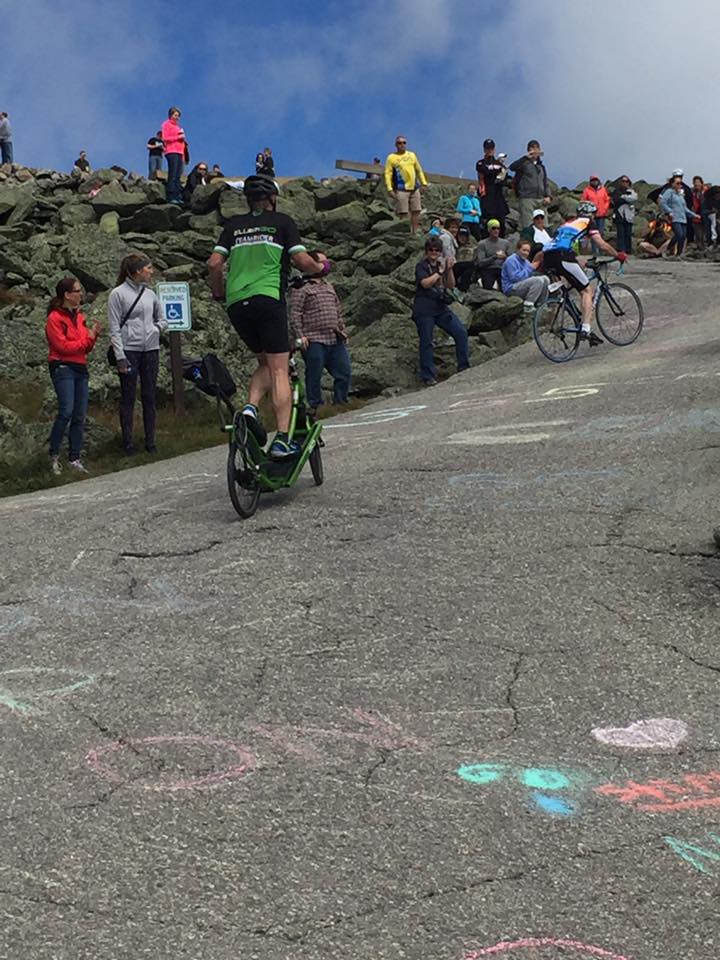
Miles take forever when you are going so slow, but eventually I neared the top. The steepest section is the corner right before the finish line. They say the average grade here is 22%, but during the practice ride, my Garmin shows at least one bump at 39%. I went wider around the corner this time and it still registered 37.5%. But, before I got there, I was doing great with my plan of riding all the way to the top without walking.
Andrew Warby nearing the top. Photogragh by Joe Viger
What an awesome photogragh by Joe Viger of Andrew Warby.
Jim Cremer nearing the top. Epic photogragh by Joe Viger.
As you can see in this photo, I am almost to the corner, but shortly after this photo was taken, I had to dismount and walk before I got back on again and finished.
The other side of the above photo. This one by Joe Viger.
I finished the ride in 2:06:17 for an average speed of 3.6 mph. I am the slowest of all five people to have ever ridden up Mt. Washington on an ElliptiGO, so I will go with being the oldest and only ElliptiGO rider from New Hampshire to ride up that beast of a hill. Andrew Warby was the first finisher in 1:56:27 coming close to the record and riding at 3.9 mph. Jim Cremer finished in 2:00:49 before jumping back into his car for the long drive back to Iowa. It was a great day for riding and for the ElliptiGO riders, proving what a versatile machine it is. Here is a video I took of the start and then the final few miles. You can scroll quickly through it to get a feel for the climb. Sorry for the smudge on the camera lens! At 8:00, I lose concentration and almost veer over the side, at 28:00 I go flying by some hikers, and at 36:00 starts the drive to the finish.
Jim and I at the summit. We couldn't find Andrew for the photo.
He was already running all the way down the hill.
I am retiring from running and riding up Mt. Washington.
Next time up, I hope to go on the Cog Railway.
Lessons learned for future riders:
DON'T!
If you must, you will need to change your gearing. Talk to Keri at ElliptiGO.
I used a 130 chainring and a 20T cog, I have an eight speed. Jim and Andrew had 11 speed GOs so their gearing would be different. Jim Cremer says he used a 38 tooth chainring and the stock sprocket on his 11 speed. He used 1st and 2nd gear most of the time, with 3rd and 4th once in a while on the rare brief mini-breaks. Andrew used a 42 tooth chainring. It still allowed him to get some speed on the flats and he kept it on for several months prior to train with it as much as possible. Note, I tried riding on regular roads with my setup, but it was nearly impossible. All of my 8 speeds were too low and unless I was going downhill, I could barely get over 10 mph, no matter how fast I was spinning,
Make sure your ElliptiGO is ready for the challenge. Mine was not for the practice ride, and even with all the repairs I made, my rear wheel was still off a bit during this ride. I should have had a professional mechanic go over it.
I did not use a heart rate monitor. I was scared of my heart rate being too high due to the practice ride and also some rides up Pack Monadnock. I think I kept it in an acceptable place the whole ride, so I am happy about that.
You can never build momentum on this ride, if you don't move, you will stop!
I think it would be best to lose as much weight as you can before doing this ride. I was no where near my former running weight. My ElliptiGO weighs 42 pounds so that is a disadvantage when compared to cyclists, whose bikes weigh 1/3 to 1/2 of that.
I found that on my eight speed that in the lowest gear, I could not really get over 4 mph, but you need that gear where it is steep (and that is most of the way). The second lowest gear would keep me around 4 mph. The next higher gears did not get enough use, but when they did, I could go faster. There just wasn't enough time to keep those gears engaged.
I brought water, but did not drink it while riding. I would have to stop pedaling to drink and that would cause my ElliptiGO to stop or fall over. Drink a lot before your ride. Wear sunscreen, I did not, and got sunburnt a bit.
You cannot ride an ElliptiGO or bike down the hill. You will need to find a ride down. This is not hard. Jim and I both found rides down the day of the ride.
Here are three recommendations from Andrew Warby to anyone who wants to attempt the climb in the future:
1) Gear down to something that will give you a level of resistance you are comfortable with
2) Maintain an even effort
3) Do the practice ride the month prior. It will help you know what to fix.
I have only had Hit Reset: Revolutionary Yoga for Athletes by Erin Taylor for a couple weeks now, but I am slowly reading and putting to use some of its exercises. I am not a person to do Yoga as a practice (I have been told that I should) so I am liking this book as as fuses yoga moves with practical advice for using it to correct imbalances and weaknesses in key body areas. It is also a book for athletes and not for people who just practice yoga. I am particularly working on the glutes right now and the book has taught me a new way to think about their recruitment and use. The book is very colorful with loads of photographs and instructions. It can sometimes be hard to find your way due to all the color as it reminds me of magazine layouts, but I am finding the knowledge and information to be both practical and useful.
Here is a preview of the book. Here is the book's website. Here is the JASYOGA Youtube page
Here is a the publisher's information on the book.
HIT RESET offers athletes new ways to find more speed, power, and endurance.Yoga coach Erin Taylor’s HIT RESET approach uses yoga to solve the specific problems you face as an athlete. Her revolutionary way to do yoga can improve functional strength, flexibility, muscle recruitment, breathing and focus, core strength, and durability. HIT RESET starts by defining 10 problems that hold athletes back and the specific yoga solutions that can fix them. Each chapter shows you how your body should work, how to self-diagnose flaws in your movement and functional strength, and how to apply just a few specific yoga poses so you can “hit reset” and get back to peak athletic form. In just a few minutes each day, you can practice the yoga solutions in HIT RESET anytime and anywhere without a mat or studio classes.
Armed with these key, highly effective yoga fixes, you’ll begin a radical redefinition of balance that can make you a healthier, stronger, and more resilient athlete. HIT RESET can help you solve:
Imbalances that lead to injury by redefining balance from head to toe
Feeling easily winded with deep breathing exercises
Feeling distracted or nervous with focus exercises
Poor posture with core activating and strengthening poses
Sleepy feet and stiff calves for a stronger foundation
Knee pain with better form and strength poses
Stiff hamstrings and sleepy glutes with activation exercises
Unstable hips and IT band problems with hip helpers
Stiff shoulders and sides with opening poses
Yoga can help you in your sport, but only if your yoga is solving the problems you face as an athlete. HIT RESET offers a yoga revolution for athletes by making yoga work for you. Join the HIT RESET revolution and you’ll find a no-nonsense approach that will make you a stronger, more resilient athlete.
As Sean says, you can find hundreds of books on stretching on Amazon, but only three books on muscle activation. I am not sure if I have any books primarily trying to teach muscle activation (I do have 2 cds), although looking at some of these moves, I think it just might be what you are calling what you do. Do not confuse these movements with Muscle Activation Technique. I did go through many sessions of MAT and it was costly and only benefited me in the short term. MAT involves testing, small movements, and retesting. The movements are done while lying down and you need a practitioner to help you. I think Sean's moves are more about loading and firing your muscles. You might find this an inexpensive way to think about your muscles in a new way, help out some weak muscles or movement problems, or deal with imbalances.
Here Matt Hsu of Upright Health demonstrates a glute stretch that hits the spot! Most stretches I do irritate my glutes. This one can hit where I feel real tight without the irritation the next day. The stretch starts a little after the 2:30 mark.
YogaJP starts with a similar glute stretch to the one Matt shows, but this more well-known version irritates my glutes. However, after the glute stretch she goes into a piriformis stretch (about 1:45) that for some reason works for me. I don't know if it helps the hips or low back along with the piriformis, but this one feels good to me too!


 My biggest fear for Sunday, was that I might sleep in and miss the start, but I got there on time to meet fellow ElliptiGOer Steve Lecours, who I was planning to ride with, I did arrive on time and it was a chilly and windy morning again. Right before starting, I noticed my brakes were a bit off and then noticed my rear wheel nuts were also loose. I attempted to fix things and then Steve and I were off on the initial 17 mile loop through Massachusetts. I felt pretty good, but my ElliptiGO felt tight and I was having a hard time keeping pace with Steve. I chalked it up to the previous day's ride and the fact that I hadn't warmed up yet. At the end of the loop, I stopped to look at my chain and sure enough, I had tightened the rear wheel which had tightened the chain so that there was absolutely no slack in it at all. I loosened things up and hoped for better.