Saturday, June 30, 2012

Lessons from the Cheetah


Photos I took in Kenya last summer.
http://kenyain2011.blogspot.com/
The New York Times recently posted an article titled
What Runners Can Learn from Cheetahs by Gretchen Reynolds and author of the book The First 20 Minutes: Surprising Science Reveals How We Can: Exercise Better, Train Smarter, Live Longer. In is she wants to explore the biomechanics of cheetahs running to help improve the humans mechanics of running. After all the cheetah has been clocked at 65 miles per hour and the fastest human, Usain Bolt, has only been clocked at 28 mph. 
Sorry Usain, you are not that fast after all!
She writes about some scientists in England who compared the running of the cheetah to a similarly speedy animal,  the greyhound whose body mass and running form are similar.
Both animals employ a running form known as the rotary gallop. Their legs churn in a circular motion, the animal’s back bowing and its hind legs reaching almost past its ears at full stride.
Up until about 40 mph, both animals are similar in stride, but then the cheetah finds another gear. They discovered that when finding this faster gear,
 ...their leg turnover rate spurted and their pace dramatically increased. They began bringing their legs around faster and faster, their strides lengthening, even as the frequency of their strides increased. The greyhounds, on the other hand, maintained a fairly even stride frequency throughout their entire run.
They also discovered that,
 The cheetahs also hit the force plates differently from the greyhounds, their paws remaining on the ground slightly longer — an action that presumably allows the legs to absorb more of the forces generated by the pounding stride.
This is all very interesting, but how do you draw lessons from this to teach human runners to run faster, after all we are not really built like greyhounds and cheetahs, and obviously we only use two legs to run. So they come up with this:
The lessons for human runners are somewhat abstract, since we have only two legs and, with rare exceptions, cannot curl them up past our ears, as cheetahs and greyhounds do. “The cheetah’s back functions as an extension of its hind legs,” Dr. Wilson points out, its spine coiling and extending with each stride, as ours cannot. But there are tips we can glean from the cheetah. The speed with which a creature brings its leg back around into position appears to be one of the main determinants of speed, Dr. Wilson says. The faster you reposition the leg, the faster you’ll move. But swift leg turnover requires power. “Compared to the greyhound, the cheetah has bulky upper legs,” Dr. Wilson says. Its powerful thigh muscles allow its legs to pump more rapidly than the spindly greyhound’s can. So strengthen your thighs. And perhaps invest in lightweight racing shoes. “Having less weight in the lower portion of the leg aids in swift repositioning” of the limb, Dr. Wilson says.


OK the article is entertaining and may contain an element of truth, but like most articles today, you can get more lessons from the comments that readers make and this is where the real fun of this article begins.
First off we learn about another high speed animal that wasn't mentioned in the article, the pronghorn antelope, one reader mentions:I think that the truly remarkable runner is the Pronghorn Antelope, which can run about 45mph for 15 minutes to one hour. Covering 10 miles in 15 minutes is a feat that no other animal can approach. Two difficult problems to solve for this type of high-speed distance running are 1) supplying enough oxygen, and 2) not overheating. Pronghorns have very large lungs and hearts for their size to supply oxygen. Cheetahs do overheat in their short sprints and can't eat what they've caught for up to 30 minutes until their body temperatures return to normal. I don't know why Pronghorns don't overheat.
Of course you have the wise guy commenting too, and these two left me chuckling,
At first I read this as, "what runners can learn from cheetohs" and I was so excited. 
 Wasn't the Segway supposed to make us all fast & nimble?
But the most insightful comments and lessons probably come from the fact that the scientists studied captive cheetahs who rarely felt compelled to run faster the 40 mph.
I think the huge speed differential between captive Cheetahs (40mph) and wild, hunter Cheetahs (65mph), can teach us a lot about our own obesity problems. Why do cultures who supply large amounts of calorie-dense food to people who don't work physically hard for it, inevitably become slower? And fatter?... Athletes begin to decline when they stop being "hungry," which is literally true as well as a metaphor for ambition. Luxury and comfort bring on lesser health and fitness, and in our country this trickles down even to those below the poverty line, who still have no trouble getting high-fat, processed-carbohydrate foods for little money.
In the end, I am not sure if studying the cheetah can really make us faster. We already know to strengthen our legs, wear lighter shoes, and move those legs quicker.


Friday, June 29, 2012

Julia Lucas has some courage!

Julia Lucas may be the heartbreak kid of these 2012 Olympic Track Trials with her 5000m race last night. She took off in the later stages of the race, upping the tempo and giving herself a good sized-lead by the final lap. Unfortunately, her legs starting giving out and she was passed by two runners, but it still looked like she had 3rd place locked up as she hit the final straightaway. Unfortunately with a step left to go the faltering Lucas was passed at the finish line and lost the Olympic position by .04 seconds. Due to the fact that Julia had increased the pace of the field in the final laps, Kim Conley was able to beat the Olympic A standard by .21 of a second. I am sure Julia will be kicking herself for years for how she ran the race. If she kept the pace down she would have earned the Olympic spot due to already having the A standard and if she had not forced the pace then maybe should could have finished more strongly. Even if she had faltered and slowed down sooner, the other two runners would not have sprinted to catch her and even if they passed her, they might not have earned the A standard and she would be gointg to London. As my friend Michael Wade said, "She ran like Pre on Pre's track and finished 4th - also like Pre. Nothing to be ashamed of there." Here are the highlights of that race. Sorry they can't be embedded.  Some people have said it was a stupid race on Julia'a part, but she seems to be a courageous runner to me and it turns out this was not her most courageous run. Check out this 2007 video describing how she ran into a burning building to save two children. Now that is a courageous run!


 Here is Julia, after the race, describing what it felt like to be "running underwater" the last 100 yards.


Wednesday, June 27, 2012

The Purple Runner by Paul Christman


There is a very short list of classic running stories. Once a Runner a novel by John Parker has held the esteemed number one position for years, but there was always the mention of another book The Purple Runner first published in 1983 and written by Paul Christman. I have read and enjoyed Once a Runner and even sold a copy for $250 before it had been reprinted, but I have never had a chance to read The Purple Runnerdue to it long ago being out of print (I will sell a book for a lot, but do not want to spend a lot for an out of print book). The good news is that The Purple Runner is back in print and you are in for a treat if you enjoy reading stories with interesting characters who are involved with the sport of running.


The Purple Runner has always seemed sort of mysterious to me. I had seen ads for it in the back of running magazines in the 1980s, but never had a chance to even remotely find out what the story was about. Well, the story is sort of mysterious too, or at least one character is, that being the title character. The purple runner is a world class running talent who strives to remain anonymous as he speedily trains through the Hampstead Heath in England. Due to his disfigured face, he remains reclusive, but throughout the story my imagination was piqued as to which former American distance runner who died in an automobile accident in the Pacific Northwest could this mysterious runner actually be possibly modeled after. 

Imaginations are free to run wild with this story. Could the reclusive runner venture forth and enter the London Marathon? Could he finish the race in under 2 hours. Remember this story took place in the 1980s when the world record had not seen the recent assault by the Kenyan and Ethiopian runners of the present age. What was once so preposterous is now something that could actually happen. The story leaves you wondering what the purple runner might do as well as who he might be.

Another main character in the story is a Kiwi (New Zealand) female runner. Will she learn the dedication that is required to become a champion runner after a move to England. There is a wily old hard-core 50+ year old runner who trains to break 2:30 in the marathon and a couple of other American runners who also end up running on the Hampstead Heath and who intertwine their lives with the other main characters. 

The book was written by an author well versed in the running sub-culture. The workout times and distances, the races, and the numerous mentions of the the great runners of the 1970s and 1980s add an element of authenticity and delight to the story. I do not want to give away the mysteries of the book. At times, the book sounds like it could have been written recently and at other times you know you are reading a somewhat dated story. None of this detracts from the intricacies of the plot and by the end of the story, all elements start blending together towards the dramatic conclusion making the book extremely difficult to put down until its conclusion. 

Without giving away something that happens in the London Marathon at the end of the story, I am extremely curious if that one bit of action was added to the story during a revision based on an actual event that happened at a later Olympic marathon. All in all it is a satisfying read. One, because I know now what The Purple Runner is about and two, it was an entertaining read right to the dramatic end.

The S.E.R.F. Strap by DonJoy to correct internal hip rotation

I guess I used to sit a lot like this when
I was a kid. It is not a good way to sit!

I am started to try something new with my running, that someone who has a similar biomechanical stride may want to try. I realized post labral tear surgery that my body is still not symmetrical. No matter what the PT shows me to do, I still maintain my same running movement patterns I had prior to surgery. My problem is two-fold according to many doctors: tibial torsion on my left side that has my foot pointed to the side as well as femoral anteversion on the same side that has my femur and knee pointing in to a knock-kneed position. I am told I was probably born this way and you can't change it. I have a hard time believing I had two problems both on only one side. I have noticed that the PT does not help me with the internal rotation of my hip. I started wondering is this a problem I was born with or a compensation for my everted foot because when I point my foot straight, my knee knocks in? I am primarily concerned because the internal rotation of the hip seems to give me a pinching problem where the adductors join the hip, plus the glute medius problems I keep getting when running and I am tired of these problems and just want to run. I am willing to try anything at this point.


I found a strap last week called the DonJoy SERF Strap that is supposed to limit the internal rotation of the hip as you move. I have often wondered if someone could make a product to do that and lo and behold they have.
Developed in conjunction with Dr. Christopher Powers at the University of Southern California, the S.E.R.F. Strap™ is the FIRST patellofemoral brace designed to treat patellofemoral pain stemming from abnormal hip motion(s). The S.E.R.F. Strap™ utilizes a unique 3-point hip-leg anchor to treat patellofemoral pain caused by excessive hip internal rotation, adduction, and/or knee valgus. Made of thin Breathe-O-Prene®, the S.E.R.F. Strap™ is lightweight, breathable, and designed to be worn underneath clothing. The S.E.R.F. Strap™ can be used to control abnormal hip motion during leisure/sport activities and as a training tool in the clinic.


I ordered the DonJoy SERF Strap and tried it out as soon as I got it. I wrapped it around my knee and pulled it tight and wrapped it around my waist. It is a lot of strap, but it wasn't uncomfortable. I ended up doing my longest run since February at 45 minutes. The next day I did 42 minutes. I took a day off and went 49 minutes on a real running route (not just laps around the neighborhood) and then yesterday I jumped into the Mine Falls 5K Trail race just to see what would happen if I ran at a slightly faster pace. First off, I don't get the pinching feeling in my adductors and hip joint after my runs. I think the strap rotates my leg to straighten it out a bit and also pulls my femur out to the side a little also so that it doesn't pinch. It seems like me foot no longer tries to point straight, but goes out to the side, but I think this is good if the knee is tracking straight with the hip because that is the way my body is built. There is a lot of adjusting that my body and muscles have to do. I note that after runs, the muscles around the outside of my hip (or the greater trochanter) are sore and tired, but it is muscles that are sore and not my hip joint for a change. So far the strap is doing something.
Patella Femoral Syndrome can be caused by many thing in the body including muscle weakness, tightness, and/or biomechanics. Depening on the cause of your injury the S.E.R.F strap could help. It basically acts as a cue for you gluteal and hip muscles to fire when they are supposed to. It will not weaken the muscles you are trying to strengthen and can be a good tool to help with proper mechanic at your hip and knee while running and doing your strengthening exercises. (from SERF strap website)
Whether it leads to another injury, I don't know. It doesn't seem to be a permanent thing, but more like a tool to retrain your muscles and stride. I don't even know if I am putting it on correctly or at the correct tension, but it is an interesting experiment. Yes, I notice it as I run, but more-so because it alters my leg movement patterns. It is not really distracting otherwise, more interesting, I would say.

 At the last moment, I decided to run the 5k race just to get moving with the running crowd again. I have done very limited running over the past few months, so I was just hoping to jog through the thing and I figured I would do it between 25-30 minutes. I ended up running my second slowest 5k in 38 years (last Thanksgiving I ran a few seconds slower in a post-surgery turkey trot). I ran to the level of discomfort and kept the same pace throughout the race and finished in 24:25. It actually felt pretty good, despite running about 5 minutes slower than I was doing just 2 years ago with the bad hip. It is a good beginning point to start a slow year long build up to the place where I can run quickly again.

I wished I had this strap before my surgery as I saw one review where someone mentioned it helped with their pain.
I really really really really really liked this! you can wear it underneath clothes and it really truly works! I used mine because I had a labral tear in my hip and I guess the doctor said it would strengthen a muscle that would make my pain go down. It definitely did! (from SERF strap website)

Saturday, June 23, 2012

Meet Your Body by Noah Karrasch


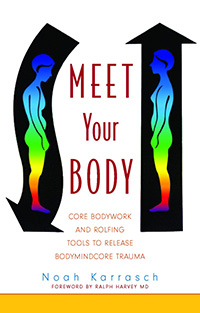
After getting some Rolfing done two weeks ago, I noticed some improvements in my posture. The most important thing I wanted from the session was to loosen up my left hip (post surgery) and to work my foot to get my big toe on the ground. Most of the work was on my right side (which was tight and I just didn't know it). The good news was my toe joint and toe were now touching the ground the way they were supposed to or is it my second  toe joint that is no longer pushed down. Anyhow, my foot is in much better alignment and so far is staying that way. After the Rolfing session, I checked online to see if there are any new books written in the past few years related to Rolfing. I discovered a book titled Meet Your Body: CORE Bodywork and Rolfing Tools to Release Bodymindcore by Noah Karrasch. I read some reviews on the book and two things struck me. One the book looks at the body as a set of 21 important hinges and he starts out exercises for the big toe hinge and those were the exercises that got a lot of positive reviews. I thought the book sounded interesting and I wanted to see just what he had for the big toe.

The book is an easy read and it is easy to find what you want if you just want to skim through, which I have done. It is very interesting in how he sees the engineering of the body and how to improve the movement of these hinges. I have only concentrated on the big toe so far and I have done the exercises and together with the Rolfing I feel more powerful and aware of what my big toe is doing. The first MTP joint used to just collapse on me and now I am pushing off it. I am very convinced that the big toe joint plays an important part in the health of your body and running stride and that it is directly related to imbalances in the hip. I find these exercises to be helpful and look forward to moving up the chain. One caveat, the author does tie in emotional experiences into the ill health of bodies. This could be interesting or off-putting to some.

This is the first of three posts of new things I am trying. The next two posts deal with first a convict and then a strap! The good news is I am getting somewhere. Despite 90 degree heat, my last three runs have been for 38, 45, and 42 minutes. It is not much, but it is the longest I have run since February.

Noah Karrasch on the importance of good foot awareness


Friday, June 22, 2012

Wiring up the Kenyans

It seems like Lolo Jones is not the only world class runner being wired up in some fantastical way to help improve performance and avoid injury. If you read Toni Reavis's blog you would note that he is spending time in Kenya these days and hanging around with some of the fastest runners to have ever graced this planet. On the Road to Kenya: The Cattle Dip Loop Toni meets up with the Kenyan marathon team in Iten and explains the technology being tested out on these runners.
Today’s run would also serve as a field test for a new wireless sensor technology developed at the UCLA Wireless Health Institute that holds the promise of re-ordering the level of sophistication that athletes and coaches can bring to their training.  Small accelerometers worn on the laces of each shoe would monitor, record and transmit the stride characteristics of Abel Kirui and Wilson Kipsang throughout their run.  With this information in hand they and their coaches will be better able to analyze the small asymmetries in ground contact time, back-kick dynamic, pronation and supination during the varied runs in their training regimen. As Pegasus Sports Performance CEO Bill Shea, an interventional radiologist by training, outfitted Wilson and Abel with the sensors and the small cell phone which they will wear to transmit the signal to the internet and onto our computers ...
 Then he gets to witness a short "easy" workout by these Kenyan greats. In Toni's second installment Into Thin Air: Kamarini Stadium Toni visits the track in Iten where the "also rans" are dreaming big. An "also ran" in Kenya may mean you are a world class well-known runner or just a young kid dreaming of becoming a champion. The third installment Poor Weather Forecast for Kenyan Olympic Trials has Toni talking about racing for fast times vs. racing the competition. He also talks about marathon pacers and the saturation of Kenyans in the market.


Toni's latest installment Meet at the Corner Shop: Fartlek into Masai Land has Toni traveling to Ngong a town near Nairobi where world marathon record holder Patrick  Makau trains and gets back to the technology being used with the Kenyans:
Throughout today’s run Makau will be wearing a pair of Pegasus Sports Performance sensors on his shoe laces, and an android cell phone tucked in a belt pouch strapped to the small of his back. With this equipment, we will record and transmit data monitoring Patrick’s cadence, rear kick dynamic, ground contact time, and pronation during the course of his 1:30 workout, which will include the warm up and cool down phases.
We also learn that Makau comes from a different tribe than the majority of top Kenyan runners and has a different build.

But what was also apparent was that Makau’s Kamba tribe body is much different than that of his Kalenjin tribe rivals like Wilson Kipsang, the 2012 London Marathon champion.  Of the 42 tribes in Kenya, perhaps five represent the running talent of the nation. And of those five  the Kalenjin have long been considered the cream of the crop with their longer, thinner legs, and narrower hips making for a more aerodynamic cleaving of the air. 
Makau’s Kamba-built gait rides atop a sturdier base as he is broader across the shoulders and hips, almost resembling a 400-meter power runner rather than the long, lean marathoner we associate with Kenyan athletes.

I am fascinated with Kenya and with the technology that is being tried out on the runners there, so I had a question yesterday for Toni which I left on his blog.
I am enjoying your series on Kenya. What a fascinating place. I was there last summer-although it was not running related. Are they using the data to tweak the strides of these athletes or just testing out the technology. Will the tweaks be workout related (form breaks due to fatigue) or actually trying to alter their form (might not turn out too well)?
Toni was gracious enough to answer and provide more information:

Jim,Initially this is a beta test of the equipment in the harshest of road conditions with the very best athletes. But the runners and their coaches will receive all the data that is collected, and be able to identify and understand where the imbalances may be in their stride mechanics.This data will inform their decisions on drills, workouts, and therapies which might address those imbalances, so that their fitness is better utilized to generate speed without crossing the line into over-use injury. 
For athletes of this caliber, small things can have big consequences. Realize that just a 1% difference over the course of a marathon equates to 2:00. So it is critical that these athletes be as precise as possible as they strive for success. 
One half of the equation is to get as fit as possible, Avoiding injuries is a big part of that quest. The second half of the equation is to transfer that fitness into forward motion as efficiently as possible. The Pegasus sensor technology can be an invaluable tool to achieve both halves of their goals, while making their structure a better implement of their fitness.Make sense?
Well it sounds like an interesting concept: helping the best runners find the nuances in their biomechanics that need adjusting so as to become even better runners. I remember the days before timers were on your watch and you timed your workout by where the big hand and the little hands were on the watch face. Can you imagine the day when instead of runners placing on sports watches and  heart-rate monitors, runners will be wearing devices like these being tested to get the data they need to become better runners and stay injury free. Well, as long as they know what to do with the data! I would have loved something like this to figure out what my wonky stride has been doing all these years and then to see what I could have done to improve my running form rather than running myself into the ground.

Stay tuned to Toni's blog and see how many more installments he writes and then continue reading what he has to say about running. Toni is the voice of running in the U.S. He can be heard commentating on races all the time and has done so for many years. He knows the athletes and the movers and shakers of the sport and he has opinions on many running related topics that are well worth listening to.

Here is an earlier post Toni had made on Pegasus Sports Performance. Here is the website for Pegasus Sports Performance.

As I mentioned, Toni has been reporting on running for a very long time. Here is a picture I snapped of him at the 1976 Falmouth Road Race as he was interviewing Bill Rodgers. I can't tell, but that might that be Bob Hodge behind Toni's massive FlipCam?


Here is a newly published book: Running with the Kenyans: Passion, Adventure, and the Secrets of the Fastest People on Earth.


Thursday, June 21, 2012

Lolo Jones and her toes!


You hear a lot about Lolo Jones these days and not even coming from her track and field fans. She is one of the true celebrities of the sport. Who can forget her crash in the 2008 Olympic Olympic finals?


Sport Illustrated has a new article called "Wired for Speed" (similar but not the same as this article) in their current issue on Lolo Jones and the technology that she is using to help her get to the London Olympics. I found this passage interesting:
Jones doesn't particularly enjoy reliving the 2008 Olympic final. But she has seen replays of the race, watched her lead foot clip the ninth hurdle and jolt her back from first to seventh place. She cannot be sure what went wrong; it could have been any number of things. But her doctor's theory is that it was an early manifestation of tethered spinal cord syndrome, a congenital neurological disorder that limits the movement of the spinal cord. After Beijing, Jones was hitting hurdles in races more often and experiencing debilitating back pain, which led her to see Dr. Robert Bray, a neurological spine surgeon based in Los Angeles. Bray recognized a telling symptom of the disorder: the loss of position sense in her feet. Essentially, Jones was running without knowing exactly where her toes were. An MRI revealed the condition, and last August, Bray operated on her back.
Good luck to Lolo. I have never heard of tethered spinal cord syndrome, but despite the disorder, it shows the importance of knowing where your feet are on the ground and the importance of your toes while running (and hurdling). Lolo is another Recover Your Stride hero!

Update: Actually I have heard of tethered cord syndrome. I should know better, but I forgot the name. My teen-aged daughter had spinal surgery 2 years ago to remove a cyst in her lower back and is now receiving PT for, "tethered cord syndrome". She is hoping to play field hockey this fall in college. The PT was amazed that she was able to play in high school. She is doing lots of core work now to rewake some of the nerve pathways. I guess that means my daughter is a Recover Your Stride hero too.

Here is a video and article on the movement analysis technology that Lola is using.