I have had a few people over the years contact me to ask me whether I was ever
able to "recover my stride" and return to running. Why yes I have. This video
tells part of the story.
Here is a link to an old blog post I made on the
1975 Falmouth Road Race.

Showing posts with label Bill Rodgers. Show all posts
Showing posts with label Bill Rodgers. Show all posts
Thursday, August 7, 2025


Thursday, August 29, 2019
Great old video of the 1982 Bix 7 miler
This is an old 8mm film of a race I never ran, but of a time when I did. It is great to see Rob DeCastella, Bill Rodgers, Frank Shorter and others in fine running form.
Sunday, November 23, 2014
1976 Olympic Marathon Trials video with Frank Shorter, Bill Rodgers, and Don Kardong
Here is a video of the 1976 Olympic Trials Marathon. It is not the best quality, but seeing videos of these great runners of the 1970s is fun to watch.
Sat May 22, 1976 Eugene, OR
This reunion flashback video is of a special movie made by Martin Darrah on the US men's Olympic Marathon trials in Eugene, Oregon. There is great footage and wonderful commentary by the leading runners in this race. The WVTC had 5 members who competed in this race. They were Don Kardong, Tony Sandoval, Chris Berka, Ron Zarate and Chuck Smead. Kardong would place third and make the team heading to Montreal. There is some fantastic slow motion video of Frank Shorter and Bill Rodgers(1st and 2nd in this race) as well as Kardong and Tony Sandoval(who finished behind Kardong in 4th). Additional commentary can be heard from running author Joe Henderson.From marathonguide.com
Sat May 22, 1976 Eugene, OR
Qualifiers: 87
Starters: 77
Finishers: 49
Starters: 77
Finishers: 49
Frank Shorter and Bill Rodgers ran virtually step for step at in what seemed to be a sub-2:10 pace until two or three miles from the finish Rodgers was affected by a leg injury and had to drop back. Shorter would become the first, and as of this writing only, man to win back to back Olympic Trials Marathons. Don Kardong would finish third in 2:13:54.
At the 1976 Olympics, Shorter would go on to win silver behind East German Wlademar Cierpinski who - in recent years - has been suspected of using performance enhancing drugs. Bill Rodgers led the Olympic Marathon in the early miles but fell back with the same leg injury that affected his Trials performance - he would however, rebound to handily win the 1976 New York City Marathon. Don Kardong in fourth place at the Olympics, missing the bronze medal by just three seconds.
At the 1976 Olympics, Shorter would go on to win silver behind East German Wlademar Cierpinski who - in recent years - has been suspected of using performance enhancing drugs. Bill Rodgers led the Olympic Marathon in the early miles but fell back with the same leg injury that affected his Trials performance - he would however, rebound to handily win the 1976 New York City Marathon. Don Kardong in fourth place at the Olympics, missing the bronze medal by just three seconds.
| 1. | Shorter, Frank ( FL) | 2:11:51 | |
| 2. | Rodgers, Bill ( MA) | 2:11:58 | |
| 3. | Kardong, Don ( WA) | 2:13:54 | |
| 4. | Sandoval, Tony ( CA) | 2:14:58 | |
| 5. | Fleming, Tom ( NJ) | 2:15:48 | |
| 6. | Varsha, Bob ( GA) | 2:15:50 | |
| 7. | Bramley, John ( CT) | 2:17:16 | |
| 8. | Pfeffer, Kirk ( CA) | 2:17:58 | |
| 9. | Galloway, Jeff ( GA) | 2:18:29 | |
| 10. | Burfoot, Amby ( CT) | 2:18:56 | |
| 11. | Busby, Bob ( MO) | 2:19:05 | |
| 12. | Hatfield, Carl ( WV) | 2:19:18 | |
| 13. | Sudzina, Marty ( PA) | 2:19:55 | |
| 14. | Forrester, Perry ( CA) | 2:20:01 | |
| 15. | Kurrle, Ron ( CA) | 2:20:18 |
Tuesday, August 19, 2014
ElliptiGO riders at the Falmouth Road Race and Falmouth Mile
ElliptiGO riders had a great showing at the Falmouth Road Race and Falmouth Mile. Here are some photos I took at both events.
In the Falmouth Mile there were three ElliptiGO athletes (all in the women's mile). I heard that Ben True rides an ElliptiGO (Ben was 2nd in the Road Race last year) and was entered in the mile, but he did not race as he has a 5000m race coming up in Europe. ElliptiGO milers Katie Mackey and Sarah Brown finished first and second in the women's mile and Gabe Grunewald finished 7th.


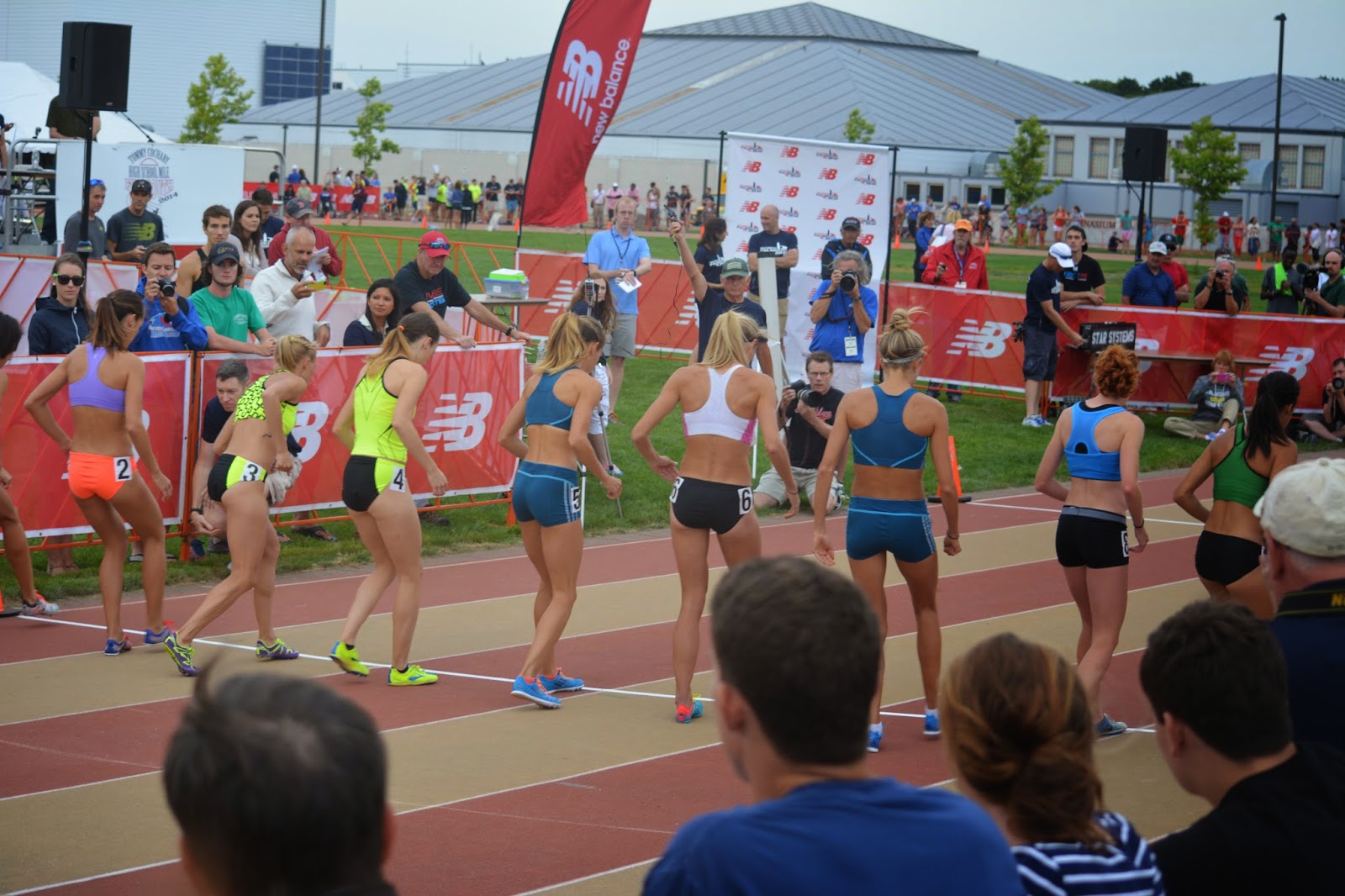


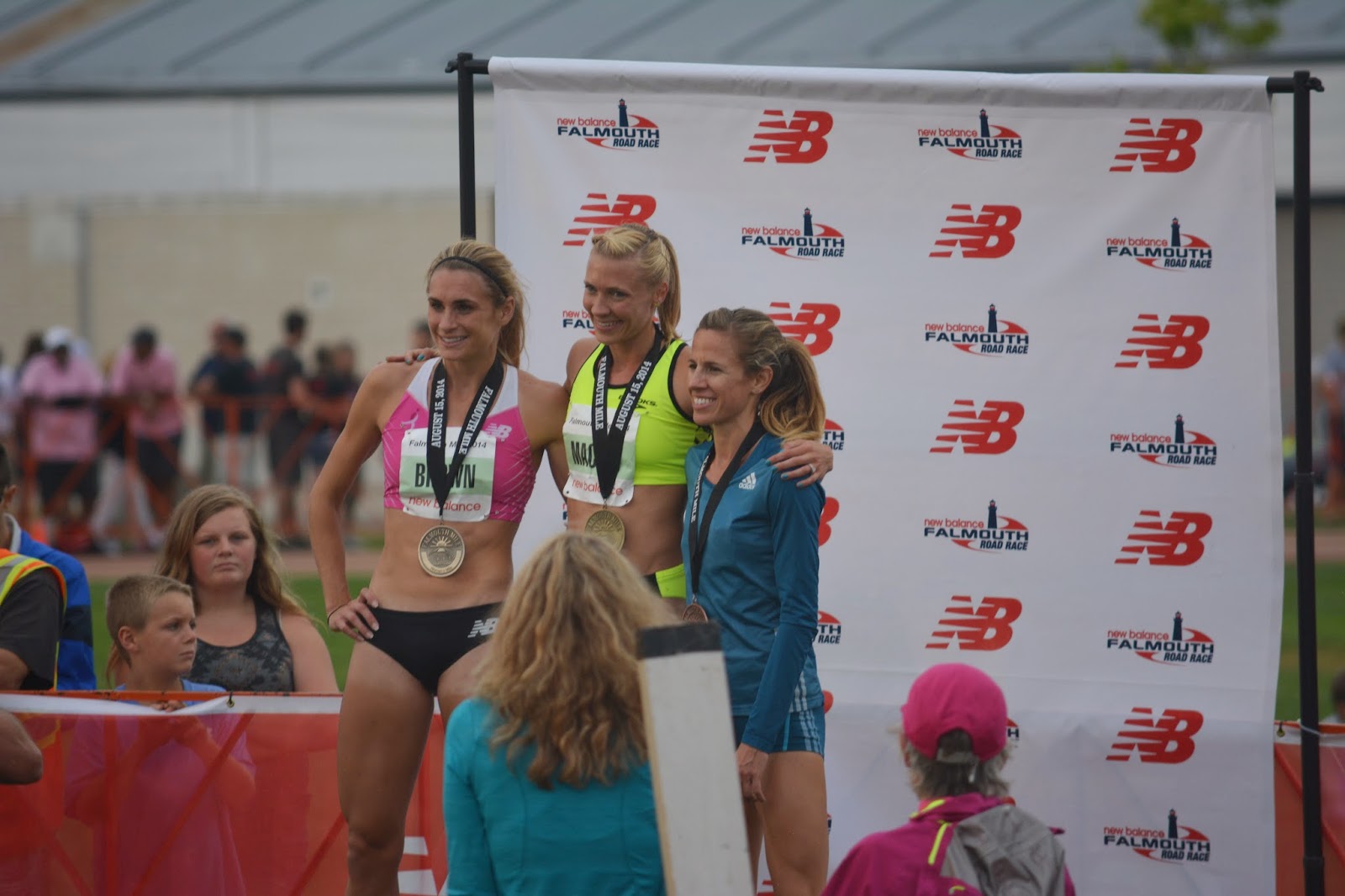
I tried taking a video of the women's finish. It didn't come out that good. This part is in focus.
Results of the women's mile
1. Katie Mackey, 4:27.79
2. Sarah Brown, 4:28.70
3. Morgan Uceny, 4:29.62
4. Brie Felngagle, 4:29.84
5. Amanda Eccleston, 4:30.43
6. Stephanie Garcia, 4:31.26
7. Gabriele Grunewald, 4:36.33
8. Heidi Gregson, 4:38.16
9. Aisha Praught, 4:44.44
In the Falmouth Road Race the next day, ElliptiGO athlete Craig Leon finished 8th overall.


Meb was racing too! I wasn't sure what he was doing so far back from the front, but then I saw he was running with Joan Benoit Samuelson.


At the expo on Saturday, I got this photo of myself with Frank Shorter and Bill Rodgers. I got to talk a bit about ElliptiGO riding with Frank. All three of us ran the 1975 Falmouth Road Race. A race that has been called the beginning of the running boom. Frank reemphasized that there was a "paradigm shift" with that race where the two best marathoners (Frank was the current Olympic Champion and Bill was the current Boston Marathon champion) raced on the roads for the first time. Bill had written a letter to Frank inviting him to run Falmouth. Frank wrote back (Bill had the old letter with him) and I think it was suggested to Bill that he take $600 under the table to run the race. Frank said he would have asked for the same. Only 850 runners ran that race and I am proud to be one of them. I started running at Falmouth High School in the fall of 1973 (a month after the first Falmouth Road Race) at the new high school and track (where the Falmouth Mile is held every year) and I grew up about 1/2 mile from the finish line of the road race.

Does anyone know of any other ElliptiGO athletes who ran? I may have a photo of them.
In the Falmouth Mile there were three ElliptiGO athletes (all in the women's mile). I heard that Ben True rides an ElliptiGO (Ben was 2nd in the Road Race last year) and was entered in the mile, but he did not race as he has a 5000m race coming up in Europe. ElliptiGO milers Katie Mackey and Sarah Brown finished first and second in the women's mile and Gabe Grunewald finished 7th.
I tried taking a video of the women's finish. It didn't come out that good. This part is in focus.
Results of the women's mile
1. Katie Mackey, 4:27.79
2. Sarah Brown, 4:28.70
3. Morgan Uceny, 4:29.62
4. Brie Felngagle, 4:29.84
5. Amanda Eccleston, 4:30.43
6. Stephanie Garcia, 4:31.26
7. Gabriele Grunewald, 4:36.33
8. Heidi Gregson, 4:38.16
9. Aisha Praught, 4:44.44
In the Falmouth Road Race the next day, ElliptiGO athlete Craig Leon finished 8th overall.
Sarah Brown came back after her mile race to run the full course the next day.
Meb was racing too! I wasn't sure what he was doing so far back from the front, but then I saw he was running with Joan Benoit Samuelson.
After finishing, Meb came back on the course to cheer on the runners.
At the expo on Saturday, I got this photo of myself with Frank Shorter and Bill Rodgers. I got to talk a bit about ElliptiGO riding with Frank. All three of us ran the 1975 Falmouth Road Race. A race that has been called the beginning of the running boom. Frank reemphasized that there was a "paradigm shift" with that race where the two best marathoners (Frank was the current Olympic Champion and Bill was the current Boston Marathon champion) raced on the roads for the first time. Bill had written a letter to Frank inviting him to run Falmouth. Frank wrote back (Bill had the old letter with him) and I think it was suggested to Bill that he take $600 under the table to run the race. Frank said he would have asked for the same. Only 850 runners ran that race and I am proud to be one of them. I started running at Falmouth High School in the fall of 1973 (a month after the first Falmouth Road Race) at the new high school and track (where the Falmouth Mile is held every year) and I grew up about 1/2 mile from the finish line of the road race.
Does anyone know of any other ElliptiGO athletes who ran? I may have a photo of them.
Friday, June 14, 2013
Bill Rodgers on Breakfast Sausage
Someone recently dug up this old 1970s commercial starring Bill Rodgers on letsrun.com.You can get more wisdom from Bill Rodgers in his recently published biography. My review here.
Monday, April 22, 2013
Bring back the Innocence: Boston Marathon 2013
The Boston Marathon is dear to my heart. It has woven itself through my life for decades starting in 1968 while as a third grader I decided I wanted to run that race in Boston. The night before this year's race, I started rereading Joe Falls 1977 edition of the book, The Boston Marathon
 . As I was reading, I was reminded how simple and innocent it was to be a runner back then. Here is a quote from the first chapter, "The runners is Boston seem special. Maybe it's because they are all God's children. They seem to understand charity and they seem to understand discipline. How many times in the course of 80 years has one runner paused to aid another runner. That's charity. And who will ever know of all the discipline that they put into their lives in order to prepare themselves to run in this race, this arduous test of one's self." How could someone decide to wreak havoc on such a race and onto such people?
As the violence of the bombing became known, I felt for the runners who nearing the finish of such a monumental goal, were stopped. Many were so close to fulfilling months of training and years of dreaming. As I learned more of the circumstances and those most injured or killed by the bomb, I realized most of the victims were spectators. One of the biggest thrills of running Boston is the hundreds of thousands of fans along the route that cheer on all runners or their own friends and family members. Those who run Boston know how important the fans are to the event. Yet it seems that most of the injured were these fans who came to cheer on the runners. They are such good people to do that!
I can also say, that throughout the news of the event, I often thought of the volunteers and staff of the B.A.A. Marathon. I often thought of race director Dave McGillivray who so kindly let me run the whole "Midnight Shift" of the 2000 Boston Marathon with him (video). I know how thorough and prepared he is with the race each year and just knew that this must tear at his gut. I know many people that volunteer at the finish line or work as race announcers and I was wondering what was happening and if they were O.K. So much planning and hard work by runners and volunteers and staff at the Marathon and those are all good and noble things and I can't comprehend the savage need to attempt to destroy all of that.
In the week prior to the Boston Marathon, I was wishing I had rewritten my review of Bill Rodgers new autobiography Marathon Man. I felt like I had missed my favorite part of the book, not that it was anything insightful but it is because of what I admire about Bill Rodgers and what I really think that running (at least for me) is all about in the end. Bill Rodgers just loved to run and the passages of him as a kid and an adult portrays his childlike enthusiasm and enjoyment with the physical act of running and being out in nature. We learn about him running through the woods with abandon all the while looking around at the birds and the woods. Running to me is all about getting back to the element of just freely running around like a kid and enjoying every second of it. I have seen Bill like this in a race and it still amuses me. I remember a 5 mile race in 2006 run before a major rainstorm that Bill Rodgers was at. After finishing, I went back to cheer other finisher on. It finished on a road over a dam. Everyone looked determined and miserable due to the race conditions until Bill Rodgers came into view. I watched with complete amusement as Bill headed right for all the puddles on the side of the road so that he could splash through the puddles as he ran. To me that is pure Bill Rodgers and after all the racing and miles that he has put in, I was so happy that to see that splashing in puddles still made running fun!
That is the running innocence that I don't want to lose. I still don't cut my hair short, because there is something about running and feeling it flop around behind you like Billy's hair or Pre's hair or any runner's hair from the 1970s. The other reason is it is one of the few things I can think of that cost money to have something taken from you! The innocence of youthful running,, legs stretching out, jumping over obstacles and cornering around trees, no care in the world, good stuff to hang a lifetime on; running. As I implore my failing legs to restore their carefree youthful moves and looseness, I so want running to return to those days. And maybe not just for my body.
 Back when I started running in 9th grade at Falmouth High School, we were given an anthology of short stories to read. One of the stories was called "See How they Run" by George Harmon Cox (written in 1941). You can now find the story in The Runner's Literary Companion: Great Stories and Poems About Running
 . In this story based on the Boston Marathon a young collegiate miler decides to run the The Boston Marathon because his father is dying and can't. This would make the 20th consecutive race for his father. I remember reading this story multiple times to get a "feel" for the race. It seemed so simple and innocent in those days (I assume it was somewhat factual) with the competitors meeting together before the race at a barn and the camaraderie of the older participants. I guess newer marathoners would also consider it quaint that I remember running Boston in the early 1980s and hanging out in the school on Ash Street on the Village Green in Hopkington. You could just wander in like in many smaller road races today and sit in the hallways and stretch. The young Johnny Burke is somewhat cocky at the start, but in the end he learns about the race and himself and gets the girl. What more could someone want from a race. That was extra motivation for myself to get out their and run Boston someday. I ran my first marathon in Dallas in 1977 and it took 8 more attempts before I beat the 2:50 qualifying time in 1981 so that I could finally run Boston in 1982. That is over 200 miles of marathon running just to get a shot to run Boston. Qualifying was always in my mind and Boston was firmly entrenched in my blood. I remember thinking I would be one of the runners that ran it every year, but my interests changed after having a streak of two races (I ran in 1983 as a bandit in 3:07, but was given a medal despite my protest that I had no number. I was told that I was fast enough to get the medal by a volunteer. This was the first year that Boston gave out medals.) At that 1983 race, I heard about the Cape Cod Endurance Triathlon and I went from being a marathoner to a triathlete. Injuries, life, and other circumstances have meant I have only done about 8 Boston Marathons. I have lost count and will have to research my results someday to find out how many I have actually done, but I found 7 medals (plus 1981) so that makes 8, or 7 if you disallow banditting in 1983.If I don't run Boston however, I am always at the marathon expo and watching the race and being thrilled by the whole day each and every year.
 |
| Jon Sinclair and Kim Jones. |
It is hard to recapture the race memories before hearing of the bombing. The winners will never get their due and I haven't even yet read over the race stories or find out how all my friends did (if I didn't hear their times before the bomb). I do know that all my friends are safe, but I also know that one para at the school I work at was hit with debris from the bomb and still has shrapnel in her head and body. She will be OK. I also have heard that Jeff Bauman, the spectator in that horrible photograph taken of him with missing legs in the bomb's aftermath works at a Costco in my city of Nashua.
 In retrospect, I would like to reflect on that Joe Falls' quote from 1977, "The runners is Boston seem special. Maybe it's because they are all God's children. They seem to understand charity and they seem to understand discipline." Lets remember that and not lose the innocence and fun and the work of running The Boston Marathon. I know it is a big business now, but every runners personal achievement is not about business, but rather about finding ways to enjoy and benefit from living a happy and childlike life that is full of wonder and perseverance If that is missing, then maybe you missed out on the point of running.
Thing to reflect on:
1) Do not lose the innocence of running. Run with childlike abandon.Splash through puddles.
2) Learn to understand the hate and violence. Do not resort to hate or violence in your life.
3) Pray for and do whatever you can for those affected my the marathon violence.
4) Thank the fans and volunteers. They create the experience that us runners enjoy.
5) Get my body working, so that I can qualify and run Boston in 2014. We cannot let evil and hatred win. This is our race and our sport!
There was a race on Monday. Here are the highlights.
Monday, April 8, 2013
Marathon Man by Bill Rodgers

Bill Rodgers has a new book out: Marathon Man: My 26.2-Mile Journey from Unknown Grad Student to the Top of the Running World written with Matthew Shepatin and it is a fun read. Bill was once the greatest runner on planet earth and his rise to running success is an often told story (I still have a copy of his 1982 autobiography Marathoning
 ). I wasn't sure if this book would be a rehash of everything I have read before or something new. Well, this book had me hooked before the first chapter began with his humorous story about being a guest at the White House with President Jimmy Carter. I laughed out loud a couple of times and I could tell this would be a great book.
written with Matthew Shepatin and it is a fun read. Bill was once the greatest runner on planet earth and his rise to running success is an often told story (I still have a copy of his 1982 autobiography Marathoning). I wasn't sure if this book would be a rehash of everything I have read before or something new. Well, this book had me hooked before the first chapter began with his humorous story about being a guest at the White House with President Jimmy Carter. I laughed out loud a couple of times and I could tell this would be a great book.The book alternates between a retelling of his 1975 Boston Marathon triumph and his story of growing up and running through the years. In the first chapter, I learned not only who gave him his racing shoes, but also where he got his headband, and the t-shirt with the "Boston- GBTC" printed on it, as well as those white gardening gloves. A lot of the story is focused on Rodgers great 1975 Boston race as he slowly takes you along the course during the race in alternating chapters.
We learn about his close friendship with his brother Charlie and childhood friend Jason Kehoe. We also learn how Amby Burfoot, his college roommate and Boston Marathon champion himself played such a critical role as his mentor, even though they were complete opposites in how they approached runner.
 |
| Jerome Drayton and Bill Rodgers |
I spent all day Sunday reading the book (a sign that a book is a good read) and had a splendid time reading about the running boom years with Bill Rodgers. There was a lot going on with the politics of the time, the emergence of the running boom, amateurism versus the need for professionalism in sport, and learning to train properly. I think that if you want to know Bill's story for the first or even fifteenth time, this book will keep you interested. I enjoyed hearing his thought processes as he described his racing, his outlook on life, and although I knew the connection with Amby Burfoot, I like how he gives so much credit to Amby's mentoring and the the lineage that was passed on to him from Amby back to Amby's high school coach and 1957 Boston Marathon winner Johnny Kelley (the younger). Bill calls himself the last of the great New England road runners who came up running on the roads rather than on the track like most of the champions of today.
At times the book seemed a bit repetitive and it might need a little bit of editing to tighten it up. Too often we heard about Bill's ADHD or how he used to chase butterflies as a kid. There were a few mistakes too, that as a teacher seem to stick out to me. The text says that Frank Shorter asked for a plane ticket and $6,000 to race the 1975 Falmouth Road Race. I was puzzled about that,as I was one of the 800 people that ran that race, I had never heard that figure before particularly for a race that cost a couple dollars to enter. A couple pages later the price had been reduced to a more likely $600. The female champion of the 1975 Boston Marathon is listed correctly as Liane Winter and a page later is called Liane Miller. These things can be corrected (at least on the Kindle version that I read) and I wouldn't point them out except we had an author at school today and he said that a typesetter retypes the whole text of a book before it is published and they can sometimes make mistakes. I hope it was the typesetter and not the author's who overlooked these and a couple other smaller mistakes.
Other than that, it was a book I thoroughly enjoyed. It makes a great book to pair up with Cameron Stracher's soon to be released Kings of the Road: How Frank Shorter, Bill Rodgers, and Alberto Salazar Made Running Go Boom
 as they cover similar events and people from a completely different point of view. Runners who don't know Bill's Story will get a glimpse into the times when running was looked upon as a strange endevour to pursue and the top runners lived in poverty to a few years later when Bill could sell millions of dollars worth of clothing in the first year of his clothing business for runners. Those who know Bill's story will enjoy his retelling on the failures and successes he had along the way to bringing running and marathons into the mainstream and the public consciousness in the late 1970s.
Here is some vintage video of Bill Rodgers closing in on the finish of the 1975 Boston Marathon. You can also see Steve Hoag (or Tom Howard) running with Tom Fleming as well as Ron Hill in his hand-made Union Jack shorts.
Saturday, March 30, 2013
Growing up with The Falmouth Road Race
 |
| Meeting with Amby Burfoot in 2000. |
As a kid, I was not fast, as I don't think I was granted many fast-twitch muscle fibers. I was born with a lot of endurance, however, and I was told I would be a good distance runner some day when I didn't really know what that meant. I had some books on running and famous Olympic runners when I was in elementary school and decided that I wanted to run the Boston Marathon when I was in third grade. No one would take me to the race, so Amby Burfoot won instead! I guess I was a bit ahead of the curve, as I acknowledged the Boston Marathon, even as a kid. Running in the 1960s was not on many people's radar or even lists of things to do (unless you were a kid).
I recall being in 7th or 8th grade and the gym teacher had all the boys run a mile at Gov. Fuller Field. I was in the lead until about 3/4 of the way when stomach cramps hit me, but I was still the third runner to finish and I felt some accomplishment in beating all the guys in my grade who were considered the athletes at the time. Around the same time, I realized that one of my female classmates was very special, Johanna Foreman made the Faces in Crowd section of Sports Illustrated for her running prowess and the entire school had an assembly in her honor. At a time when girls where starting to pursue equality in sports, John Carroll began coaching girls alongside the boys and the girls were gaining National prominence for the Falmouth Track Club. Without knowing it, Falmouth was becoming known for its runners. Johanna went on to be a top American middle distance runner when she was in high school along with two other girls mentioned in Stracher's book: Tammy Hennemuth and Nancy Robinson (and there were plenty of other fast female runners). While I liked the idea of running and had even cut a few articles I had found of people who had actually run across the United States as some sort of inspiration for a later date, I was just a normal kid having fun doing all the sports of the neighborhood: street hockey and street football games, pickup baseball games at Worcester Court or at the ball field in Falmouth Heights right across from the beach, or just riding our bikes all over town.
Then I met my first runner. Well, I knew who he was already, but my family would marvel as we watched a high school friend and runner constantly running by our house and all over town through the summer seasons. Tommy Johnston lived a couple miles away and we kept seeing him zipping around and I think I recall that he was usually doing 8 mile runs. All that I can say is that I was very impressed and wanted to do likewise some day! In those days it was extremely rare to see anyone running on the roads at all!
 |
| Tommy Johnson running in the 1976 Falmouth Road Race. |
A few weeks after that first Falmouth Road Race, I was a 9th grader at at the brand new Falmouth High School. I had intended to go out for the soccer team, but had been on vacation with my family during the preseason camp and sign up. A few weeks into the school year, Tommy's brother Stewart and I decided to join the cross-country team. It was an early release day, so there was plenty of time for running that day. I think the date was September 19, 1973 and if so, that is the date I became a runner. We ran the entire 2.9 mile cross-country course as a preview plus warmups and strides around the track as it was also a race day, we ran down the road to cheer on the varsity runners before our race. Stu and I ran together near the back of the pack when our race went off and about a mile into the woods, we went left where we should have gone right. We got lost and two girls from the opposing team followed right along. There was a lot of walking and a lot of time before we made it out of the woods and onto Gifford Street far past Brick Kiln Road where we were supposed to be . By the time we made it back to the school an hour or so later, everyone was worried about the two missing girls. No one even cared that Stu and I had been lost! I didn't run again until the next Monday (another race). All that I remember was that I could barely walk for days, let alone think about running. My legs were impossibly sore (at the time I think we calculated that we had done 8 miles of running and walking that afternoon).
Stu and I did not distinguish ourselves as runners and we usually finished last on our team of some very good runners. The only highlight would be the end of season team race which was a handicap race on our home course. I improved my best time on the course by 37 seconds and was the first to finish in an unremarkable time of 19:53 but I ended up "winning" the race: well, at least being the first finisher as I had improved the most and the starting times were based on your best time. I may not have been good, but I was hooked on running.
Unfortunately, with a new school came some really weird scheduling ideas and and an "out-there" school philosophy. Of course, this was the year when streaking became a fad and so there was a lot of overall weirdness going on. Classes were often only 20 minutes long (called mods) and there was tons of free time to study or seek out help from teachers. Right! Basically, I would spend hours in the gym each day playing basketball or would just hang out in the library with a large group of friends. By Spring, I would ride my bike to school, so I could leave school early and ride to a friend's house. We would stop along the way, if it was warm, and swim in the pond at Goodwill Park and then take his two person kayak out from Salt Pond, go under Surf Drive through the metal "tubes" underneath the road, and swim and play along the ocean off Surf Drive (around mile 4 of the Falmouth Road Race). I got a lot of biking and swimming in those days, which would serve me well in a few years.
With the school system in disarray, I along with 3 other Falmouth boys headed off to the Stony Brook School on Long Island. I knew the 2nd edition of the Falmouth Road Race was going to be happening that August and even though I was now a runner, I did not train or enter the race that year with all the planning I needed to move away from home.

 |
| After finishing the 1975 Falmouth Road Race. |
 |
| Classic Runner's World cover of the 1978 Falmouth Road Race. |
After graduating from the Stony Brook School, I enrolled at Wheaton College in Illinois and ran cross-country there too! Yes, that is the same school that Tommy Johnston ran at and I chased his best times until the final cross-country race of my senior year where I finally beat his college best time. Even though Tommy was the first real runner I knew, I don't ever recall running one step with him despite both of us running for Falmouth High School and Wheaton College.
 |
| Heading for the finish in 1980. |
+and+Mike+McLeod+(No.+41)+at+the+1981+Falmouth+Road+Race.jpg) |
| Eventual winner Alberto Salazar with Mike McLeod at the 1981 Falmouth Road Race. |
 |
| 1979 Falmouth winner Ellison Goodall |
Cameron Strachers's book Kings of the Road: How Frank Shorter, Bill Rodgers, and Alberto Salazar Made Running Go Boom
covers the glory years of American distance running during the running boom and the Falmouth Road Race plays an important part in the story. He says that the running boom ended with the 1982 version of the Falmouth Road Race. Not only did Alberto Salazar start to struggle being on top of the world after that race, but the dominance of American men in the running scene started to decline as well. In fact, since 1982 only one American male runner has won the Falmouth Road Race. It is erroneously reported in the book that Bruce Bickford won in Falmouth in 1985, but the only American male champion since Salazar was Mark Curp in 1988 (Bickford was ranked number one in the world for 10,000 meters in 1985). The 1983 race was won by a Kenyan, Joseph Nzau.There are a few reasons for the decline of American male distance running after 1982 and Stracher covers those reasons in his book. I would also like to add one more reason to his list and it also has its Falmouth ties.
In February 1982, at a little known event held in Hawaii that catered to a small group of fitness fanatics, a young lady crawled to the finish line. Sports Illustrated had done an article on the Hawaii Ironman Triathlon a few years earlier and ABC had televised the race for a few years. I remember watching it in college and not having an understanding of the biking and swimming legs at all, but being enthralled with what type of athlete would prove most dominant. Julie Moss was less than one mile from winning the female race when her body gave out and television cameras caught the gut wrenching display of Julie making it to the finish line any way she could and ultimately being passed by Kathleen McCarthy for the win just before stretching her hand across the finish line. When the race was televised on Wide World of Sports thousands of people watched and decided that they just had to do that race (including me). The television broadcast was such a hit and created such a stir that it was shown again the next week.
I think that event had as much of an impact on the way American's viewed endurance sports as Frank Shorter's triumph in the Olympic marathon. People took notice! Just as I was on the running boom and marathon bandwagon, I was soon to be on the triathlon bandwagon. The next year at the 1983 Boston Marathon, it was announced that Dave McGillivray was going to put on an Ironman distance race on Cape Cod that September. Dave was a big running figure already in New England as he had run across the country for the Jimmy Fund in 1978 and received a lot of publicity for his efforts. He had also participated in the Hawaii Ironman. As soon as I heard about the race, I was in, despite not having any swimming or biking background. I went out and bought a $300 bike and started training. I had no coaching and did not know any person who had even completed a triathlon, let alone any swimmers or cylcists. I swam that summer off (appropriately) Racing Beach in Falmouth trying to learn how to do the freestyle stroke and keep my head in the water. I biked out to the Cape Cod Canal and back and I ran. One note: Dave McGillivray became the race director of the Falmouth Road Race in 2012.
The Falmouth Track Club had been putting on a members only triathlon for a couple of years and that summer in 1983 that race became my first triathlon. I finished fourth overall, but the newspaper reports had the organizers already complaining about the size of the event and the non track club members in the race. Then, big time triathloning hit Falmouth. The nationwide Bud Light Triathlon Series showed up in Falmouth and about 900 triathletes came to race at Old Silver Beach. It was credited with being the largest open water swim on the east coast at the time and the race organizers were also credited with creating hills on the swim. It was stormy and the storm and angry waters were not just in the salt water. Falmouth officials did not want the swim to go off on time and instead wanted the organizers to wait for the waves to die down. The race organizers did not listen and the race started on time, but they were not invited back to Falmouth again. I got the feeling that the town was not really appreciating the attention the race got when they already had a road race that needed attention. Triathlons did not happen for many years after that in Falmouth.
One other side note about the USTS race. The day before the race at the prerace show, the featured guest was a young lady whose finish had brought the nationwide spotlight onto triathlons. Julie Moss was in town to be the master of ceremonies at this Falmouth event. While triathlons being hosted in Falmouth were stalled after that race, the attention given to triathlons and multi-sport races was on the upswing. And yes, that September I did complete my third triathlon at the Cape Cod Endurance Triathlon (a full distance Ironman event). The race passed through many Cape Cod towns, from Sandwich to Provincetown, but the one town it did not get near to was Falmouth.
 |
| Scott Tinley (here in 1985) and Scott Molina would both later win the Cape Cod Endurance Triathlon. |
Other Falmouth Road Race Posts
And here is the coolest part of Cameron Stracher's book. It is nice to see my past blog posts played a part in his research for the book.

Sunday, March 24, 2013
"Kings of the Road" by Cameron Stracher
 would be the book I would have loved to have written. I am not a writer however, and I am so glad that Cameron Stracher did the heavy lifting and put into book form so much of what I love about the history of running. This is a wide-ranging, but smartly cohesive book that should be on the must read list of every person who calls themselves a marathoner, a road racer, a jogger, or a runner. The complete and marathon-length title of the book is Kings of the Road: How Frank Shorter, Bill Rodgers, and Alberto Salazar Made Running Go Boom (official release date is April 9). This is a book about how running invaded the consciousness of everyday people all across America in the years between 1972 and 1982: a time we now call the "The Running Boom." There were many catalysts of change that came together to create such a wonderful moment that reshaped the thinking and athleticism of people across the country. The running boom led to mass participation running events as well as to the world leading status of American distance runners. This book explores those roots and moments and how they all came together.
 |
| The Start of the 1978 Falmouth Road Race. |
 |
| Frank Shorter winning the 1975 Falmouth Road Race. |
red and white striped Dolfin shorts while running through town no longer brought catcalls or unpleasant comments (well, that may not be entirely true!). Runners were skinny, but tough and even admired. Besides framing and retelling the stories of Shorter, Rodgers, and Salazar and their impact on the world stage, this book delves into many of the influences and history of athletes and events from ancient times up to those preceding and coinciding with the running boom. Without being wordy, the details are enough and quite interesting for a reader already familiar with this history of running as well as for a novice without a knowledge of these facts. Many runners will already be familiar with the three chosen runners, but this is not their biographies. Their achievements are noted, but framed within the greater context of moving onto the story of how running became the popular sport of the masses at this time in history and how the careers of these three athletes intertwined over this short period of time.
 |
| Bill Rodgers leading the 1978 Falmouth Road Race at about the 6 mile mark. |
 This is the book that should resonate with the beginning joggers trying to go from Couch to 5K, to the charity or bucket list marathoners who fill the roads in the big city marathons, all the way up to the highly competitive racers who compete throughout the country in scholastic races or in road races measured in distances from the 5k on up to the marathon. Those who have run the Falmouth Road Race know its winding roadways and this book likewise twists and turns as the story of running unfolds. You will enjoy how Stracher combines the personalities and events that somehow can be traced back in some way to a seashore race run along Vineyard Sound.
The roads are crowded these days with runners, but I am not sure the younger post-running boom crowd really knows or appreciates the vibrant history of the sport that is so readily available to them each weekend with choices of multiple races from which to choose from in order to compete. It is time to remember.
 |
| A photo I took of the awards ceremony after the 1976 Falmouth Road Race. Frank Shorter, Bill Rodgers, Randy Thomas, George Reed, Alberto Salazar, Amby Burfoot, Bob Hodge, and Mike Buckley. |
 |
| Finish line at Falmouth 1980. |
story and I was happy to be there. |
| Here is a photo I took after the 1980 Falmouth Road Race of Bill Rodgers and Fred Lebow of the New York City Marathon having an intense conversation. You can read about Bill and Fred and their disagreements over money and competition throughout "King of the Road." Little did I know that I was probably interrupting a serious disagreement here. |
twists history, science, and culture together with a cast of compelling characters, a noteworthy setting, and some rather dramatic races. I have heard that certain parts of "Born to Run" were more storytelling than accurate reporting. The events and happenings retold in Kings of the Road are told with a reporters accuracy to the facts (I did notice a couple of minor mistakes). It all rings true to what I saw and experienced! I wanted to rip through the book to find its secrets, however I also wanted to slow down my reading and savor the retelling of events, because they brought back so many pleasant memories. Each chapter starts with a historic photo (nice to see), a running quote, and an intriguing title. As I was reading, I was constantly brought back to many a hot humid Sunday afternoon in August starting in the small village of Woods Hole and ending up 7 miles later on a ballfield in Falmouth Heights. The ocean along Vineyard Sound, the salty air, Nobska Lighthouse the winding roads, crowds of spectators, bursting lungs and weary muscles, a downhill sprint finish, and a party with thousands of other runners where you could mingle with the running superstars of the day. This is the annual Falmouth Road Race and a great event to evoke the times when running became King and the Kings of the Road became superstars. |
| Salazar at 6 miles, 1977 Falmouth. |
This is already a wordy post, but I have more to say. Look for additional posts centered more on my recollections and connections to the Falmouth Road Race with a local flair as well as an additional reason, with ties to Falmouth, for the demise of the popularity of competitive running and the nationwide disintegration of interest in the sport of running.
Subscribe to:
Posts (Atom)