Showing posts with label Kettlebells. Show all posts

Wednesday, November 27, 2013

The half-kneeling kettlebell windmill

This is a new variation on the kettlebell windmill exercise. Sometimes I have problems with a standing windmill when creating too much torque or an improper twisting motion and not being as stable as I should be while moving on on my feet. Mitch Hauschildt of Maximum Training Solutions, discusses the 1/2 kneeling windmill as an alternative in the first part of a 3 part series on this dynamic and effective movement that forces mobility with stability. The first two parts are below. The third video has not been uploaded. These are good for hip and lower back problems, so grab a kettlebell and see how these work for you.


I see that Pavel Tsatsouline has a new kettlebell ebook out today: Kettlebell - Simple & Sinister. Pavel narrows down the kettlebell experience to two moves: the swing and the get-up and when you think of kettlebells you think of Pavel. I have been getting back into kettlebells and have been thinking of making December a 10,000 swing challenge month, something I accomplished once back in April of 2011. Another interesting kettlebell ebook comes from Sean Schniederjan,  The Missing Manual - Precise Kettlebell Mechanics for Power and Longevity (Simple Strength). Sean's ebooks are usually very simple and precise about what you need to do to be move properly.


Saturday, April 30, 2011

The 10,000 Kettlebell Swing Challenge


I can't believe that it was the end of August when I had to stop running. I got a few training runs here and there in as I kept testing things out with my hip as well as two 5ks in the Fall, but there was nothing I could train for without my hip hurting, and the only goal was to figure out what was really wrong with my hip. It has been almost two months now since my last attempt at running. That is the longest I have gone without running a step since I began running in 1973. With the warmer weather I had at least hoped that I could do some cycling. I found I could cycle pretty much pain free, but that if I did, the next couple of days would be really painful with what I think is an irritated nerve on my left side. That means there is not much else I can do for exercise without bothering my hip. Fortunately I did find I could do kettlebell two-handed swings (doing one-handed swings put enough torque on my hip to cause irritation). So in the last few months I began swinging, I went from a 35 pound kettlebell doing about 100 swings max on a good day to using a 50 pound kettlebell and reaching a goal of 1000 swings (not continuously but with breaks like doing intervals on the track).

At the end of last month I learned of a kettlebell  30 day 10,000 Swing Challenge for the month of April. I decided to join in and was thrilled to have some training goals. It was just the push that I needed. Well today I finished my 10,000th kettlebell swing of the month and I am sort-of-sick of doing them, but very happy that I could complete some sort of athletic goal for the first time in months. Doing lots of swings can be very monotonous and boring, but it is at least doing something. They get the heart really pumping and the lungs really working like when you are doing a good hard run, however I miss the feeling of the wind in my face and the changing ground underneath my feet. It is also weird to be feeling that my arms and shoulders are becoming the fit parts of my body and not my legs, even though the swing is a whole body exercise. Holding onto the kettlebell was a lot harder a month ago, but my grip is much stronger now. I also find it funny that my hands were getting blisters instead of my feet.

Last Saturday I also thought up my own challenge within the challenge and did what I am now calling a Kettlebell Swing Marathon. To complete the marathon you have to complete 2620 kettlebell swings in one day. The number comes from the fact that a marathon is 26.2 miles long. Let me tell you that was one long day! The most swings I had ever done in a day was 1300 so it doubled my previous best day. The last 600 swings were mentally very similar to the last 6 miles of a marathon. It would have been very easy to give up and call it a day, and I was getting fatigued, but I was still able to keep good form and press on to reaching my goal. I doubt I will ever try that again in my life, however! I did this kettlebell marathon with the 50 pound kettlebell.

Throughout the month I used the 50 pound kettlebell for the high repetition days. On the easier days I used the 35 pound bell at times. I like my 50 pounder better as the handle is wider to fit both hands. The handle on my 35 pounder is thicker and doesn't have quite enough room to fit a full grip with both hands which makes it uncomfortable for a lengthy swing session.I did intervals of 25 -50 with the 50 pound bell and intervals of 50-300 with the 35 pound bell. Here is the progressions I did. There was no rhyme or reason to my training, if my hip felt good I did more, if my hip was sore I only did a few or none at all. I missed more days than I would have liked, but some days my hip wasn't feeling up to it. The kettlebell marathon day also took a bit out of me and I put off those final swings.

April
1-500
2-500
3-1000
4-200
6-200
8-500
9-500
10-600
11-200
12-800
15-200
18-800
19-200
20-300
22-200
23-2620
29-680
Total 10,000

Next week I finally get to go and discuss my labral tears with a doctor and find out if and when I can have surgery. I am not sure when I will have the chance to run again. The best case scenario would be the fall, the worst would be a year or so, and I can't even contemplate being told I can't run anymore! I am just so excited to finally get going on taking the steps to finally fix my hip.

Friday, April 1, 2011

The Kettlebell Swing

This is an outstanding video lesson on performing and troubleshooting the kettlebell swing. It comes from Delaine Ross from All About Kettlebells.


While the labral tears in my hip won't let me run or bike, strangely enough I can do hundreds and even over 1000 of these in a workout without any hip or back pain. It must be because both legs are stable and all motion is forward and back. On the other hand, if I perform one-handed swings I get an irritated back and irritated nerves down my leg that will last for a day or so just like when I bike. It must be the little bit of twist through the hip and back. The kettlebell swing is cardio and strength training all rolled into one exercise.

I joined a Kettlebell Challenge where you are supposed to try to complete 10,000 kettlebell swings in the month of April. My goal is to do 15,000 swings. You just can't take the distance runner out of me!!

On the other hand, this video shows you how to NOT use kettelbells, even though the instructor says it is the "funnest" way to use kettlebells!!

Sunday, February 13, 2011

A Training Week (almost)

I am getting hopeful that I can get back to training and running a bit more consistently. This week had its up and downs, but I still got in more day and miles of running this week then I have since November when I got a cortisone shot in my hip.

Sunday I ran on the treadmill, where I have been doing all my running, so I can stop if necessary. Things were going good. I hit three miles and I started hoping I could make 5 miles. At 4 miles, I felt a pinching feeling in the front of my hip and immediately stopped. Two days later I tried again and did 5 miles with no problems. Friday I tried for another 5 miler, but had to stop at 3 miles.


I have also been working on kettlebell swings. I have been playing around with kettlebells for a few years, but the swing used to hurt my left hip and that was only when doing about 25 swings. With the physical therapy on my hip, I found out I could swing more and had got up to 500 swings with my 35 pound kettlebell. I was doing intervals of about 75-100 swings at a time. A couple of weeks ago I got a 50 pound kettlebell, but the most I had done with it was 100 swings. I had a goal to do 1000 some day, but never made the time.

Friday I got a DVD by Tracy Reifkind called Programming the Kettlebell Swing. In it she tells how to break down the kettlebell swing into shorter on-off intervals. I only watched a bit of it before I decided to follow a similar plan. I cut the swings down to 10 in an interval, but later bumped it up to 25 with a 15 second break and a longer break after each 100 swings. I started swinging away to see how many I could do, when I hit 200 I decided that it was time to go for the 1000 swings using the 50 pound bell. I also felt that this would tire me out sufficiently so that I wouldn't attempt the snowshoe race the next day. They felt good, and despite the start of some blisters on my hands, I kept good form; actually I think I was developing better form as I went. Let me tell you, the heart rate really races and the breathing gets heavier when performing the swing. It was the closest I have come in months in getting that heart rate up for an extended time. I was very pleased when I finally hit 1000 swings! It was like doing a long run for the first time, when you aren't sure if you can pull it off: gratifying.

The next day, I felt real good. My hips felt nice! By afternoon time, I decided it was time to try running outside again. The last time I did an 8 miler was back in November. The cortisone shot I had earlier in that week had worn off, and I ended up stopping at the halfway point and had to slowly walk home in the cold as I could barely lift and move my left leg forward.

This time I decided to bring my wife's phone in case my hip hurt so she could pick me up. At first I felt good. By 2 miles, the front of the hip wasn't right, but I kept playing around with my form. At the halfway point, I stopped and took out the phone to make a call for help. Unfortunately the phone was not charged and so I had another long cold 4 mile walk home. At least I could walk faster this time than in November. However, last night I noticed, I could barely lift my left knee up when lying on my back, and in the morning, I couldn't lift the leg up without my hand assisting and walking is a bit difficult. That hip flexor is really sore.


By the way Tracy Reifkind is and her kettlebell swing is featured in Tim Ferris' book The 4-Hour Body with her story of weight loss and the kettlebell swing. I have been doing the slow-carb diet as highlighted in the book for about 6 weeks now. I eat eggs and frozen veggies in the morning, grilled chicken, lentils, and more veggies at noon, and steak, beans, and veggies at night 6 days a week. The 7th day is a cheat day and I eat as I want. I feel healthy and energetic on the diet. Everything is going well, except I just can't get the running going.

Thursday, January 13, 2011

Mobility Workout of the Day: Tight IT Band and Hip Flexor Fix for Runners

Kelly Starrett of www.sanfranciscocrossfit.com has a blog called MobilityWod (Mobility Workout of the Day). I was checking it out last summer and lost track of it (it is now listed on my blog list to the left). Today I was browsing through the Competitor network and saw an article by T. J. Murphy: Burning Runner: The Road to Injury Free Running Starts Now that referenced the blog and checked it out again. It is worth a good look and might be something to add to your daily practice.

I particularly liked the January 11 Mobility exercise. It was just what I needed. It is the tight IT Band- Hip flexor Fix for Runners seen here:


The only interesting thing the previous PT (not where I am going now at Athletes Treating Athletes) I saw  was the traditional hip flexor stretch with a twist. He had me angle my leg out into internal rotation so as to stretch the hip flexor. This video show a similar stretch, but with more background information and a longer stretch with props.

He uses this to clean up the junk and tightness around the hip capsule, just where I have been tight all week (which has been a minor disappointment). It feels good to do this one!

Physical Therapy had been going great. I have been in 5 times now.  Last week, I finally got into double digits for running mileage for the first time since mid November. I know 12 miles is not much, but I am being conservative. My left leg is straightening out and a lot of my muscle pain and tightness is disappearing. I even got out on the roads for two 3.5 mile runs on Friday and Saturday. While my leg pains are disappearing, it is very clear that my SI joint is now flaring up (or the source of all this non-sense). I could have run further on those two days, except that I could feel that SI joint every step. The good news was that my muscles and other pains did not return after both runs. I thought things were going good, but after PT on Monday, I tried running on the treadmill and the SI joint forced me to stop at one mile. I have had my old imbalances back since them and haven't run since.

So the goal is to find out what is up with the SI joint. The interesting thing is this is the same place I started having my back problems with, back in the 1980's, so maybe as I fix everything else the source of all the pain is returning. Today I had a checkup with the physiatrist and  he suggests getting a cortizone shot in the SI joint and then having someone do joint manipulations on that joint. So that will be the next step in the process. Hopefully I get fixed up at PT tomorrow, because I am itching to return to the Feels Good Farm Snowshoe race I did two years ago.  It was quite a challenge back then plus my hips were very off in that race. If my hips are fine I plan to run it this year even though it is 5 miles (in the snow-up and down hills) and the longest I have run since mid November is 3.5 miles. It could be a good birthday challenge. If I don't feel good I will give myself a present of not running it, but I hope to be there at this years race.

Besides the PT,  I feel really good about two other things I am doing. I continue with the slow-carb diet (almost at three weeks now). Each day is easy and I am basically eating the same things. I start the day with 2-3 eggs and a bowl of spinach ( I know, yumm!!). Lunch is some grilled chicken, spinach, lentils, and mixed veggies (broccoli and cauliflower in particular). Dinner is a nice piece of steak, beans, and more veggies. I am full all day long and not eating any sugar, bread, pasta, rice, or ice cream and cookies. Saturdays are my day to eat whatever I want, but there was hardly any good junk left in the house last week to eat!

The physical therapy has left my left hip joint working so much better. In the past, if I tried 25 kettlebell swings, I might be sore the next day. I started about 10 days ago trying them again. I started with 75 and felt good as my hip doesn't' jam up after and am constantly increasing the amount I do. Now I do sets of 100. I did 400 swings a couple days ago. I think I need to get a heavier bell. I am using a 35 pounder and would like to get a 50 pounder.


Kelly Starrett's new book:


Wednesday, July 7, 2010

Working the Insoles

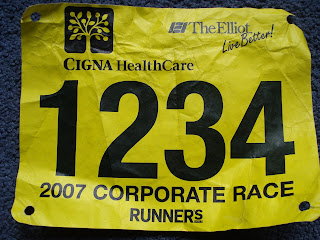
Those CIGNA 5K race people are mocking me! I am sure. I was checking out their race app/brochure and noticed the picture they used to showcase their new timing system. They used the number 1234. If you want to read the strange and unusual things that happened to me when they gave me the unlucky number 1234 a couple of years ago, check out this true story.


After one week of running with the insoles for functional hallux limitis, I have had mixed results. They feel great standing and walking and are absolutely awesome when riding my bike and kickbike. I do struggle to run with them. They feel good, but they slow me down. I feel like I am running in sand with all the support that I am not used to having. My legs and feet definitely need more time to adjust.

Last week's running
Mon. Mine Falls 5K Trail Race 20:18 (used cut-out insoles-hips were O.K. but lost balance a few times)
Tues. Lowell Classic T-Shirt night 19:55 (used brand new insoles that I got in the morning)
Gotta work on my race wardrobe! But at least I am ahead of Fil Faria, for a bit, who keeps beating me (usually by one place-twice a week!) I forgot to wear an old t-shirt. I was going to wear a 1981 Lowell Oktoberfest Marathon shirt (if it still fit).

photo Ted Tyler

Wed. Track night 6 miles including 2 X 2miles (hip was tight something like 12:15 and 12: 48) last one I almost quit after 1 lap as my hip hurt and I had a hard time moving-but I made a comeback.
Thurs. 8 miles slow with insoles
Fri. 8 miles slower with insoles but felt great otherwise.

Took out my Kickbike for the first time all year and did 8 miles (stride felt great-foot plant was excellent with the insoles),

then took out my Centurian Cinelli Equipe racing bike from the mid-80's- a great friend with all the miles and racing we did together) for another 8 miles (again felt great- I have never been able to get my left foot comfortable on a bike- and with the same setup of cleats and saddle I keep trying every year or two but it always feels off and hurts my foot and I can't balance on the saddle correctly-this time it felt excellent with the midsoles-my left leg was aligned, had power, and I could sit properly on the saddle-wow- that has never happened before even before when I started biking),

then I took out my mountain bike and did 8 miles including the trails off Gilson Rd.,

I was going to ride my black K2 but some spokes were broken (I have less than 50 miles on this bike-got it cheap-everytime I ride it something is wrong),

I didn't ride my Cannondale Triathlon bike but I need to get it cleaned up to sell.

I was still feeling fantastic so I took out my Kettlebell and worked the rest of my body. It was a great day playing with all my toys. I love days like that, but they are rare to find any more.
Sat. 8 miles- really slow-I knew I'd be sore-but my stride is real short and I ran 1 1/2 minutes per miles slower than a good day.
Sun. no running 14 miles of biking
Monday- heat! MineFalls 5K trail race 21:19 ouch. Started off great, had a hard time staying out of the lead, then my left glute spasmed up at about the 3/4 mile mark, making it hard to run for 1/4 mile or so and then it was a sort of limp home to the finish.

photo Steve Wolfe

Tues. Real hot 90+degrees! Reverse the Course 5k in Lowell 20:28. I was giving my feet a rest today from the insoles and decided to try the Cluffy Wedges in my shoe. I ordered these before I got the insoles for FHL and when they arrived I had put them aside because they came the same day I got the insoles. They work in a similar way by putting a wedge under the big toe to allow the 1st MTP joint to work. Unfortunately, after I entered the race I started to warm up and my left glute was still tight and sore from the previous day. I was limping and couldn't run. I did some quick  Postural Restoration stretches to readjust the left hip and stretched the quads a bit. This seemed to help. I got a good start in this race. Felt OK with the Cluffy wedges-more normal but my feet were beat up a bit and my right toe joint began to really hurt again after doing much better with the insoles.


photo Mike Stanwyck

I had another ART appointment today with Dr. Baroody. I explained how tight the muscles all around my hip and pelvis were: from the insertion of the hamstring to the muscles all around the hips. He gave my 5 dynamic flexibility exercises to do and will give me more stretching exercises next visit. There is so much readjustment being done that the muscles seems to be getting tighter and tighter almost like they are trying to protect my  hips from moving, so we'll see how that goes.


Tuesday, March 30, 2010

The Best Free Weight Exercise?


Below is a video of Gray Cook, that I saw last night. In it he explains the Turkish Getup as performed with a kettlebell. I think his speech is just as important as the tutorial. I mentioned Gray Cook in my last post. What I didn't mention is that I started my real search to try to improve my running mechanics and posture about 7 years ago after I read a Boston Globe preview of his book "Athletic Body in Balance Book. It did not come with the DVD when I bought the book. Maybe that would have helped! The reviewer raved that this book had saved him from imbalance injuries. I couldn't wait for the book to be published and when I got a copy, I couldn't figure it out at all. It just seemed too complicated. I need to look over the book again with fresh eyes after all I have learned in the past couple of years, but that book has led to new ideas and principles that Gray Cook and other trainers keep building upon and I think that a lot of that building up and sharing of ideas amongst the top trainers has finally led to a a PT finding a solution to my running and postural imbalances.

Anyhow, in the video below, Gray Cook answers the question, "What is the best free weight exercise  you could ever think of if you could only do one?" His answer is the Turkish Get-up. This goes back to the idea that the body is a stack of joints and that we should exercise the entire body as a coordinated unit rather than work just one muscle or joint at a time, particularly if you want your workouts to be movement based. The Turkish Getup with Kettlebells is such an exercise as I mentioned earlier here and here.

The get-up works and improves your posture, symmetry, core, flexibility, stability, low back-hip interaction, and tight hip flexors all in one series of moves. It is not just a stretch or a strength move designed in islolation for one part of the body. You do need to pay attention to the details and use your body correctly, however, otherwise you are training yourself to move incorrectly.

Gray Cook and Brett Jones have a whole DVD set dedicated to the get-up called "Kettlebells from the Ground Up: The Kalos Sthenos". It is sold through Dragondoor here. It is much too expensive for me, but I have considered getting it some day, but there is a lot of info in this free youtube clip. As noted in this youtube video,  "Kalos Sthenos" is the greek word for "beautiful strength" and is the word from which we get "calisthetics". Calisthetics these days refers to body-weight exercises, but it originally it referred to movements with weights like the getup. Here is an article telling more about Kalos Sthenos and this DVD. Gray Cook is involved with functional training and I think the get-up is used as a both functional assessment as well as a exercise to bring balance to the body and that is why they have a 2 DVD set on just one exercise.

If you haven't tried the Turkish get-up this video my prompt you to give it a shot. Don't worry about how much weight you lift, until you get the movement down.


And after running a total of 60 miles in the last 7 days including a rain-soaked run yesterday, I took the day-off from running today because of the constant downpouring of rain. It ended up being a good day for the TRX Suspension Trainer and some kettlebell work, including a bunch of get-ups, instead!

Tuesday, April 28, 2009

Time to "Get Up" and Get Those Hips Working Again

Everything was going pretty good for my hips until last month when I "tweaked" a muscle in my back. I took time off from running, but when I started back my hips were all off again. Some days seemed a little better, but they kept getting worse. The past week it has been like last year all over again. I can feel how uncomfortable and imbalanced I am, and when I go for a run it has not been smooth going. I have forced myself out the door to run and although I have run 11 miles for each of the past two runs, they have been miserable. I am trying to force my body into balance, and I should know after many years of trying to do so, that I cannot do this while running. After my runs, I find it hard to move around and am moving like a senior citizen.

I have tried all the tricks in my book. Nothing has worked. I probably overdid a bunch of them, but I was hoping to just "pop" things back into place. I woke up stiff and still out of balance this morning and I got to thinking. I have tried everything that I thought was working earlier in the year, except for one thing that I had been doing religiously when things were going well. I took out my kettlebell and started doing the Turkish Get up again (previous post). Why had I negelected to get back to this exercise after I hurt my back?

Here is a great video of how to do the turkish getup that breaks it down into specific drills for each movement. It is presented by Anthony DiLuglio from the "Art of Strength” DVD workout series. Take a look at how mobile and strong the hips and shoulders have to be to accomplish the drill.


You can find even more basic kettlebell drills here at Anthony DiLuglio's "Kettlebell Training 101". There are other basic kettlebell drill here including an alternate video of the turkish getup where he takes another person through the routine seen in the Youtube video. He also has a few different videos on Amazon. However if you want to start learning how to use kettlebells, I really like the DVD from Sara Cheatham. I bought her DVD earlier in the year when she only had 100 copies. Now I see she has it for sale again. Not only is she a good kettlebell instructor, but she is also a top-notch Z-Health instructor and she includes some good Z-Health joint mobility drills on the DVD. You can find information here, or look for her Red Star Athletics blog to the left of this post.


After doing some turkish getups again this morning, I feel the balance shifting in my hips. Hopefully this is the ingredient that I have been missing. Upon reflection, I think the turkish getup takes my hips and shoulders (which have also been very tight and not in balance) through multiple planes of motion. Not only that, but the drill strengthens my hips and the connections to my shoulders as they rotate through the various positions and movements.

Speaking of movement through multiple ranges of motion, coach Jay Johnson put this video on his site recently. He has national class runner, Sarah Vaughn, demonstrate a post workout strength leg circuit routine and then the Athena drill. Like a lot of Jay's drills, found on his DVDs, they can be quite advanced, so I may try some of these drills, although I need to be cautious. These movements work the frontal plane, lateral movements, that are movements that are not stressed in running, so I may be somewhat challenged due to all my exercise is in a forward direction and does not involve side-to-side movements. This could be a weakness that affects my hips. This routine can also be downloaded right to your ipod from Jay's site, which is very helpful if you want to keep the drills accessible.


SV Leg Circuit, then Athena (uncut) from CoachJayJohnson on Vimeo.

Monday, March 2, 2009

Resistance Stretching and Running Article

On the Innovative Body Solutions website there is a new article on resistance stretching. The article comes from Vogue magazine so unless you want to buy a copy of the magazine, you may want to read it there. It is authored by Elizabeth Weil, who wrote this article on Dara Torres for the New York Times and is the author of "Age is Just a Number" a new book on Olympic swimmer and Dara Torres. Of course it was Dara Torres' resistance stretching routine and success at the Olympics that brought a lot of publicity to resistance stretching.


Here is a link
to a previous post I made with links to many other posts on resistance stretching.

Elizabeth Weil mentions that she had been a runner for ten years starting in her teens. As she is approaching 40 years old, she decided she wanted to become a runner again and run as fast as she had when she was younger. She was fortunate to get stretched by Anne Tierney and Steve Sierra. Innovative Body Solutions is their site and they are also Dara Torres personal stretchers. In other words they are the best in the business.

In the article Tierney says, "We are troubleshooters. We'll look you over and figure out where your trouble spots are. It's usually a small chain of imbalances that are holding you back. Once we figure those out, everything will open up."

The two stretchers noticed that one of Elizabeth's hips was higher than the other and one muscle making up her quads was not properly firing and they proceeded to go through two hours of stretching all over her body so as to fix her imbalances. It is an interesting read particularly as it relates resistance stretching to running.

I did go to a resistance stretcher last fall and had some good runs afterwards that continued as I did resistance stretching on my own. However I have not been doing it for the past month. Why? I have been doing something similar in application but more directed at my own imbalances. I have been pushing my legs, from my hips, against resistance (although I am not moving the leg through the resistance). This is what is ultimately balancing out my hips to a level that I haven't had in 25 years. I think this is why parts of resistance stretching were working for me. I was starting to get at my stuck hips. Whether you call it resistance stretching, Muscle Energy Technique, leveraging, or whatever I don't care. What I care about is that something is definitely working.

I am still slowly going over the DVDs on The Malalignment Syndrome: diagnosis and treatment of common pelvic and back pain, I haven't used their tests to figure out what is imbalanced with my hips, but I have been directing the "pushing" I was already doing with the guidance and direction from the DVDs so that I have an idea of the why and how of what I have been doing. It is interesting to note that Dr. Wolf Schamberger who developed this technique is a former 2:20 marathoner who used this to fix his own imbalances.

Although it is my left hip that usually is the "sore hip" I think that my right hip is the hip with an upslip. That means that it is higher than my left hip (which explains why this is my short leg) and probably why my left leg takes more of the stress (and reacts with its own twisting) when I run. To correct this I bend the right leg at the knee and I push the right leg against the pressure of my arms. I don't push it as hard as I was doing on my own. Then for the left leg I pull the left knee towards my chest as I resist against the pressure with my arms. Both of these are exercises I had discovered on my own but now I know the how and why of doing them (and which leg to do them on). I also am starting a few exercises for the rotations of my hip (one is farther forward than the other). Is it working? I have already mentioned that I feel better than I have in 25 years when not running. As my hips come into a better balance all the aches and pains as well as tension in my muscles throughout my body from feet to upper back seem to be leaving. In basic terms, I feel loose and I am not spending my day trying to figure out how to get rid of the pains and imbalances that I normally feel. I also don't pay much attention to my body being out of balance as I feel more solid and steady in posture.

As for running? I took a test run yesterday at the Freeze Your Buns 5k race. I did this race to see if my hips would stiffen at a faster pace of running. I must say despite a slow time compared to previous years of racing, that this is the best I have felt in a race in years. Was it perfect? No, but I was so much more balanced that I am used to and I felt like I was running smoothly and with a proper running motion. I haven't felt that good in a long time! I just hope that the path I am on continues, because I would like to see how I can really do as a runner when I am not fighting my own body as I run.

The other thing I continue to do each day is the Turkish get ups with my kettlebells. This exercise is helping my hips strengthen and increases the mobility through the movement of my hips. The funny thing is I used to spend hours a day trying to figure out what was making my body so uncomfortable and trying to relieve the discomfort. I now am spending hardly any time at all, just a few things thoughout the day and I am good to go.

As for the race, I thought I was running hard (so I probably was) but I was disappointed at the time I saw at two miles. I did put on a long surge during the last mile and caught up to and passed the lead female runner, Amber Cullen. I made up about 10-15 seconds. Maybe she was having an off day, but I rarely catch people near the end of a race. It was very helpful to be pushing with her at the end because it got me under 20 minutes for the race. This is a much better time than my first 5ks last year.

Here are the result of the Freeze Your Buns race.

5K Results 2009-March-01
Name Town Age Sex Time
Ferreira, Danny Concord, NH 26 M 0:17:36
King, Andy Lowell, MA 33 M 0:17:42
Wade, Michael Nashua, NH 40 M 0:17:47
Indruk, Greg Nashua, NH 28 M 0:19:09
Hansen, Jim Nashua, NH 50 M 0:19:53
Cullen, Amber Concord, NH 26 F 0:19:54
Snow, Ken Merrimack, NH 53 M 0:20:11
Kane, Brian Merrimack, NH 47 M 0:20:29
Cullen, Gregory Westford, MA 56 M 0:20:33
Rouleau, Stephen Nashua, NH 30 M 0:21:00
Burnett, Jim Canaan, NH 59 M 0:21:31
Lee, Stephen Concord, NH 45 M 0:21:49
Poublon, Danielle Nashua, NH 10 F 0:25:58
Hiatt, Melissa N. Hampton, NH 11 F 0:26:50
Gallagher, James Merrimack, NH 42 M 0:26:51
Welts, Bob Hollis, NH 75 M 0:32:35
Adams, James Nashua, NH 35 M 0:33:13

Friday, February 20, 2009

Kettlebell Basics to Improve Running Form and Effeciency

I have been getting back to basics with my kettlebells. My goal over the past week or so has been to do just a few kettlebell exercises each day. I have chosen three exercises to concentrate on. They are the turkish getup, the swing, and the snatch. Check out the Pain Free Kettlebell Method here.

My key daily exercise is the turkish get up. Here is a quick video of someone doing one getup. I am doing about 5 minutes of getups for each side of the body.


This video show different stages of performing the Turkish getup. As you can see it works the whole body as you move from a supine position to a lunge and then a standing position. You have to stabilize throughout the body. It also helps the connection between the shoulder and the hips. As my hips are rotating through the positions I hear little pops and shifts that I hope mean that I am loosening and strengthening the hip area as I do the movements.


The most basic of kettlebell movements is the swing. It trains the hips, legs, back, and core.

Here is a video showing the kettlebell swing.


This is my favorite kettlebell exercise: the kettlebell snatch. This is a very pleasing exercise to do when you get it right. If not you can bang up your wrists quite a bit. I am just the barely the right height for doing this indoors in my house. An inch taller and the kettlebell would bounce off or through the ceiling.


One day I would like to get some kettlebell training. There is a new kettlebell gym in Nashua that I would like to visit and get some expert tips. I have used videos to learn the techniques. Getting a good instructional video is important so that you do the routines properly. Youtube can give you an idea of what to do but it is hard to sift through the good and poor instructions if you don't know what you are doing.

My newest video comes from Sarah Cheatham at Red Star Athletics.
She has sold out of her initial pressing of DVDs but you can sign up to know when she has more produced. She is an excellent instructor and you can learn some Z-Health joint mobility drills in addition to the kettlebell instructions on her DVD.

I also like the Kettlebell Goddess DVD. It is not just for the ladies! It has instruction and routines based on the type of training you choose.


Pavel Tsatsouline's DVDs will give you the basics on how to do the movements with a bit of humor.


I always enjoy exercising that involve endurance and movement. I have not been diligent with strength exercises which is probably one reason I have imbalance problems. The kettlebells are fun because the work on your stamina and movement. They are also a superb way to work on functional strength. I do like using them and think they can be an effective way to improve running form and efficiency.

Sunday, November 16, 2008

How to Recover Your Stride: Recommendations 6-10

I started a list of the 10 best things I have tried this year in order to recover my stride. It was one of my worst years of running ever, but by the end I am finding my body is working better and I am feeling much looser and freer as I run than I have in a very long time. For once I don't live day to day wondering what is going to hurt or be out of alignment. Instead I am feeling better, in control, and on a postivie upswing with my running and feeling so much better and pain free thoughout each day. My first 5 picks can be found here:

Number 1 The Ming Method as learned through the book "The Permanent Pain Cure" by Ming Chew

Number 2 Resistance Stretching

Number 3 Z-Health Joint Mobility

Number 4 Ageless Mobility DVD

Number 5 Get Out and Try Something New: Relieve the Pressure!


Number 6
"Brain Training for Runners"

My number 6 pick for recovering your stride is the book "Brain Training for Runners" by Matt Fitzgerald. I like books that present new and different ideas towards improving your running and this in not a retread of the same old ideas. More than half the book is training plans and I have no need for these as of now, but the rest of the book (about 200 out of over 500 pages) is very interesting. I especially like the proprioceptive clues. These are cues that you can use to concentrate on in order to improve your stride. I also like his core conditioning exercises, his dynamic flexibility exercises (what you should be doing before a run instead of static stretching exercises), and the anti-sitting exercises.


You can also find more of the dynamic mobility exercises on Eric Cressey's Magnificent Mobility DVD. Matt Fitzgerald wrote another book with Eric Cressey called Maximum Strength. It is more about weight training than running but it has some good drills and warm up exercises in the book. For such a cheap price, there is a lot of interesting information in the Brain Training book.

Number 7:
Self-Adjusting Techniques:

Number 7 on my list is actually two different self-help approaches to help solve alignment problems. I link the two together because both are things I could only find through use of the Internet. They both involve "thinkers" or "tinkerers" trying to solve problems with the function of body and do so in a new or different way. They both are also self-help methods. Both of these methods I have used to bring some relief to a "stuck" sacrum. Both of the methods also utilize movement of your body to fix it.

The first method I discovered was The Dorn Method. It is likened to a gentle model of chiropractic or osteopathy. I have had two runners thank me for directing them to the Dorn Method website and they have found the exercises helpful. I have not used The Dorn Method much since I made these posts because they were not the "full" answer for my alignment problems. Some of the hip exercises have been helpful in loosening up my hip and I have also used the knee and ankle alignment exercises. However now my body is in my better shape then it was when first I made these posts. I think it is a tool I could use in the future to help if things start falling apart again although it didn't magically fix things for me.

Here are my posts on The Dorn Method:

The Dorn Method: Can it be a simple fix for misaligned joints?

Winning when the Running is not going well!

The other method came from the Self-Adjusting Technique website. I found the video for releasing the sacrum on youtube and used it after a 1/2 marathon that I ran with my sacrum stuck.


Immediately after doing the release it felt loose and free again. I have found that I shouldn't do this release when it is not stuck, but the two times it was jammed it seemed to help tremendously. Meanwhile it has not been stuck like that for a while now so I am happy. There are all sorts of other releases in the e-book but I have not really tried them as things are going pretty well these days. I did find the e-book easy to read and understand, I just don't want to mess around with my body when other things are working well for me.

Here are posts I have made on this technique:

Tips for the Adjusting and Releasing the Psoas, Sacrum, and Piriformis

Loosening Up Tight Hips: Sacrum Adjustment

Number 8:
The T-Roller: Roll Out Tight Muscles


I won a T-Roller massage tool at my first race of the year. I have a couple of The Stick massage tools and have used them heavily for years. The T-Roller is small like my Travel Stick but it actually is easier to get deep into a muscle than with my original Stick (which lacks much flexibility). The reason it gets a deeper massage is that it has rollers of different widths and this allows you to target a tight tissue or trigger point more effectively. I use my T-Roller (as well as The Stick too) often when I awake and my muscles are feeling tight. It is the best tool I have for relaxing and getting back to sleep.

You can find out more about the T-Roller here:


T-Roller


Here is my post on the T-Roller

The Stick vs. The T-Roller

Number 9:
Kettlebells


Number 9 on my list it the only thing on my list that I was using last year, but it was at the end of the year so I include it here. I knew last year that I would have to try something new and different to help the hip and alignment problems that were plaguing me. I decided to look into kettlebells. They can be used for strength training but they also work the whole body out in a very fun movement orientated workout. Not only that but they get the heart pumping pretty quickly. I really enjoy swinging the kettlebells. I learned the techniques on my own through books and videos. When I use them I feel so much better particularly through the back and shoulders. I did find however, when my hips were off that the exercises were not that good for me because it would pull on my hips and back and I was practicing bad movement patterns.

Kettlebells have been the best strength training device I have ever owned. They are also the most fun. I can just barely do them indoors as when I do snatches the kettlebell swings up about an inch below the ceiling. If you are tall you better have a high ceiling. This winter I hope to get back into them more as I cut back some on the running. What is nice is that workouts do not need to take a long time. I also pick up the kettlebell at various times throughout the day and do a few swings or snatches and it always feels good.

There are a few books on kettlebells but the best way to learn is through a DVD. You can go to Dragon Door, the website of Pavel Tsatsouline to learn more about Russian Kettlebells. The best videos I have found have been the videos for the women. Pavel's videos show you how to do some of the lifts, but the women's videos take you through some routines that you can follow along with. The best is "The Kettlebell Goddess Workout". It has a variety of routines for specific body areas and includes some joint mobility work and stretches.


Kettlebells: The Iron Core Way Volumes One and Two are also good. Both take you through full body routines and explain how to use the kettlebell properly.

A kettlebell can be expensive (especially the shipping!). You need to read up on them and get the right size (which will be less weight than you think). I ordered my 35 pounder through Muscle Driver. The handle is thick but I think that is to help with your grip strength. I have two lighter weight kettlebells that I picked up at a Target store. They are good for light intensity exercise (or when learning). In summary I find kettlebells very appealing and a fun way to work with weights. But it is not just a weight workout as you are working on balance and form.

Number 10:
Relearning Good Posture

Number 10 on my list would be a book I haven't even finished reading yet. It is the book "8 Steps to a Pain Free Back" by Esther Gokhale. I find the book to be visually interesting, eloquently written, and a fascinating look at the way posture has changed in the past 80 years. It shows how toddlers, some modern cultures, and people in earlier times held their bodies and moved differently. It also explores why these changes happened. Then it has a way to bring us back into better posture. I tried a bit of the positions and found them interesting but have yet to have the time necessary to devote to this book while I am still making other changes. The book trains you how to sit, walk, move, and even sleep better and to do it without the pain of an incorrect posture. The pictures of people throughout the world and in art works just make the book something worthwhile and thought provoking to read.

Well those are my ten favorite things I have tried this year in order to recover my stride. I have bought and tried and used plenty of other things: some were helpful and some were a waste of my time and money. There are no orthotic or foot insert devices mentioned. There are no sessions with chiropractors, active release therapists, massage therapists, rolfers, physical therapist, or anyone else (except Janet the resistance stretcher). Not that these aren't good things to try or that they work is not important, but after using all of these people in the past I still could not fix the problems with my hips and alignment issues without going back for more visits. I have not gone in for an adjustment or even a massage since the summer and I am feeling more in control of knowing what to do and how to do it if I want to continue to be a healthy and competitive runner.

Every athlete and person responds differently to every different therapy. We are all an experiment of one. These seem to be strategies that work for me. They may be just as helpful to others. I also look forward to making more progress so that I can run freely into my 50's and feel as good as I did when I was much younger. I may even find more interesting and workable solutions to keeping healthy and running strong.

I am also open to learning new things. I would like to know what works for others and what else might be worthwhile to look into. Or what your experience has been if you have tried any of these suggestions.

I am very much looking forward to the next year, particularly if I can maintain and improve on the positive results I have been having for the past couple of months.